










With medieval castles, beaches, football heritage, sangria and tapas, Spain attracts millions of people each year. Its tourist industry set a visitor spending record of $2.02 trillion, creating a demand for English teachers that makes Spain one of the biggest TEFL markets in the world.
It also has moderate English proficiency, so whether you want to teach English at summer camps by the sea, public or private schools in Madrid, or universities in Barcelona, there's a role for every level. Read on for The TEFL Org's guide on teaching English in Spain, from the job types, visa requirements, salary expectations, top locations, and much more!
Key Takeaways
- Spain has a high demand for English teachers, but the market is also competitive.
- Teachers generally need a 120-hour TEFL certificate to teach in Spain, with a bachelor's degree and native English proficiency highly preferred.
- The average English teacher salary ranges from €800–€2,000 ($925–$2,325 / £690–£1,730), but international school teachers can earn around €2,500–€3,500 ($2,850–$3,990 / £2,160–£3,025).
- Top locations for teaching in Spain include Madrid, Barcelona, Sevilla, Valencia, Malaga, Zaragoza, and more.
- EU teachers don't need a visa to teach in Spain, whereas non-EU teachers will need an Employee Visa or Student Visa.
Requirements for Teaching English in Spain
With a high demand but stiff competition, it can be tricky knowing what requirements to expect from teaching jobs in Spain.
The requirements for teaching English in Spain are generally flexible because of its ambitious language goals, but employers can still be selective depending on location or school type.
Here's everything you need to know about the requirements for teaching English in Spain.
Do I need a TEFL certification to teach English in Spain?
It's not a legal requirement, but you'll need a TEFL certificate to teach in this competitive market. Generally, a 120-hour TEFL certificate is enough for most TEFL jobs in Spain, but some employers prefer teachers with a Level 5 TEFL certificate because it offers an even greater depth of training.
Most graduates at The TEFL Org complete their online TEFL course in 10 weeks, or 4–6 weeks if they can study full-time. Here's why you'll need a TEFL certificate to teach in Spain:
- Meet unique requirements: Most schools in Spain seek teachers who are already TEFL certified from an internationally accredited provider like The TEFL Org.
- Improve classroom skills: It may seem like a formality, but you'll become a competent teacher with a TEFL course. From group management, lesson planning, and ESL activities, a TEFL is your first step to becoming a pro in the classroom.
- Enhance employability: Teaching jobs in Spain are competitive, and you'll need to stand out in a saturated market. Studying a course developed by expert teachers lets employers know that you're learning from the best.
Can I teach English without a degree in Spain?
Yes, you can teach English in Spain without a degree, but Spain has a competitive TEFL market. It's not a legal requirement, but most teaching jobs and programmes require a degree. Non-degree holders can find jobs in language schools as an assistant language teacher – just as long as they've completed teacher training (like a TEFL course).
Tip: Specialist courses like teaching young learners, academic English, or business English can improve job prospects by helping you expand into other areas of teaching.
Can I teach English without experience in Spain?
Yes, you can teach English without experience in Spain – the demand for teachers is so high that many teachers start their TEFL career in Spain with a degree (in most cases) and a TEFL certificate.
But entry-level teachers may have to lower their expectations when it comes to salary. After a semester or an academic year of teaching, you can start browsing for higher paying positions.
Tip: Consider starting out teaching at a summer camp in Spain to get experience under your belt!
Visa requirements for teaching English in Spain
Spain is a member of the European Union, so EU citizens don't need a visa to teach English. This gives them a huge boost in the market because non-EU teachers need a visa and/or work permit to teach in Spain legally, which can be time-consuming and costly for schools. Irish teachers especially benefit from this, because they're one of two native English speaking countries with EU membership.
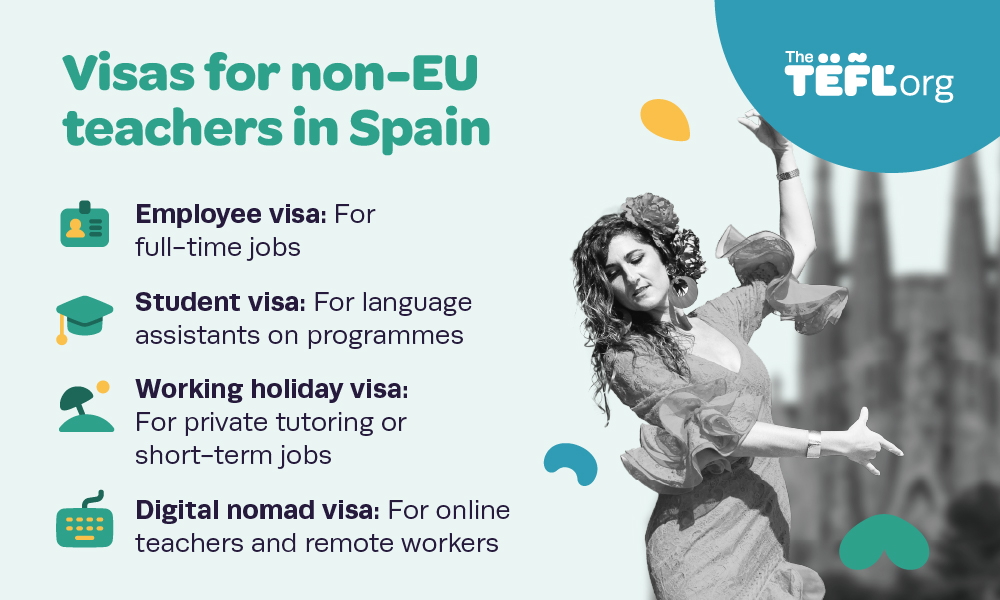
But it's not impossible if you're from a non-EU country, you'll just need to find a job and get the visa before entering Spain. Here are the most common visas for teaching English in Spain:
- Employee visa: Schools willing to sponsor non-EU teachers will help them obtain an Employee Visa. This is more common at private schools and international schools.
- Student visa: Non-EU teachers commonly teach in Spain on the student visa, especially on language assistant programmes like NALCAP or Meddeas. This visa allows students to work for up to 30 hours per week while studying Spanish at a local college or university.
- Working holiday visa: Citizens of New Zealand, Australia, Canada, South Korea, or Japan, aged 18–30 (18–35 for Canadians) can stay in Spain for up to a year with a working holiday visa. But work must be secondary to your travels – this means that you can still engage in part-time teaching or private tutoring while living in Spain.
- Digital nomad visa: If you're an online ESL teacher, you can get the digital nomad visa! To qualify, remote workers must have a university degree or three years of work experience in their field, earn twice the Spanish minimum wage, and have a minimum of 80% of their clients based outside of Spain.
Generally, most non-EU teachers enter Spain on a student visa. While it's possible to apply for a student visa independently, you can join an English teaching programme that helps you enrol in a course and find a job placement. You can find updated information and useful resources on the Student Visa Spain website.
Salary and Cost of Living
Spain is often seen as an affordable travel destination, but what about for English teachers? Here's everything that you need to know about teacher salaries, spending, and saving in Spain as an English teacher.
How much can you earn teaching English in Spain?
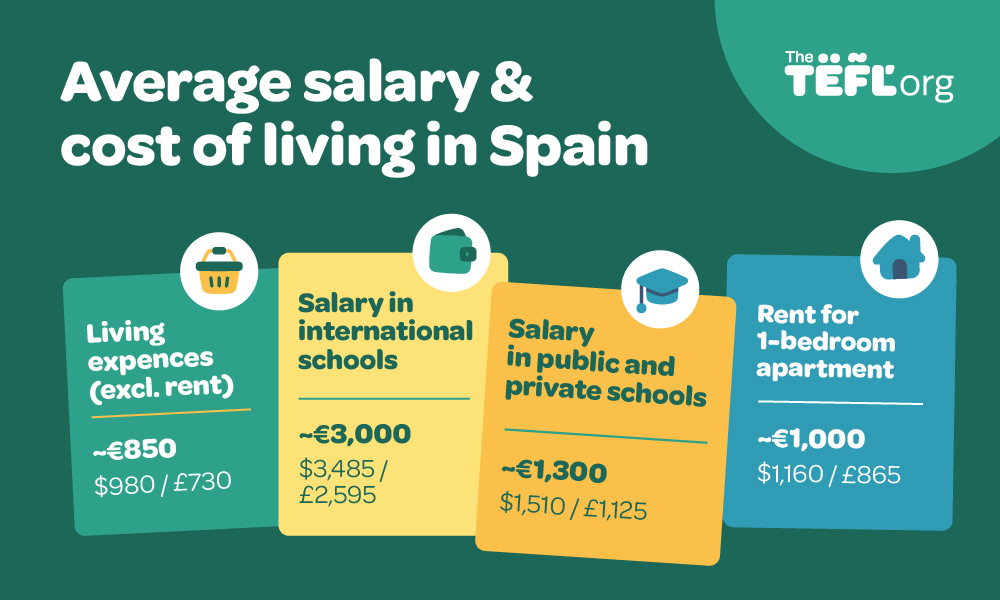
The average monthly salary for English teachers in Spain is €800–€2,000 ($925–$2,325 / £690–£1,730), but many factors will influence your teacher salary in Spain, like:
- Experience & qualifications: Having a TEFL certificate and previous teaching experience will increase your earning potential. Advanced courses (like a 250-hour Level 5 TEFL course or a teaching business English course can also boost your income if you cater to a unique crowd of students.
- Teaching job: Public and private school jobs typically pay a lower or average salary, whereas international schools pay much more. English teachers at international schools can earn around €2,500–€3,500 ($2,850–$3,990 / £2,160–£3,025) depending on the school.
- Nationality & visa: Non-EU teachers on student visas are likely to earn less than their EU counterparts because they're often limited to working 15–20 hours per week.
Want to see how the teaching salary in Spain compares with other countries? Check out The TEFL Org Teacher Salary Guide.
How much does it cost to live in Spain?
The cost of living varies significantly across Spain, with cities like Madrid and Barcelona sitting on the higher end of the scale. That said, teachers can expect to spend around €750–€950 ($880–$1,110 / £650–£820) per month excluding rent.
Here's how much rent is for a 1-bed apartment across popular Spanish cities:
- Barcelona: €1,000–€1,500 ($1,170–$1,755 / £740–£1,110)
- Madrid: €800–€1,300 ($935–$1,520 / £690–£960)
- Valencia: €800–€1,300 ($935–$1,520 / £690–£960)
- Malaga: €800–€1,200 ($935–$1,405 / £690–£890)
- Sevilla: €500–€900 ($585–$1,055 / £370–£665)
Rent alone in larger cities can exceed the average English teacher salary in Spain, but that's only if you live beyond your means. Here's how you can reduce costs and get more bang for your euro as an English teacher in Spain.
- Be flexible with location: While many teachers have their sights set on Barcelona or Madrid, enchanting cities exist all across Spain. From Sevilla, Bilbao, Zaragoza, and beyond, you can teach English in cities that offer affordability and an excellent lifestyle in Spain.
- Live outside the city centre: Living outside the city centre can save teachers up to €300 ($350 / £220) per month, and monthly transport passes cost around ~€30 ($35 / £25). Not only will you save more money, but your neighbourhood will display a more authentic Spanish vibe than tourist hotspots.
- Split the rent: Many teachers share housing with other teachers or expats to save money and socially integrate. While a 1-bed apartment in Madrid or Valencia costs around €1,100 ($1,290 / £955), a 3-bed apartment would cost around €665 ($780 / £575) per person.
- Eat like a local: Spain's culinary culture is among the best – and it's also affordable. A menu del día (a set lunch of three courses with a drink) costs as little as €10 ($15 / £11.50) at a local cafe.
- Become a private tutor: Many teachers supplement their income through private tutoring, with rates ranging from around €14 ($16 / £12) per hour or more depending on experience.
| Restaurants | EUR | USD | GBP |
|---|---|---|---|
| Inexpensive restaurant meal | |||
| Domestic beer (0.5 litre) | |||
| Regular cappuccino | |||
| Water (0.33 litre) | |||
| Markets | EUR | USD | GBP |
| Regular milk (1 litre) | |||
| Loaf of white bread | |||
| Regular eggs (1 dozen) | |||
| Apples (1 kg) | |||
| Transportation | EUR | USD | GBP |
| One-way ticket (local transport) | |||
| Monthly pass (regular price) | |||
| Taxi start (normal tariff) | |||
| Gasoline (1 litre) | |||
| Utilities | EUR | USD | GBP |
| Electricity, heating, cooling, water, and garbage (for a regular apartment) | |||
| Regular prepaid monthly mobile tariff with 10GB+ data | |||
| Internet (60 Mbps, unlimited data, cable/ADSL) | |||
| Clothing and shoes | EUR | USD | GBP |
| Pair of jeans (Levis 501 or something similar) | |||
| Summer dress in a chain store | |||
| Nike running shoes (mid-range) | |||
| Men's leather business shoes |
English Teaching Jobs in Spain
There's a high demand for English teachers in Spain, so there are plenty of teaching jobs for TEFL teachers. English teaching jobs in Spain exist across both public and private sectors, and each offers different requirements, benefits, and career progression. You can find a job with a teaching programme, or you can check out The TEFL Org Job Centre or other forums like Serious Teachers for jobs.
Public schools
Most public school jobs come through teaching programmes that work with the Spanish Ministry of Education, like Meddeas, British Council, and NALCAP.
While these jobs aren't high paying, they offer language assistant roles to inexperienced teachers across Spain. As a language assistant, you'll support the Spanish teacher with planning and presenting lessons rather than leading a classroom by yourself.
What to expect at public schools in Spain:
- Working as a language assistant alongside a Spanish teacher
- Teaching around 15–24 hours a week
- Paid national and school holidays
- Working on a student visa (for non-EU teachers)
- Monthly salary typically ranging from €800–€1,500 ($915–$1,720 / £690–£1,295)
Private language schools
Private language schools in Spain cater to students and professionals who want to improve their English beyond their current studies or work. Teachers may be language assistants or lead lessons independently, depending on the school, and courses range from exam preparation, business English, and more. These schools typically offer more teaching hours than language assistant programmes, but require working in the evening and on weekends.
What to expect at private schools in Spain:
- Evening and weekend work
- Teaching a range of ESP (English for Specific Purposes) subjects
- A variety of student ages, from young learners to business professionals
- Monthly salary ranging from €1,000–€2,000 ($1,150–$2,290 / £865–£1,725)
International schools
International schools offer teachers the highest salaries and benefits, but job requirements and responsibilities are very high. These international schools offer bilingual education where both Spanish students and international students learn from a British or American curriculum.
What to expect at international schools in Spain:
- Monday to Friday schedule
- Teaching an American or British curriculum to Spanish and international students
- Excellent salary and benefits – from €2,500–€3,500 ($2,870–$4,020 / £2,160–£3,025)
- High entry requirements and responsibilities; teachers need a bachelor's or master's degree, teaching licence, and years of teaching experience
Private tutoring
Many teachers supplement their income through private tutoring. Teachers can earn upwards of €14 ($16 / £12) per hour, especially if they have ESP (English for Specific Purposes) skills like academic English or business English.
Download our guide to teaching English in Europe
Find out how teaching English in Spain compares to other European countries.
Teaching Programmes in Spain
As one of the most popular TEFL locations, there are plenty of teaching programmes in Spain to choose from. Most of these programmes partner with the Spanish Ministry of Education, where foreign teachers can apply to become a language assistant teacher, also known as an Auxiliar de Conversación.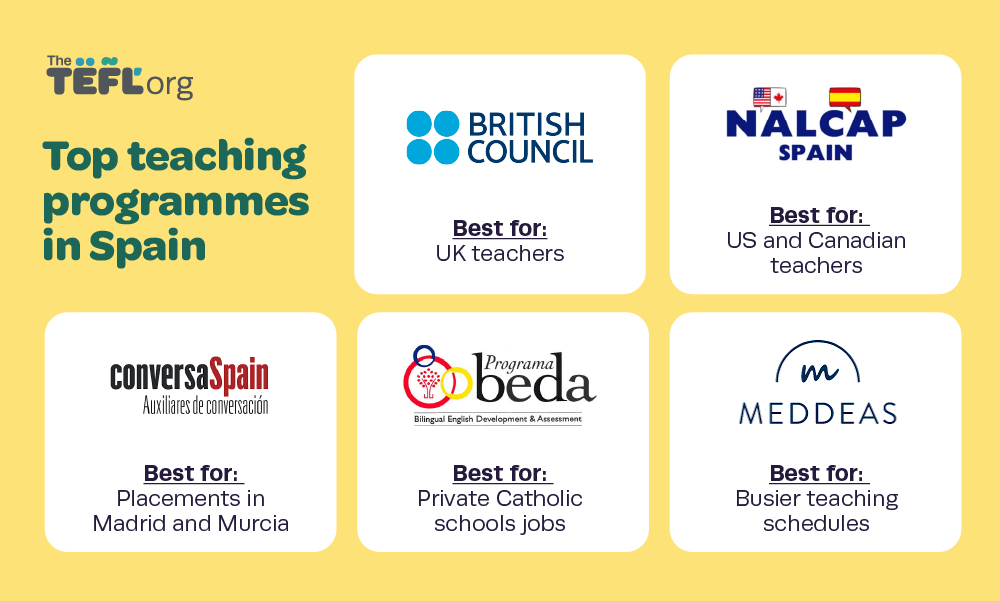
These programmes are ideal for inexperienced teachers looking for a less intense entry into teaching in Spain and also an excellent work-life balance.
Meddeas
Language assistants on the Meddeas programme teach for 20–24 hours per week on 6–9 month contracts. As a language assistant, you'll support the homeroom Spanish teacher with delivering English lessons and offering personalised support to students.
Non-EU teachers can apply to Meddeas because it's technically a paid internship, but there's a catch – they need to enter on a student visa and study teacher training at a Spanish university.
Depending on your location, teaching schedule, and living arrangements (host family or independently) you'll receive a monthly stipend of €410–€1,270 ($470–$1,690 / £354–£1,100).
To qualify for the Meddeas programme, you'll need:
- Native English proficiency (or German/French for other programmes)
- 3+ years degree within the last 4 years
- Clean criminal record check
- Refundable deposit of €850 ($975 / £740)
NALCAP (North American Language and Culture Assistant Programme)
American and Canadian teachers can join NALCAP to work alongside a local teacher in Spanish schools as language assistants.Placements run from October–May, with assistants teaching 12–16 hours per week. Language assistants earn a monthly stipend of €800–€1,000 ($935–$1,135 / £690–£854) depending on their location.
To qualify for the NALCAP programme, you'll need the following:
- Passport from the US or Canada
- Native English proficiency
- Clear criminal background check
- Have a university degree, or be enrolled as a 2nd year or higher college student in an accredited university in the US or Canada
Read more about teaching English in Europe as an American
ConversaSpain
ConversaSpain is a language assistant programme with public school placements in Madrid and Murcia. Teachers work 15–16 hours per week earning a monthly stipend of around €800–€1,000 ($935–$1,135 / £690–£854).
Teachers need to pay a programme fee which is considerably higher than other programmes, ranging from €1,520–€2,970 depending on location and programme extras like TEFL training (through The TEFL Org!), hands-on visa support, 1-week of cultural orientation activities, and so on.
To qualify for ConversaSpain, you'll need the following:
- Native-level English speaker from an eligible country, or a C2 English certificate (CEFR) if applying from select European countries
- Have a university degree, or be enrolled as a 2nd year or higher
- Aged 59 or under
- Clean criminal background check
- Maximum of four years as an auxiliar in Spanish public schools (consecutive or non-consecutive)
BEDA (Bilingual English Development & Assessment)
English teachers can work in private Catholic schools through the BEDA programme, which is run by Escuelas Católicas de Madrid. Most schools are placed in Madrid, but placements are available across Spain. You don't need to be Catholic to apply, but you should still be respectful and mindful when teaching.
Much like Meddeas and NALCAP, teachers work as a language assistant and earn a stipend of around €850–€1,200 ($975–$1,375 / £735–£1,035) per month depending on your schedule.
To qualify for the BEDA programme, you'll need the following:
- EU passport holder, or non-EU willing to obtain a new student visa
- Bachelor's degree
- Native level of English, or a C2 certificate for non-native speakers
- Non-refundable enrolment fee of €200 ($235 / £175)
British Council
The British Council also offers language assistant teacher roles for British teachers. Placements exist across Spain, and teachers can earn a monthly stipend of €800–€1,000 ($915–$1,135 / £690–£855) teaching 14–16 hours a week at a primary or secondary school.
To qualify for the British Council programme, you'll need to meet the following:
- Be aged 18–60
- Have lived in the UK for 5+ years within the last 10 years
- Clear criminal record
- Completed a minimum educational standard of UK A-level, Scottish Highers, International Baccalaureate or equivalent
Teaching English in Major Cities
Spain is full of wonderful places. From Andalucía, Catalonia, Basque Country, to old and new Castile, it's impossible to choose the "best" place for teaching English in Spain.
Here are some of the top places to teach English in Spain.
Teach English in Madrid

From the Plaza Mayor and the Royal Palace to El Retiro Park, Madrid will quench your thirst for Spanish culture. Whether you want to eat tapas and sip coffee in the old town, watch colourful Flamenco shows, or visit Madrid's Golden Triangle of Art, the capital city has it all.
Madrid was named as Europe's best destination in 2026, and plenty of teaching jobs exist in the capital city. However, as a popular destination, the TEFL market is competitive. Most teaching jobs come in the form of private language schools, international schools, or language assistant roles through teaching programmes like BEDA.
While salaries are generally higher in Madrid, so are living costs. House sharing is a great way to stretch your salary, and there are plenty of free or inexpensive activities to enjoy. If you're struggling to find a placement in Madrid, or you want to offset the cost of living, consider Getafe, just 8 miles south of Madrid.
Teach English in Barcelona

Nestled on the country's northeast coast, Catalonia's capital Barcelona needs no introduction. Welcoming millions of tourists each year for its marvellous La Sagrada Família, Museu Picasso, and beaches like Bogatell and Nova Icària, it's never a surprise when Barcelona ranks among the best cities in Europe.
The city is an international hub, so there's plenty of opportunities for teaching in Barcelona across public and private sectors. Barcelona is home to reputable universities, international schools, and language academies that teach young learners and business professionals. With a high influx of tourists, English-speaking workers are needed here. And while you're still in Spain, you can embrace a microcosm of Spanish culture – Catalan.
Teach English in Sevilla

While many teachers have vacancies in Barcelona and Madrid, there are so many other opportunities waiting for teachers – like Sevilla. Sevilla can offer teachers a slower pace of life in the south of Spain, ranking among the best cities in Europe for happiness. And with a large student population and plenty of language academies, teaching jobs are available at every corner in Sevilla.
Teaching salaries might be slightly lower than in Barcelona or Madrid, but rent is around 40% cheaper, meaning you can save much more in this idyllic Andalusian city. When you're not teaching, take a stroll through Barrio Santa Cruz and the iconic Plaza de España, or take a short trip to nearby cities like Malaga, Granada, or even Gibraltar!
TEFL Org Teacher Story
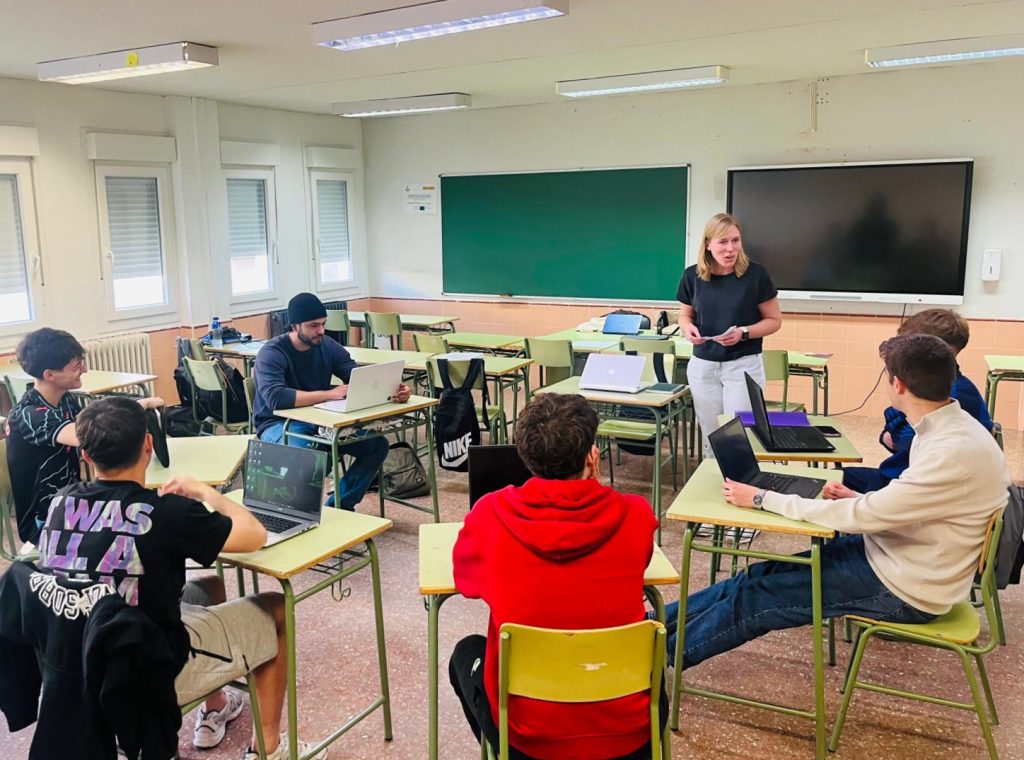
Want to know what it's really like to teach English in Spain? Take it from our TEFL Org graduate, Harriet, who taught English in Bilbao through Meddeas:
After Spain, Harriet taught English in Mexico! Find out more about what TEFL graduates experience by reading our student stories.Harriet, Bilbao
"I graduated from Cardiff University in the Summer of 2015 and, after a summer of being an activity leader for a language school in Devon, I headed to live in the small town of Mungia, just outside of Bilbao. I found a job on The TEFL Org website with a company called Meddeas.
During my first year, I taught all types of English to soooo many different ages – it was crazy. But good crazy.
I taught English conversation skills to teens in secondary school, played games and sang songs with younger children in 'fun, after-school English class,' and even participated in baking and playtime with little ones at home.
The experience really pushed the boundaries of my confidence and teaching abilities and I often found myself doing activities that I truly hadn't anticipated myself doing. I played the guitar and sang Christmas songs with nursery school children; I invigilated exams; I went on a week's residential trip to the mountains and even ended up half-directing an end-of-year performance."
Start Your Teaching Journey with a TEFL Certificate
Teaching English abroad isn't just about speaking English fluently or checking boxes for formality's sake. By becoming TEFL certified, you'll develop classroom confidence and essential teaching skills to overcome the challenges of working with English learners.
From developing an understanding of lesson planning, classroom management, learning styles, and more, you'll become a professional with a TEFL course. To teach abroad with confidence, why not get started with our accredited 120-hour TEFL course?
Frequently Asked Questions
Q. How much does an English teacher make in Spain?
The average monthly salary for English teachers in Spain ranges from €800–€2,000 ($925–$2,325 / £690–£1,730), but teachers at international schools can earn around €2,500–€3,500 ($2,850–$3,990 / £2,160–£3,025) depending on the school.
Q. When is the best time to apply for jobs in Spain?
The school year in Spain runs from mid-September/October to June. So, the best time to apply for jobs in Spain is around 3–9 months before this date depending on the job or programme. Some language academies hire year-round.
Q. Are English teachers in demand in Spain?
Yes, English teachers are in demand in Spain. However, Spain is also a popular TEFL destination, so having the right qualifications (like a TEFL) is essential.
Q. Do you need a degree to TEFL in Spain?
No, a degree isn't technically an essential requirement to teach in Spain. However, most employers do prefer teachers who hold a university degree.
Q. Do you need to speak Spanish to teach in Spain?
No, you don't need to speak Spanish to teach English in Spain. On the other hand, learning the Spanish language – even to a small extent – will improve your cultural immersion.
Q. Can non-native speakers teach in Spain?
Yes, non-native speakers can teach English in Spain. Non-native speakers may need to provide proof of education in an English-speaking country, or an English language proficiency test like an IELTS or CEFR certificate.