






With snow-capped mountains and cool cosmopolitan cities, Canada is a hub for travellers on their holidays or extended gap year. It’s also home to a large ESL (English as a second language) market for an English-speaking country, but teaching jobs depend on your visa status and qualifications.
From teaching immigrants in Toronto and Vancouver to French-speaking students in Quebec, Canada offers different paths for TEFL / ESL teachers. Read on for The TEFL Org’s guide to teaching English in Canada, from the job types, requirements, salary expectations, visas, and more.

Key Takeaways
- There are paid and unpaid teaching opportunities across Canada, from teaching immigrants to French-speakers.
- Teachers generally need a TEFL certificate and a bachelor’s degree; some roles require a teaching licence.
- TEFL or ESL teachers can earn around CAD $2,900–$4,000 ($2,065–$2,850 / £1,545–£2,135) per month, or more if you’ve got previous teaching experience.
- Popular teaching jobs in Canada include private language schools/language centres, summer camps, language assistant roles at public schools, and international schools.
- Teachers can enter on a Skilled Worker Visa, or a working holiday visa through the International Experience Canada (IEC) programme.
- Top locations include Toronto, Vancouver, and French-speaking cities like Montreal and Quebec City.
Requirements for Teaching English in Canada
English is a main language in Canada, but some provinces like Quebec are French-speaking. So, there’s a high availability of local teachers who can speak English, making it a tricky market to break into especially if you’re a foreign teacher. That said, you can still teach English as a foreign language (or as a second language in this case) in Canada as a citizen or a foreign teacher.
Here’s everything you need to know about the teaching requirements for ESL / TEFL in Canada.
Tip: TEFL refers to teaching English in non-English-speaking countries; ESL often refers to students learning English in an English-speaking country, like Canada.
Do I need a TEFL certificate to teach English in Canada?
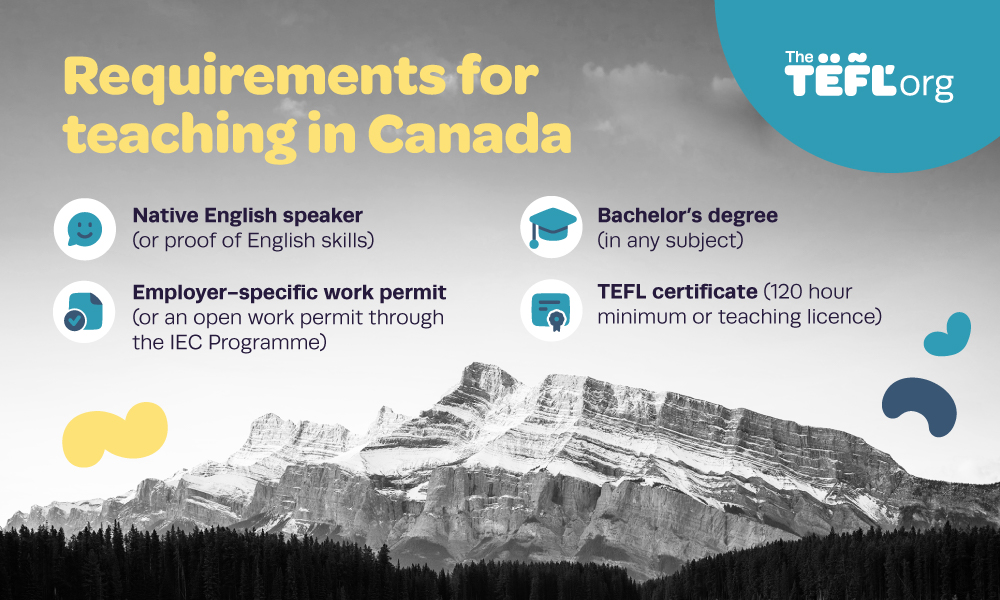
If you want to teach English as a foreign or second language, you’ll need a TEFL certificate at minimum. Most employers require at least a 120-hour TEFL certification, but some might ask for a Level 5 Diploma or a teaching licence depending on the school.
Requirements at public schools are very high unless you’re applying for language assistant roles, and private international schools also have a high entry requirement.
Private language schools, summer camps, volunteer programmes and private tutoring gigs are the easiest route for TEFL certified teachers.
Tip: The requirements for teaching English to native speakers are much higher than for teaching English to second language speakers.
Can I teach English without a degree in Canada?
Generally, you need a degree to find a job teaching English in a school in Canada. But it’s not legally impossible to teach English without a degree.
Canadian citizens who don’t have a degree can work as private tutors, summer camp workers, or at private language schools. But if you come from overseas, not holding a degree will make it more difficult to find full-time employment as an English teacher.
But while most employers look for teachers with university degrees, it’s possible to teach as a language assistant in French-speaking territories as a part of your year abroad at university.
Tip: If you don’t have a degree, you can still teach English without a degree elsewhere in Latin America, Europe, or Asia!
Do I need teaching experience to teach in Canada?
You can teach English without experience in Canada, and new teachers often find more luck applying for jobs at private language schools, summer camps, online, or through language assistant roles. Employers at some jobs, like international schools, require at least a few years of classroom experience.
Can I teach in Canada as a non-native speaker?
Teaching English as a non-native speaker in an English-speaking country is difficult. But it’s not legally impossible, especially if you’ve got residency status, near-native fluency, and a language certificate like IELTS, TOEFL, CEFR, or a degree from an English-speaking university.
While most employers only hire native English speakers, you could teach online, at summer camps, or as a private tutor.
Tip: If you speak French, this can go a long way in your application towards job opportunities in French-speaking Canada like Montreal and Quebec City.
Visa requirements for teaching English in Canada
Most employers look to hire Canadian citizens, but it’s not impossible for foreign teachers to find TEFL jobs or ESL jobs. You’ll need to get the right work visa for teaching, and you can either enter on an employer-specific or an open work permit.
An employer-specific work permit means securing a job before arriving in Canada, while an open work permit means you can work for any Canadian employer that’s compliant with labour laws. Generally, local employers hire permanent residents, so the most popular route for non-Canadian TEFL teachers is through the open work permit.The most popular way to get an open work permit is through the International Experience Canada (IEC) Programme, which is a working holiday programme valid for up to 2 years. With this, you can find a job in-country, whether it be at a language school, summer camp, or as a private English tutor (or any other industry). But again, you’ll need to meet the employer’s unique requirements.
To apply for the IEC programme, you’ll need the following:
- Be 18–35 years old
- Hold a passport from a country with a Youth Mobility Agreement (YMA) with Canada
- Have at least CAD $2,500 ($1,775 / £1,330)
- Show a clear criminal record
Download our guide to teaching English worldwide
Everything you need to know about teaching English in Canada and around the world

Salary and Cost of Living
Canada has a high quality of life, but it can also be expensive. But if you’re heading there to work, you can also earn a good teaching salary.
How much can you earn teaching English in Canada?
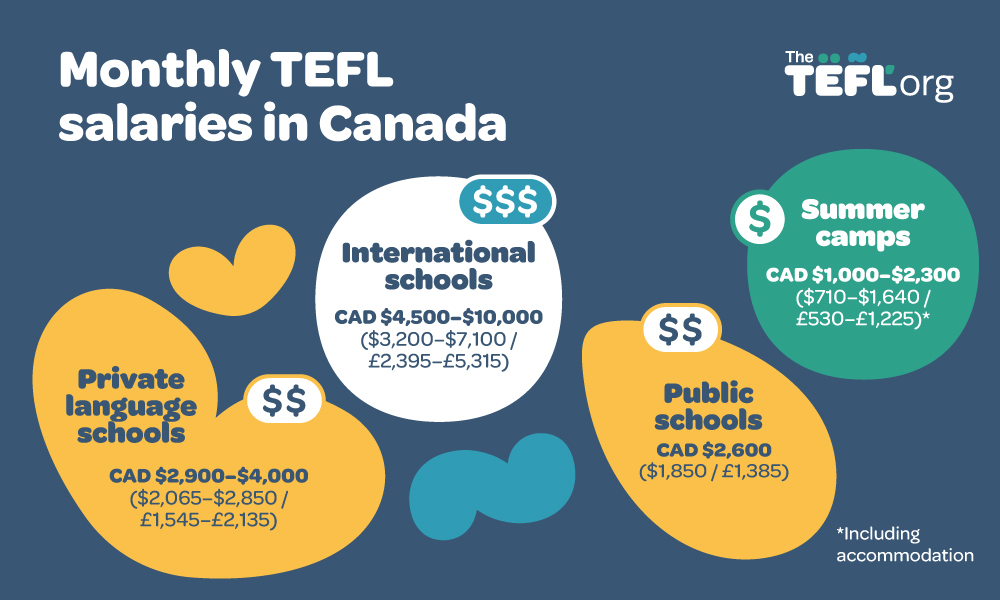
The ESL teacher salary in Canada ranges from around CAD $2,900–$4,000 ($2,065–$2,850 / £1,545–£2,135) per month before taxes — similar to the median salary across most industries in Canada.
There are plenty of factors that affect your teaching salary, like your experience, qualifications, visa, and school type, so it’s never “one size fits all”. Here’s how salaries compare across teaching job types in Canada:
- Public school: Public school teacher salaries are high in Canada, but most TEFL or ESL teachers work as language assistants at public schools, earning a salary of around CAD $2,600 ($1,850 / £1,385) per month.
- Private language school: Full-time teachers at language centres or language schools earn around CAD $2,900–$4,000 ($2,065–$2,850 / £1,545–£2,135) per month, or more for teachers specialising in subjects like teaching corporate English or exam preparation.
- International school: Experienced teachers with a master’s or teaching licences can earn from CAD $4,500–$10,000 ($3,200–$7,100 / £2,395–£5,315) per month depending on the institution, with Upper, Columbia, Cambridge being examples of reputable schools.
- Summer camps: Summer camp teachers usually earn around CAD $1,000–$2,300 ($710–$1,640 / £530–£1,225) per month, with placements lasting around 4–9 weeks.
- Private tutor: Private tutors can set their own rates, typically ranging from CAD $20–$75 ($15–$53 / £11–£40) per hour depending on experience or specialist qualifications.
- Online ESL teacher: Online teachers can earn similar rates to private tutors if working independently, but most teach for ESL companies that usually take a cut of their earnings.
Tip: Salaries are often listed as gross and don’t take tax into account — factor this in when planning your budget.
How much does it cost to live in Canada?
Canada can be expensive, with living costs averaging at CAD ~$3,250 ($2,315 / £1,730) including rent, food, bills, and more across the country, but it varies from one lifestyle or location to another.
Here’s how monthly living costs range across different Canadian cities:
- Vancouver: CAD $4,253 ($3,020 / £2,260)
- Toronto: CAD $3,380 ($2,765 / £2,070)
- Edmonton: CAD $3,205 ($2,285 / £1,710)
- Calgary: CAD $3,515 ($2,505 / £1,875)
- Quebec City: CAD $2,735 ($1,950 / £1,460)
- Montreal: CAD $3,290 ($2,345 / £1,755)
There’s a significant difference in living costs across cities. On top of that, you can adopt these mindful budgeting habits if you’re a foreign teacher in Canada:
- Be flexible with location: A high salary isn’t everything, and if you’re more open to different locations, you could save up more in cities with lower living costs. Compare living costs across different cities before accepting a job.
- Look beyond salary: Don’t just look at the salary in the job contract, look to see if it offers other benefits like accommodation, transport costs, or other perks. Seasonal jobs, including summer camp jobs, are very popular and offer staff members accommodation and meals which can offset expenses.
- Live outside the city centre: Living and working in Canada means you don’t have to rush. Consider living in quieter neighbourhoods rather than tourist hotspots — you could save upwards of CAD $250 ($180 / £135) per month.
- Take the bus: With extensive subway and bus networks, public transport can help you save money in Canada as a teacher. A monthly transport pass costs around CAD ~$100 ($70 / £50) depending on the location, which is cheaper than relying on Ubers or leasing a car.
English Teaching Jobs in Canada
Most ESL and TEFL jobs are in the private sector. Public-school teaching roles generally require recognised teaching qualifications. Many language schools offer part-time hours, so you might need to combine classroom teaching with online lessons or private tutoring to earn a full-time salary.
If you’re applying through the IEC programme, you can start your research before you travel and you can hit the ground running. Otherwise, you can apply for jobs through platforms like Indeed, JobBank, The TEFL Org Jobs Centre, or regional job boards like NovaScotia.
Public schools
Unless your teaching qualifications are recognised in Canada through the Educational Credential Assessment (ECA), most teaching positions at public schools are as assistants.
Language assistants support the main teacher by offering personalised guidance to students and also help teachers with other administrative tasks. Generally, most public school jobs for ESL / TEFL teachers are in French-speaking Canadian regions.
What to expect at public schools in Canada:
- Teaching as a language assistant in French regions
- Large class sizes
- Providing individual support to students
Private language schools
The biggest ESL market for teachers in Canada is in private language schools. Language schools, or language centres, cater to immigrants learning English as a second or third language. Many of these students are already studying or working, so classes usually take place in the evening or weekends.
While some language schools offer general English classes, others offer ESP (English for Specific Purposes) subjects like exam preparation or Business English for adult learners.
What to expect at private language schools in Canada:
- Evening and weekend classes
- Smaller classes than public schools
- Focus on ESP subjects
International schools
International schools are private schools that charge high tuition fees to students from overseas learning English as the main language. International schools offer some of the highest salaries and benefits for teachers, and students can expect an excellent quality of education. But standards and requirements are high, including a master’s degree and years of teaching experience.
What to expect at international schools in Canada:
- Teaching mainly foreign students
- Excellent salary and benefits
- Intense workload and high levels of responsibilities
Private tutoring
If you’re a citizen or you’re on an open work permit in Canada, you can work as a private tutor. As a private tutor, you can set your own schedule, hourly rates, and curriculum. But while this is a flexible way to earn money, you’ll need to market yourself to students, and hours can be low to start with as you take on more students.
What to expect as a private tutor in Canada:
- Flexible hours and rates
- Marketing yourself to students
- Preparing your own curriculum and lesson materials
Volunteer programmes
With a large immigrant population and French-speaking provinces, there are plenty of opportunities for teaching English to ESL students as a volunteer in Canada. Volunteering is an excellent way to gain experience in education. Volunteers often help immigrants or French-speakers develop conversational English skills, either in classrooms or informal settings that include more engaging activities, from team building, arts and crafts, and so on.
Popular programmes include Cuso International, ELTOC, Immiland, MOSAIC, Maison, and more.
Teaching English Online in Canada
While there’s a big market for TEFL teachers in Canada, teaching English online means that you don’t have to limit yourself to the area. Many teachers use online teaching to supplement their income whereas others use it as their full-time job.
- Work for an online ESL company: As an online teacher, you can work for a platform that finds students for you and provides lesson materials — but often takes a cut of your earnings. Popular examples of online ESL platforms include English Hunt, VIPKID, Qkids, and more.
- Find students through a marketplace: Preply is an example of a marketplace platform. You create your lessons and gather students, but the platform takes a percentage of your lesson fees for connecting you with students.
- Teach English independently: You can go one step further by building your own website and hosting your own classroom, cutting out the middle-man. But bear in mind, it requires a lot more work, like marketing yourself, planning and preparing lessons, and so on.
Teaching Programmes in Canada
As an English-speaking country, there aren’t that many teaching programmes in Canada. But they do exist, typically as opportunities for entry-level teachers to work as language assistants.
British Council Language Assistant Programme
British or Irish teachers with French-speaking skills can join the British Council Language Assistant in Quebec programme as language assistants. On this programme, teachers work ~18 hours a week (and 6+ hours of preparation time) at public primary and secondary schools across French-speaking regions of Canada. Teachers receive CAD $2,600 gross per month, and contracts last 9 months.
Programme requirements:
- UK or Irish passport
- A2 level of French
- Clear criminal background check
- Have lived in the UK/Ireland for at least 5 years within the last 10 years
Odyssey Language Assistant Programme
Canadian teachers can apply to work as a language assistant teacher through the Odyssey programme. With Odyssey, teachers are usually placed in French-speaking regions like Quebec or New Brunswick. Teachers work 25 hours per week for 9 months and receive a salary of ~$30,000 CAD and benefits like a relocation allowance.
Programme requirements:
- Canadian citizenship or permanent residency (excluding student visas)
- Completed at least 1 year of college-level studies or university (depending on placement)
Recruiters & employers
From language and international schools and summer camps, here are some of the most notable recruiters and employment opportunities for TEFL teachers in Canada.
- Access English offers general English courses, exam preparation, and much more to students of all ages in Toronto.
- Camp Canada looks for university students (or soon to be) aged 19–30 to work as summer camp counsellors with students aged 6–16.
- Birmingham International Collegiate of Canada promotes interactive, creative teaching. They teach IELTS, run summer camps, and a number of other programs.
- English Encounters is in Burlington, Ontario. Courses include Business English, Exam Preparation and Intensive English Courses.
- The Language Instruction for Newcomers to Canada (LINC) offers free English classes and career guidance to immigrants and refugees in Canada, with paid and voluntary roles for native English speakers.
- Oxford House is a top-rated language school with branches in Toronto, Vancouver and Calgary, offering courses in IELTS Examination Preparation, CELTA Cambridge Examination, English for Business Success, and more.
- TESOL Ontario’s jobs board lists a range of roles, including volunteer teaching positions and IELTS examiner work.
Teaching English in Major Cities
Canada is the second-largest country in the world, and it’s actually 30% bigger than Australia. So it’s no surprise that they have plenty of appealing cosmopolitan cities to choose from. From Vancouver in British Columbia, Toronto in Ontario, and the French-speaking cities in Quebec, there are plenty of cities that offer teaching opportunities.
Teach English in Toronto

Toronto is Canada’s largest city, and around 46% of its population come from abroad, creating a huge opportunity for ESL teachers. With such a high percentage of immigrants, you’ll find students of all ages.

From professionals learning Business English to young learners adapting to life in an English-speaking country, teaching opportunities vary across the city. Popular examples of language centres include Access International, ILSC, Night School, Kaplan, and more.
Teach English in Montreal

Compared with Toronto, Montreal offers a different kind of teaching market because it’s in Canada’s French-speaking province — Quebec.
While Quebec City is the province’s capital, Montreal is its biggest and most cosmopolitan city. So from working as a language assistant in public schools to a classroom teacher at language centres like ILSC, Institute Linguistique, and LCI, teachers can find different ESL job vacancies in Montreal.
Around 70–80% of both Montreal and Quebec City’s population speak French as their first language. While both have a similar demand for English teachers, Montreal’s larger population makes it a bigger market.Ready to Teach English Abroad? Don’t Forget Your TEFL Certificate
Ready to teach English? Don’t forget your TEFL certificate! Whether you’re a Canadian citizen looking to teach near home or a foreign teacher looking to teach English abroad, you’ll need to study the essentials of teaching to not just find teaching jobs but also to enjoy your experience in the classroom.
From studying lesson planning and classroom management techniques to teaching complex grammar structures, you’ll learn everything you need with a TEFL course.
Why not get started today with our 120-hour TEFL course?
Frequently Asked Questions
Q. Are ESL teachers in demand in Canada?
Canada has a high population of immigrants and French speakers, so there is a demand for ESL teachers. But the market is competitive because Canada has plenty of English-speaking teachers already.
Q. How to become an ESL teacher in Canada?
If you want to teach English as a foreign or second language, you’ll need a TEFL certification. Generally, employers require TEFL or ESL teachers to hold a university degree.
Q. How much does an ESL teacher make in Canada?
It depends on the job type and level of experience, but TEFL or ESL teachers generally earn around CAD $2,900–$4,000 ($2,065–$2,850 / £1,545–£2,135) per month.
Q. Can a UK teacher teach in Canada?
Most ESL jobs go to Canadian citizens, but it’s not impossible for UK teachers to work in Canada. UK teachers can apply for the International Experience Canada (IEC) and enter on an open work permit.