












With cherry blossoms, endless conveyor belt sushi, and its fusion of traditional and modern, Japan has established itself as one of the world’s most alluring destinations. However, despite its influential pop culture and booming tourist industry, Japan’s English proficiency score is low, creating a high demand and opportunities for English teachers in Japan.
With the right research, preparation, and TEFL certificate - which stands for Teaching English as a Foreign Language - you can find a job teaching English in schools across Japan, from Tokyo and Osaka, to Nagoya and beyond.
Key Takeaways
- Japan offers teaching opportunities in public schools, private language institutes, international schools, summer camps, and freelance tutoring.
- Most full-time roles require a bachelor’s degree and at least a 120-hour TEFL certification, while non-degree holders can work part-time on other visas.
- Living costs vary by location; major cities like Tokyo and Osaka offer strong job markets and high salaries but their cost of living is significantly higher.
- English teachers at public and private schools typically earn ¥220,000–¥280,000 per month ($1,385–$1,780 / £1,050–£1,350), with salaries ranging from ¥400,000–¥600,000 per month ($2,505–$3,825 / £1,900–£2,900) at international schools.
- Visa options depend on your teaching job and qualifications, with the E-1 and E-2 visas being the main working visas for full-time teachers.
Requirements for Teaching in Japan
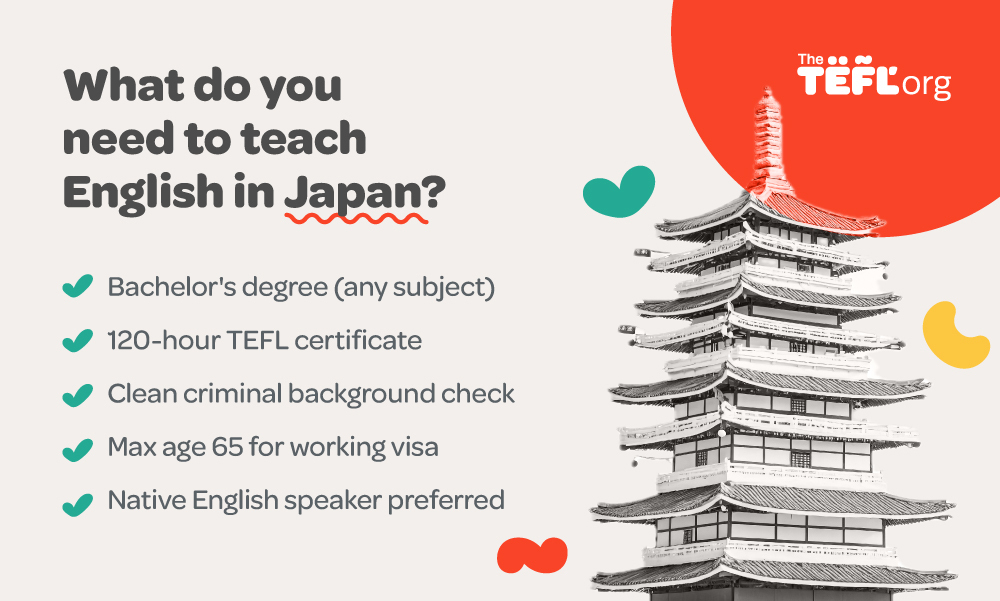
Most teaching jobs in Japan require a bachelor's degree, native English proficiency, and a TEFL certificate to legally teach on a working visa. While it's possible for non-degree holders or non-native speakers to teach in Japan, jobs will be harder to come by.
Do I Need a TEFL Certificate to Teach English in Japan?
While not a legal requirement, most employers in Japan require teachers to have a minimum of 120 hours TEFL qualification — especially if you don't have teaching experience. You can teach in Japan with online or in-person TEFL courses, just as long as they're accredited.
Here are the benefits of becoming TEFL certified before teaching English in Japan:
- Improves your teaching skills: A TEFL course improves lesson planning, classroom management, teaching techniques, and understanding of how foreign language teaching is different to traditional lessons.
- Prepares you for cultural differences: A TEFL certification from an accredited provider (like The TEFL Org) reflects real classroom experiences, which is key to Japan’s structured teaching environment.
- Boosts employability: Japan's work culture values effort and clear learning outcomes, and TEFL training gives employers confidence in your teaching abilities when reading your CV/resume.
Tip: Employers expect a minimum of 120-hour TEFL training (including online courses), and advanced courses like the Level 5 TEFL course can stand out among other qualifications.
Read more about choosing the right TEFL course for teaching in Japan:
Can I teach English in Japan without a degree?
It’s possible to teach English in Japan without a degree, but your opportunities and salary will be lower. Here are the ways you can legally teach English in Japan without a bachelor’s degree:
- Student Visa: International students at Japanese or English-medium universities can find part-time work for up to 28 hours per week while on a student visa.
- Spousal Visa: A spousal visa in Japan — where you're married to a Japanese citizen — offers unrestricted work authorisation, meaning that you can legally teach English.
- Japanese Citizenship or Naturalisation: If you have a Japanese passport and citizenship, you can work as an English teacher without a degree. However, this requires at least five years of living in Japan.
- Working Holiday Visa: Travellers looking to cover expenses can potentially find temporary or part-time work on the Working Holiday Visa.
These options can help you gain teaching experience but don't give the same access or benefits that full-time roles on standard work visas do.
Can I teach English in Japan with no experience?
Many teaching jobs in Japan welcome inexperienced teachers, particularly at public schools through the JET Programme and private schools also known as an eikaiwa. TEFL certification will encourage employers that you have the skills needed to teach English in Japan.
Visas for teaching jobs in Japan
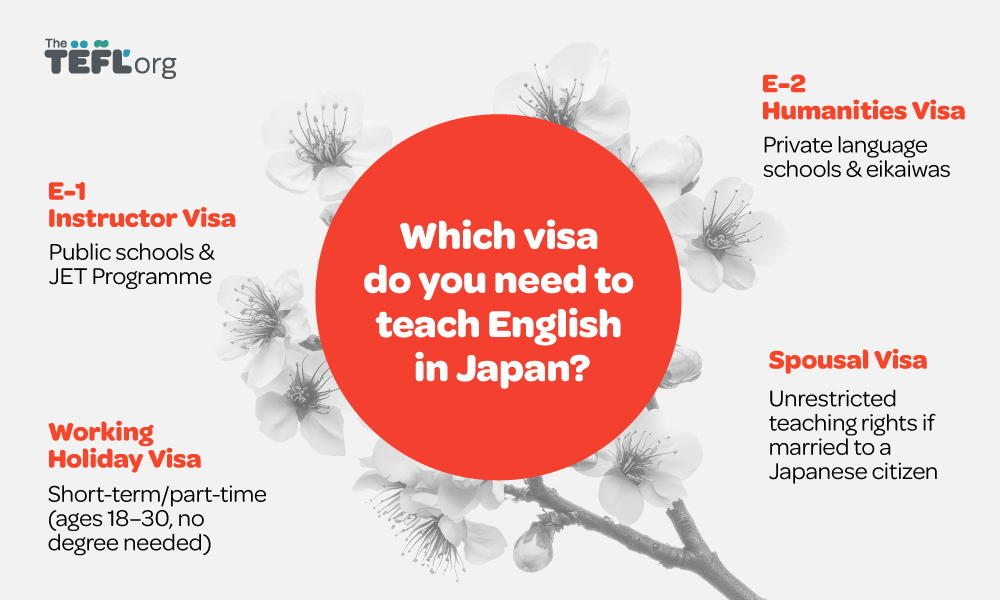
To legally teach English in Japan, you'll need to be on a long-term working visa. According to Japan's Ministry of Foreign Affairs (MOFA), your working visa will fall under one of the following categories:
- E-1 Instructor Visa: Teachers at public schools will often obtain the E-1 Instructor Visa. ALT (Assistant Language Teacher) positions through Boards of Education (BOE) or the JET Programme typically fall under this category.
- E-2 Specialist in Humanities Visa: Teachers who find TEFL jobs in private language schools, conversation schools, and business English providers will often enter Japan on the E-2 Specialist in Humanities Visa.
Both fall under Japan's Working Visa category and permit full-time, paid teaching work. Your employer will help you with the visa process after securing a teaching job in Japan, but you'll also need the following:
- A bachelor's degree in any subject
- Maximum age of 65
- 120-hour TEFL course (preferred)
- Clean criminal background check
- Completed visa application form from the Japanese Embassy website
- Job offer and a Certificate of Eligibility from your school or employer
- Native English speaker with a passport from U.S., U.K., Ireland, Canada, Australia, New Zealand and South Africa (preferred)
- Teaching experience and/or a degree in English/education (preferred but not essential)
The Working Holiday Visa is another way for non-degree holders to find flexible, short-term teaching jobs in Japan. While this visa offers part-time work, it’s primarily used for tourism and doesn’t offer the same salary or benefits as a standard working visa.
To apply for Japan's Working Holiday Visa, you'll need the following:
- Be between 18 and 30.
- Possess a passport from a partner country, including Australia, New Zealand, Canada, South Korea, France, Germany, UK, Ireland, and more.
- Have not received a Working Holiday Visa from Japan before.
- Be able to show either $3,300 / £2,500 in cleared funds or $2,000 / £1,500 with a return/onward flight ticket.
Read more: How to become an English teacher in Japan
Get our guide to Japan
Download your free guide to teaching English in Japan

Salary and Cost of Living
Japan's cost of living can be high compared to other Asian countries, particularly in hubs like Tokyo, Kyoto, and Osaka.
The good news is that with our thorough research and insight from in-country TEFL teachers, you can make informed decisions and make the most of your teaching salary in Japan.
How much can you earn teaching English in Japan?
The monthly salary for teaching English in Japan ranges from ¥220,000–¥280,000 ($1,380–$1,755 / £1,045–£1,330) with ¥250,000 ($1,585 / £1,200) being a common average for those in public and private schools.
But salaries don't tell the whole story, as job benefits like reimbursed airfare, housing allowance or support, commuting allowance, and health insurance can make a difference to your budget.
However, your salary will be influenced by a number of factors:
- Experience & qualifications: Having prior teaching experience and a reputable TEFL qualification offers greater potential for higher-paying positions.
- Teaching job: Specific teaching jobs like international schools will offer higher salaries of around ¥400,000–¥600,000 per month ($2,505–$3,825 / £1,900–£2,900), but the job requirements and responsibilities are far higher.
- Location: Generally, bigger cities offer higher salaries but also higher costs of living. Some chain schools may offer the same salary nationwide, which means that your earnings can go further in smaller cities and suburbs.
Tip: Teachers can supplement their income with private English tutoring, charging anywhere from ¥2,000–¥8,000 per hour ($11–$45 / £9–£35) depending on experience.
Find out how much you can earn as an English teacher abroad

| Restaurants | JPY | USD | GBP |
|---|---|---|---|
| Inexpensive restaurant meal | |||
| Domestic beer (0.5 litre) | |||
| Regular cappuccino | |||
| Water (0.33 litre) | |||
| Markets | JPY | USD | GBP |
| Regular milk (1 litre) | |||
| Loaf of white bread | |||
| Regular eggs (1 dozen) | |||
| Apples (1 kg) | |||
| Transportation | JPY | USD | GBP |
| One-way ticket (local transport) | |||
| Monthly pass (regular price) | |||
| Taxi start (normal tariff) | |||
| Gasoline (1 litre) | |||
| Utilities | JPY | USD | GBP |
| Electricity, heating, cooling, water, and garbage (for a regular apartment) | |||
| Regular prepaid monthly mobile tariff with 10GB+ data | |||
| Internet (60 Mbps, unlimited data, cable/ADSL) | |||
| Clothing and shoes | JPY | USD | GBP |
| Pair of jeans (Levis 501 or something similar) | |||
| Summer dress in a chain store | |||
| Nike running shoes (mid-range) | |||
| Men's leather business shoes |
How much does it cost to live in Japan?
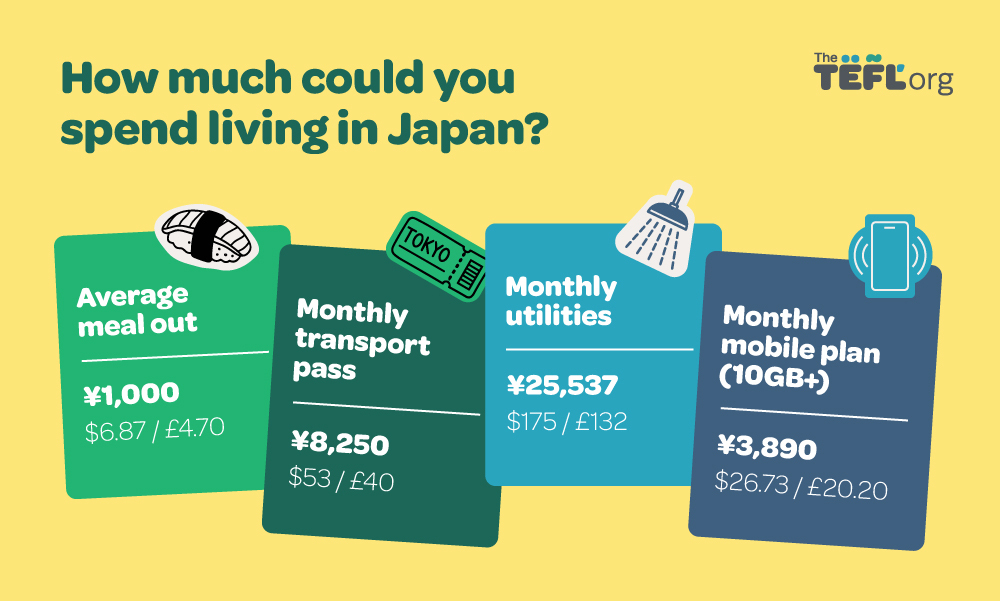
Living costs in Japan vary based on where you live and your unique lifestyle. For example, living in rural areas or smaller cities will be more affordable than living in Tokyo or Kyoto.
Here's how you can stretch your salary when living in Japan:
- Shared or modest housing: Opting for shared or modest housing outside the city center can reduce your rent costs by up to ¥30,000–¥50,000 ($200–$315 / £150–£240) per month.
- Shop at local markets: Buying local ingredients is cheaper than imported goods. Too busy to cook? Bento boxes offer a convenient, nutritious meal for as little as ¥200–¥700 ($1.50–$5.30 / £1–£4).
- Eat at Japanese restaurants: A meal at a local Japanese restaurant can cost around ¥1,000 (£4), but indulging at western restaurants might cost more.
- Use public transport: Make use of public transport to get around — a monthly transportation pass can cost around ¥8,250 ($53 / £40).
From rent, food, phone bills, car rentals, and more, TEFL Org graduate Katherine takes you through her living expenses in Japan.
English Teaching Jobs in Japan
Teaching English jobs in Japan range from teaching young learners at summer camps, teenagers at public schools, to business professionals in private schools, and more. With the right approach and expectations, teaching in Japan can be rewarding at every level.
Types of Teaching Jobs
Private language schools
Private language schools, also known as eikaiwas, offer entry-level jobs and year-round hiring for TEFL teachers. Lessons vary in age groups from young learners to adults and subjects from conversational English to business English and more. Most eikaiwas provide teaching materials and training for new teachers.
Advanced teachers with qualifications such as a master’s degree or teaching license can find positions at international schools in Japan, which offer the highest salaries and benefits.Typical expectations of teaching in private schools in Japan:
- Mix of part-time or full-time shifts in the evenings and weekends
- 12 - 30 teaching hours per week between 10am and 10pm
- Wide range of student ages
- Eikaiwas offer monthly salaries of around ¥240,000–¥280,000+ ($1,505–$1,719 / £1,140–£1,330)
- International schools offer monthly salaries of around ¥400,000–¥600,000 ($2,505–$3,760 / £1900–£2,850)
- Benefits may include health insurance, housing support, and flight reimbursement

Public schools
English teachers at Japanese public schools typically work as Assistant Language Teachers (ALTs). Despite larger classrooms than at private schools, ALTs support homeroom Japanese teachers rather than leading classes independently.
ALTs may work in elementary, junior high, or high schools from Monday to Friday at one or more schools within commutable distance. The JET Programme (Japanese Exchange and Teaching) is a highly popular government programme that offers opportunities for ALT positions.Typical expectations of teaching English in public schools in Japan:
- Weekday schedule; weekends off
- Team-teaching with a Japanese teacher in larger classrooms
- Strong support and training in most placements
- Monthly salary from ¥220,000–¥280,000 ($1,380–$1,719 / £1,045–£1,330)
- Benefits may include health insurance, housing support, flight reimbursement, and 10–20 days of paid leave and national holidays
Recruiters
Not quite sure where to begin? Recruiters hire year-round and will match you with suitable schools across Japan based on your unique preference and experience.
To narrow down your search, we've compiled a list of some of the best recruitment companies for teaching English in Japan:
- AEON offers full-time placements nationwide teaching parent-baby to adult classes. Competitive salaries start at around ¥275,000 per month and subsidized housing at ¥55,000 per month.
- JET Programme is a programme sponsored by the Japanese government for new teachers, offering extensive support and competitive pay around ¥4 million per year before tax.
- Interac is one of the largest ALT dispatch companies in Japan, partnering with many public schools. Teaching salaries range from ¥2.4–¥3 million per year before tax.
- Amity specialises in teaching children aged 6 months to 15 years, with 80+ branches across Japan.
- ECC offers lessons for children and adults, with typical salaries around ¥3.24 million per year before taxfor one-year contracts.
- GaijinPot is a popular job board offering teaching positions across Japan. Some roles seek candidates who already live in Japan.
- Westgate offers short-term university and adult education contracts (3 - 7 months), with salaries ranging ¥260,000–¥280,000 per month.
- Winbe English is an English Conversation School specialising in children’s classes. Training is provided and salaries start at ¥250,000 per month.
Download our guide to teaching English in Asia
Learn how teaching in Japan compares to other countries in Asia
Teaching Programmes in Japan
Instead of endlessly scrolling for jobs online, many teaching programmes offer job placement, pre-departure support, cultural orientation, and in-country support. The JET Programme is among the most popular and is one of the best in the world for first-time TEFL teachers.

What is the JET Programme?
The Japan Exchange and Teaching (JET) Programme is a government initiative that promotes English education and cultural exchange across public schools in Japan. Since 1987, the JET programme has sent over 80,000 teachers from 82 countries and to Japan – and counting!
With strong support and a collaborative teaching style, the JET Programme is a great option for new teachers finding their feet in Japan. ALTs make up the majority of roles, earning around ¥4.02 million ($25,900 / £19,200) per year before tax, with paid flights and housing support, plus 10 to 20 days of paid annual leave.
Through JET, you can apply for one of the following roles:
- ALT (Assistant Language Teacher): ALTs support the Japanese homeroom teacher's lesson preparation and presentation across one or more schools in a typical week.
- CIR (Coordinator for International Relations): An office-based position that requires higher Japanese proficiency for translation purposes and international exchange.
- SEA (Sports Exchange Advisor): Roles in sports-related departments promoting international exchange through sports training and athletics programmes.
Eligibility Requirements for the JET Programme
To be accepted onto the JET Programme, you'll need:
- A bachelor’s degree in any subject
- Native English speaker or a passport from a participating country
- A TEFL certificate (preferred)
- A genuine interest in Japan and cultural exchange
- To not have resided in Japan for 6 or more consecutive years within the past decade
Tip: During the interview process, additional factors like adaptability, communication skills, and cultural awareness are also considered.
Teaching English in Major Cities
Teaching English in Japan is a wonderful opportunity, but each city offers a unique experience. Here are some of the top cities for teaching in Japan.
Teaching English in Tokyo
From Shibuya Crossing to the Imperial Palace, Tokyo is a fusion of the archaic and modern. As the world’s largest metropolitan area and Japan’s capital, Tokyo offers an enriching cultural experience and a thriving job market for TEFL teachers.
TEFL certification and experience will help you stand out in Tokyo’s competitive job market. Most teachers in Tokyo work in private language schools or eikaiwas, but you can also find jobs in public schools and international schools. While most teachers find work before arriving, some prefer being ‘on the ground’ before finding a job in the city.
Tokyo is consistently ranked among the world’s most expensive cities, so saving money can be tough. However, for teachers looking for culture, job variety, and a fast-paced urban lifestyle, Tokyo is hard to beat.
Read more: How to Teach English in Tokyo

Teaching English in Osaka
From the ancient Shitennō-ji temple to the colourful street markets of Shinsekai, Osaka offers an exciting lifestyle for teachers looking beyond the capital.
As Japan’s third largest city, Osaka offers many teaching opportunities in a less competitive market than Tokyo. Osaka’s lower living costs mean you can stretch your salary further, whether you want to save up or spend it on weekend trips to nearby locations like Kyoto and Kobe.Like other major cities, teaching jobs in Osaka range from public schools as an ALT, private schools, and international schools.
TEFL Org Teacher Stories
Want to know what it's actually like teaching English in Japan? Take it from our TEFL Org graduate teachers who used their TEFL qualifications to teach in Tokyo and beyond.
Ursula, Tokyo
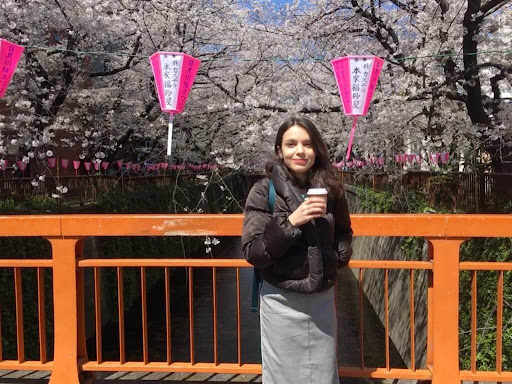
"That first night I lay in bed and honestly thought: what have I done? I was out of my comfort zone and far away from everything I'd ever known.
The next few years were filled with a lot of joy, but also a steep learning curve. Preparation definitely helps: teaching at first can feel like a crazy whirlwind. The most important thing is to practice and keep an open mind. There are different challenges in teaching students of any culture.
One of my favourite things about teaching was seeing a student's sense of achievement after becoming more comfortable over time. And it's easier to empathise with how nerve wracking speaking another language is when you have to leave the school and do it for yourself.
Teaching English gives you the opportunity to learn so much from people from a completely different culture from your own. The confidence and knowledge I gained from the experience is priceless."
Read more about Ursula's journey to Japan or discover more student stories from across the world.
Wiley, Fukushima
Curious about what a day in the life of teaching in Japan looks like? Let Wiley take you through a typical day!
Ready to teach English in Japan? Don't forget your TEFL certification!
TEFL courses offer some of the best training and insight into teaching, granting access to better job opportunities abroad. Whether you want to learn online, in-person, or both, TEFL courses come in many different forms to cater to your schedule.
Read more about TEFL courses:
Frequently Asked Questions
Q. Why should I teach English in Japan?
Japan not only has a huge demand for English teachers but it offers insight into one of the world's most alluring cultures. Teaching English abroad allows you to work and live in Japan, not just travel, while integrating with local communities and immersing yourself within Japanese culture.
Q. Can I teach English in Japan without a degree?
Yes, it's possible to teach English in Japan without a degree if you're on a Student Visa, Spousal Visa, Working Holiday Visa, or have a Japanese citizenship. However, the salary potential and opportunities will be limited.
Q. What qualifications are needed to teach English in Japan?
To teach English in Japanese schools, you'll generally need a bachelor's degree and a TEFL certificate. Entry-level teachers are welcome provided they're TEFL certified.
Q. Can I teach English in Japan without experience?
Yes, you can teach English in Japan without experience especially if you have a high-quality TEFL certificate. Many jobs and programmes welcome entry-level teachers and offer in-country support and assistance.
Q. Can I teach in Japan without speaking Japanese?
Yes, you can teach English in Japan without speaking Japanese. Students benefit from language immersion in an English-only classroom, but learning local phrases will improve your cultural experience beyond the classroom.
Q. Are English teachers in demand in Japan?
There's a high demand for English teachers in Japan because the country needs workers who can speak English, particularly in hospitality or at international companies.