










Making up around half of South America’s landmass, Brazil is the fifth largest country in the world. Beyond its size, Brazil is a great choice for TEFL teachers with its picturesque landscapes, indigenous heritage and colourful festivals.
Portuguese is the official language, and Brazil’s low English score means there’s a high demand for English teachers. Whether you have your eyes set on Rio de Janeiro, São Paulo, or Brasilia, you can find English teaching jobs across the country. Read on for The TEFL Org’s guide on teaching English in Brazil, from the salary and requirements, to visa processes, and more.
Key Takeaways
- Brazil has a moderate English proficiency score, and it has a high demand for TEFL teachers.
- Teachers generally need a TEFL certificate, and most employers prefer a bachelor's degree and experience (but they’re not essential). Non-native English teachers can also work in Brazil.
- TEFL teachers can find most teaching jobs in the private sector.
- Teachers can earn around R$2,540–R$5,000 ($670–$985 / £500–£735) or around R$6,000–R$12,000 ($1,180–$2,365 / £880–£1,760) at international private schools.
- Teachers need the Temporary Work Visa, also known as the VITEM V to teach legally. Some employers ask teachers to work on a tourist visa, but this is illegal.
- Top locations include Rio de Janeiro, Sao Paulo, and the capital city, Brasilia.
Requirements for Teaching English in Brazil
English is a core part of the curriculum in Brazilian education, but limited resources and large class sizes means that only a small percentage of Brazilians speak English fluently.
But while the demand for English teachers is high, you can’t just walk in and expect to be hired. You’ll need to plan ahead to make sure you meet the requirements not just for the bare minimum, but a job you’ll actually enjoy.
Here’s what you need to know about the teaching requirements in Brazil.
Do I need a TEFL certification to teach English in Brazil?
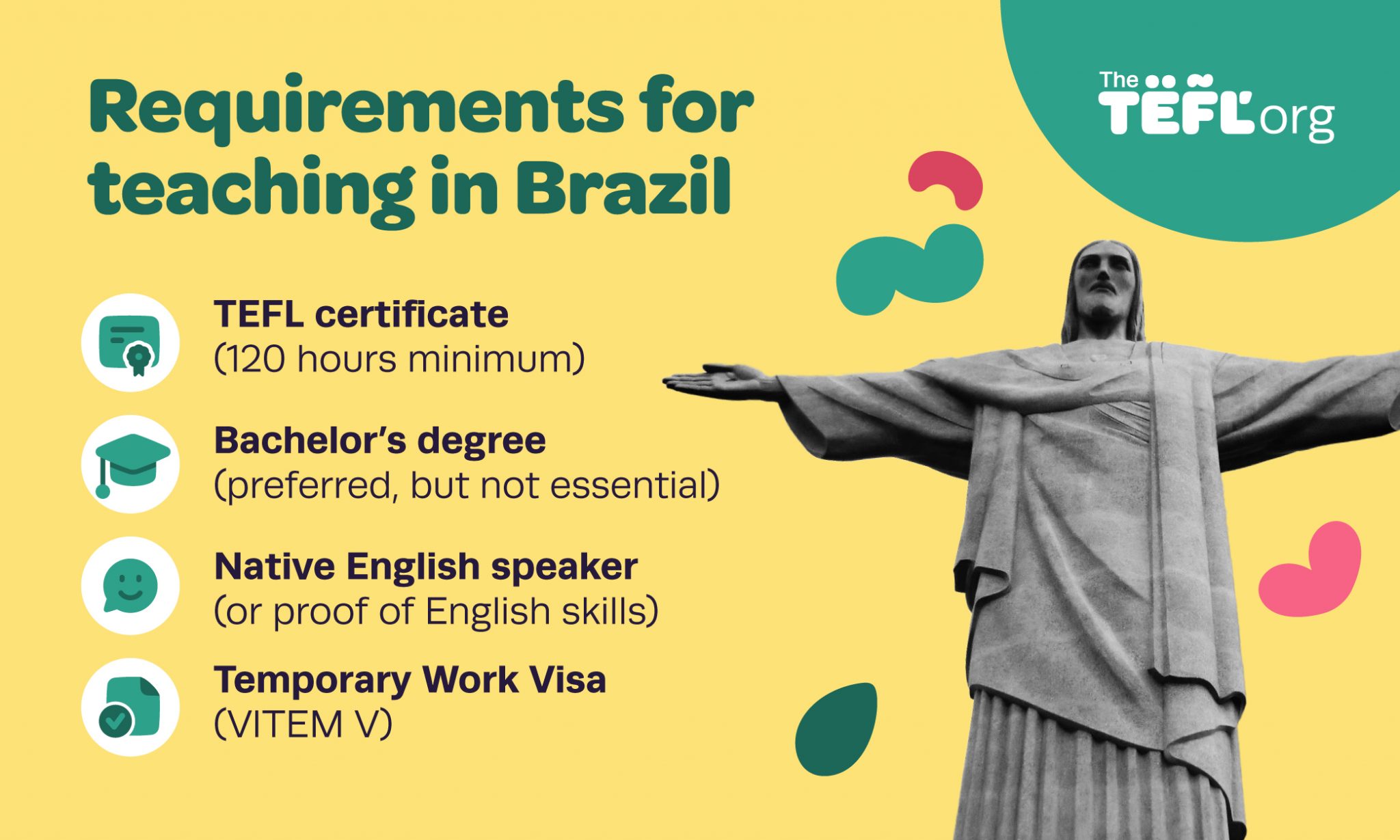
You won’t find much luck without a TEFL certificate in Brazil. Most employers set a benchmark of at least 120 hours of TEFL training for English teachers.
Some employers might list a Level 5 TEFL course as a requirement, but that’s not always the case. A TEFL certificate shows employers that you’ve studied the essentials of teaching English as a foreign language, and that you’ll be classroom ready from the moment you sign the job contract.
Tip: Its common for Brazilian companies to train employees in English (especially in financial and communications fields), which makes Business English a popular subject.
Can I teach English without a degree in Brazil?
Fortunately for non-graduates, you can teach English without a degree in Brazil (as long as you’re TEFL trained). But while a university degree isn’t a legal requirement, most employers look for teachers with a degree in any subject.
This doesn't mean it’s impossible to teach without a degree, it just means that you’ll need to put more time and effort in your search before finding the right job.
Do I need teaching experience to teach in Brazil?
If you have a TEFL certificate and preferably a degree, you can teach English without experience in Brazil. But previous experience will definitely boost your application and you’ll qualify for jobs offering higher salaries.
Many employers accept TEFL certified teachers regardless of their experience, so be sure to mention the skills and knowledge that you’ve gained from your TEFL course in the interview.
Can I teach in Brazil as a non-native English speaker?
Latin American countries are popular for teaching abroad as a non-native speaker, but you’ll need a TEFL certificate and proof of English fluency. Some employers in Brazil specifically look for teachers from English-speaking countries, but this tends to be in international schools where they follow a British, American, or IB curriculum.
You can show proof of your English skills through a language certificate like IELTS, TOEFL, or CEFR, or a degree from an English-speaking university.
Visa requirements for teaching English in Brazil
To teach English in Brazil legally, you’ll need a Temporary Work Visa, also known as the VITEM V. But you’ll need to find a job first so your employer can sponsor your application, and then you can apply for the visa at your local Brazilian embassy.
Your employer needs to prove to the Ministry of Labour that local teachers aren’t available for that particular teaching job, which can make it more difficult for foreigners to find work. But it’s still possible if you’ve got the right qualifications.
To meet the requirements for this visa in Brazil, you need:
- A passport valid for at least six months
- A recent colour photograph
- A completed and signed online visa application form
- A notarised criminal background/police record certificate (if you’ve lived in different countries over the previous year, you’ll need records from each country)
- Notarised copies of your birth certificate
Important: Some employers hire foreign teachers on tourist visas and pay them “under the table.” Although it might be common, it’s illegal and risks fines and deportation.
Download our Teaching English in Latin America Guide
Everything you need to know about teaching English in Latin America
Salary and Cost of Living
In the heart of Latin America, you’d expect Brazil to be affordable. And it is, but you’ll need to be mindful about your location, lifestyle, and experience level to see how far your teaching salary goes.
How much can you earn teaching English in Brazil?
The teaching salary isn’t high in Brazil compared to other countries like China or South Korea, but when compared to the low cost of living, it isn’t bad by any means.
Less experienced English teachers can earn around R$2,540–R$5,000 ($670–$985 / £500–£735) per month, but teachers with a few years of experience can earn a higher salary at well-known private language schools or international schools.
The salary varies from one private language school to the next, but international schools offer salaries of around R$6,000–R$12,000 ($1,180–$2,365 / £880–£1,760) per month among benefits like housing allowance, insurance, and so on.
Tip: Look into popular industries in each city. From finance in São Paulo, tourism in Rio de Janeiro, to engineering in Curitiba, you can increase your value as a teacher by specialising in teaching niche subjects in English.
How much does it cost to live in Brazil?
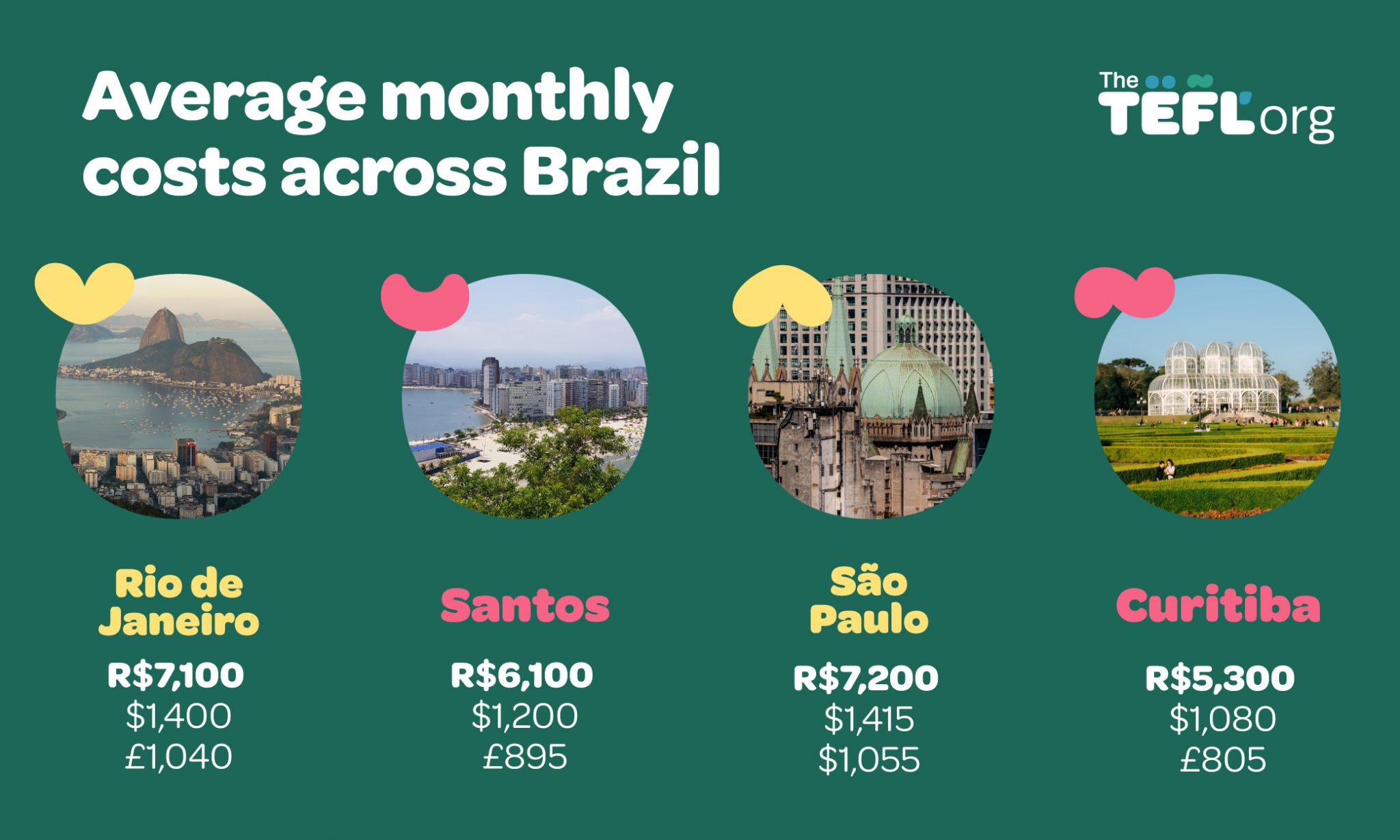
Brazil is an affordable country, but again, you need to compare it to the salary you’ll earn. English teachers can expect to spend around R$4,800 ($945 / £705) per month including rent, but this varies by location and lifestyle. Living in some cities like Rio de Janeiro and São Paulo might cost as much as R$7,200 ($1,415 / £1,055) depending only our lifestyle.
But remember that these are average costs. You can reduce spending and make the most of your teacher’s salary (while still living comfortably) by adopting these mindful spending habits.
- Avoid tourist spots: You can save up to R$2,000 ($395 / £295) per month living outside the center in cities like Rio. This also means living in an area that has a tight-knit community.
- Split the rent: Living with other teachers or expats is a great way to make friends and also save money. A 1-bedroom apartment costs around ~R$2,700 ($530 / £395) in São Paulo, but a 3-bed apartment costs ~R$2,035 ($400 / £295) per person per month.
- Eat like a local: Eating like a local in Brazil saves money and introduces you to some of the country’s best delights! You can shop at feiras – street markets offering fresh produce that are significantly cheaper than western products.
- Eat out at Kilos: If you do choose to eat out, consider checking out a Kilo or quilo. It’s a popular pay-by-weight buffet-style restaurant where you can indulge in a variety of food at low prices, for around R$25 ($5 / £3.70).
- Embrace free activities: Brazil isn’t known for luxury shopping or tall skylines. From lively neighbourhoods, green national parks, long beaches and hiking trails, there’s so much to do in Brazil that doesn’t involve your wallet.
| Restaurants | BRL | USD | GBP |
|---|---|---|---|
| Inexpensive restaurant meal | |||
| Domestic beer (0.5 litre) | |||
| Regular cappuccino | |||
| Water (0.33 litre) | |||
| Markets | BRL | USD | GBP |
| Regular milk (1 litre) | |||
| Loaf of white bread | |||
| Regular eggs (1 dozen) | |||
| Apples (1 kg) | |||
| Transportation | BRL | USD | GBP |
| One-way ticket (local transport) | |||
| Monthly pass (regular price) | |||
| Taxi start (normal tariff) | |||
| Gasoline (1 litre) | |||
| Utilities | BRL | USD | GBP |
| Electricity, heating, cooling, water, and garbage (for a regular apartment) | |||
| Regular prepaid monthly mobile tariff with 10GB+ data | |||
| Internet (60 Mbps, unlimited data, cable/ADSL) | |||
| Clothing and shoes | BRL | USD | GBP |
| Pair of jeans (Levis 501 or something similar) | |||
| Summer dress in a chain store | |||
| Nike running shoes (mid-range) | |||
| Men's leather business shoes |
English Teaching Jobs in Brazil
Not all English teaching jobs in Brazil are advertised online, you might find more luck visiting the country and applying for jobs directly. But if that sounds too time-consuming or big-budget for you, you can still check out The TEFL Org Job Centre and other websites like Serious Teachers or Tes.
Most full-time contracts involve teaching around 20–25 hours per week, and how much work you take home (like grading or lesson planning) depends on the unique teaching job.

Public schools
The school year runs from February–December (with a break in July) and English is a mandatory subject from grade 6 or age ~11. And while most English teachers in Brazil's public schools are locals, foreign teachers can still find jobs if they have at least a B1 level of Portuguese.
These roles are less common than private school jobs, but it’s also possible to teach at a public school as a language assistant with the Fulbright English teaching assistantship.
What to expect teaching at public schools in Brazil:
- Teaching from February to December
- Modest teaching materials and resources
- Teaching in larger classrooms while following the national curriculum
- More competitive than private language schools
Private language schools
Private language schools are among the most common path for English teachers in Brazil, with plenty of schools in big cities like São Paulo, Rio de Janeiro and Brasília. These schools usually focus on specific English training, like preparing for exams or learning Business English, so having skills in ESP (English for Specific Purposes) areas is very useful.
What to expect teaching at private language institutes in Brazil:
- Evening and weekend classes
- Year-round hiring
- Wide range of students ages and abilities
- Classes focused on general English, Business English and exam preparation
International schools
International schools in Brazil offer some of the highest salaries and benefits because they’re privately funded and have high tuition fees. These schools follow an international curriculum and teach most subjects in English, so they're usually looking for experienced, qualified teachers, and experience teaching British or American curriculum goes a long way.
What to expect teaching at international schools in Brazil:
- Monday to Friday timetable
- Teaching smaller classes of local and international students
- Teaching an international curriculum (UK, US, or IB) in English
- Higher entry requirements, often including a degree, teaching licence and previous classroom experience
Tip: Private bilingual schools can also be a good option, although many schools prefer teachers who speak Portuguese.
Private tutoring
Many teachers become private tutors to boost their income outside working hours. Depending on your experience, you can expect to earn around R$50–R$150 ($11–$30 / £8–£22), but you’ll need to network and market yourself to find your own students. In major cities, there's a strong demand for Business English and Academic English. But tutoring alone doesn’t qualify you for a work visa – most teachers secure a job with a school before taking on private students.
What to expect as a private English tutor in Brazil:
- Flexible hours and the ability to set your own rates
- One-to-one or small group lessons
- High demand for ESP subjects in major cities
- Teaching in the evening and on weekends around your current teaching schedule
Teaching English in Major Cities
Brazil is South America’s largest country, which means you might need to narrow down your search. From the Amazon rainforest to the Atlantic Ocean, the country is buzzing with energetic cities for English teachers to consider.
Teach English in Rio de Janeiro

From iconic religious monuments to lively beaches Rio de Janeiro is a postcard-perfect location. Whether you’re after sunbathing and playing football on the beach or you want to Samba you way through Rio Carnival, nothing comes close to like in Rio.
It’s also the former capital, and with a population of 6.8 million (or 13 million if you count the wider metropolitan area), a thriving tourist scene, and plenty of jobs at language schools and international schools. Welcoming around 12 million tourists each year, Rio needs English teachers to keep up with a growing hospitality demand.
There’s plenty to do when you’re not teaching Brazilian students, like relaxing on Ipanema beach or playing beach volleyball and football on Copacabana. If you’re beached out, hike up to the iconic Christ the Redeemer statue by day, and enjoy Samba and street parties at night.
Teach English in São Paulo

There’s a high demand for English teachers, especially those who can teach business English at language centres. For teachers with a teaching license and years of experience, São Paulo also has plenty of international schools that offer British and American education to students.
Beyond teaching, you’ll struggle to run out of things to do. From rooftop bars to busy food markets, art galleries to football stadiums and more, São Paulo is as varied as it is sprawling. It’s also home to Brazil’s largest Japanese-Brazilian population – or Nikkei – which forms a unique environment especially when you stroll through Japantown.

Ready to Teach English Abroad? Don’t Forget Your TEFL Certificate
Teaching English abroad in Brazil is a fantastic opportunity for professional growth, but you can't do it without a TEFL course. While it might seem like a means to an end to get access to teaching jobs, you'll also become a better teacher.
A TEFL course teaches you how to navigate language barriers, plan and present lessons, and help your students speak English with confidence. When you're TEFL certified, you'll not only have access to opportunities across the world but you'll also feel confident in your abilities to lead the classroom.Get started today with our 120-hour TEFL certificate.
Frequently Asked Questions
Q. Are English teachers in demand in Brazil?
Yes, English teachers are needed in Brazil, from the biggest cities like Rio de Janeiro and Brasilia to the smallest villages. According to EF, Brazil has moderate English proficiency, and industries like finance and tourism especially need English speaking workers.
Q. How much do English teachers make in Brazil?
English teachers in Brazil earn an average salary of R$2,540–R$5,000 ($670–$985 / £500–£735) per month, but teachers at international schools can earn around R$6,000–R$12,000 ($1,180–$2,365 / £880–£1,760) per month.
Q. What qualifications do I need to teach English in Brazil?
You need a TEFL certificate to teach English in Brazil. Most employers require at least 120 hours of TEFL training, and they prefer a bachelor’s degree and native English proficiency (but they’re not essential).
Q. Do I need to speak Portuguese to teach English in Brazil?
No, you don’t need Portuguese fluency to teach English in Brazil. But having a B1 level of Portuguese or higher will help significantly in your Brazilian job search, and if you can, it’s advantageous to take Brazilian Portuguese proficiency exams before heading over. On a cultural level, practising Portuguese will help you form better connections with the local community.