







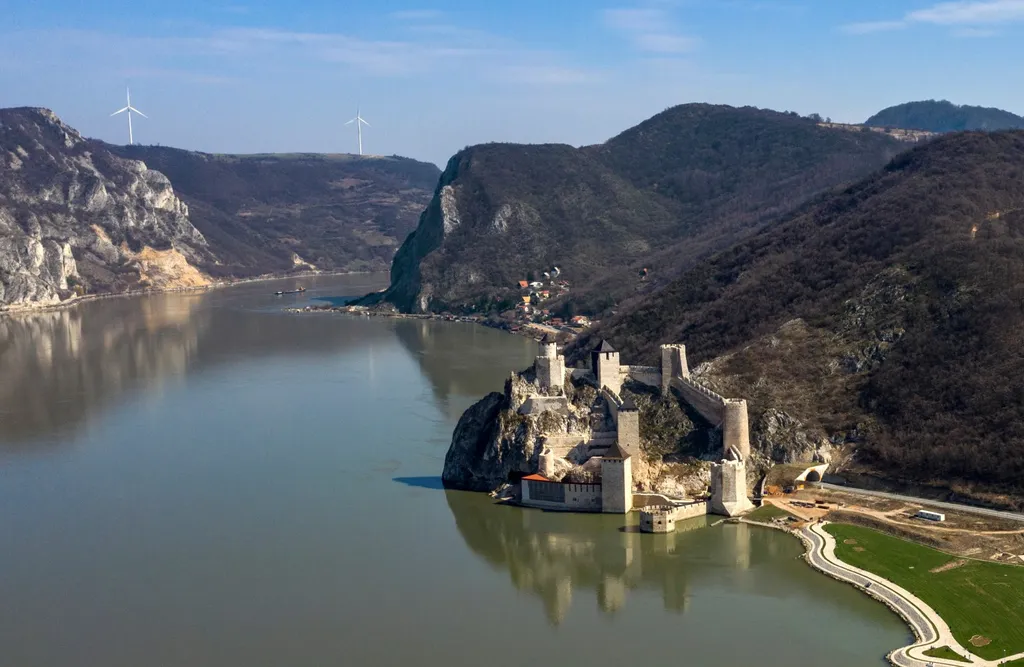
Serbia is where Balkan geography meets Slavic culture, but despite its rich history and striking landscapes, it’s still an overlooked destination. Serbia only welcomes a fraction of tourists compared to neighbours like Hungary and Croatia, but still has plenty to offer for new and experienced TEFL teachers alike.
While English is a foreign language in Serbia, it’s popular among young people in cities like Belgrade, Niš, and Novi Sad. So, you might wonder where that leaves teaching opportunities for foreigners. Read on for The TEFL Org’s guide on teaching English in Serbia, from the requirements and salaries, to visa processes and more!
Key Takeaways
- English speakers are common among the younger generation and in cities like Belgrade or Novi Sad, but there’s still a high demand for English teachers.
- Teachers generally need a TEFL certificate and a bachelor’s degree to find a job teaching in Serbia.
- The average salary ranges from 92,000–140,800 РСД ($900–$1,365 / £680–£1,035), but teachers with advanced qualifications can earn more at international schools.
- English teachers need a Single Permit to work in Serbia legally.
- Top locations for teaching include Belgrade, Novi Sad, and Niš.
Requirements for Teaching English in Serbia
Serbia’s Ministry of Education made learning foreign languages compulsory in school in 2004, with most Serbian students choosing to study English. Today, English is taught from first grade in most schools, which sets a high bar for teaching requirements.
But English is valuable for workers and businesses in Serbia, so there’s still a high demand. Plenty of students want to improve their English skills to study abroad, and high paying jobs at international companies also look for English speakers.
Do I need a TEFL certification to teach English in Serbia?
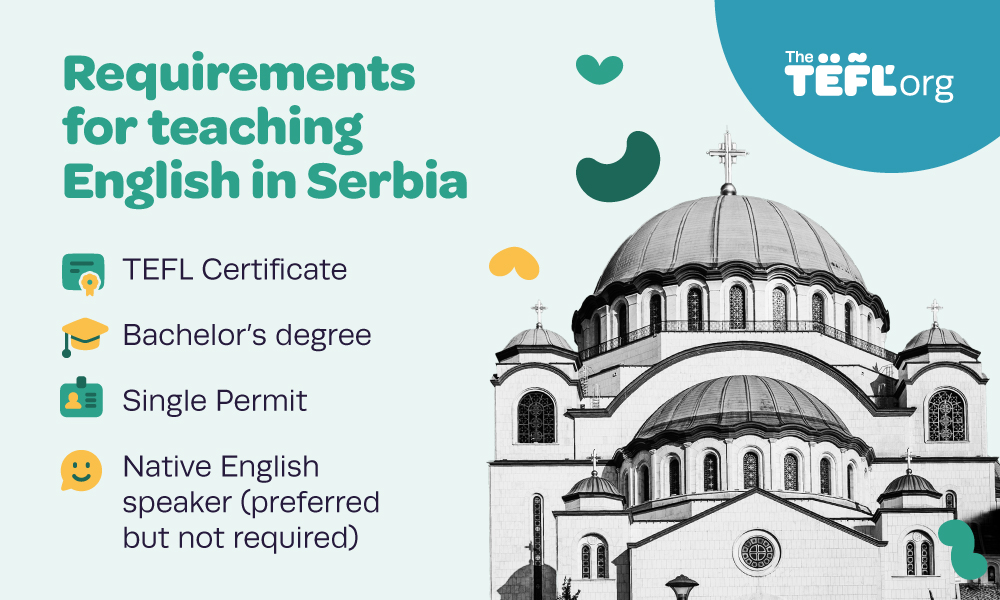
Yes, you need a TEFL certificate to teach English in Serbia. Although it’s not a legal requirement for teachers, employers commonly list 120 hours of TEFL training as the minimum requirement. With a TEFL course, you’ll learn how to manage large classrooms, plan and present engaging lessons, and help students achieve their language goals.
You don’t have to stop at 120 hours – some employers want teachers with a Level 5 teaching qualification or a qualification in an advanced course.
Tip: Many international businesses have offices in Belgrade and Novi Sad, which means teaching Business English is a valuable skill!
Can I teach in Serbia without a degree?
In most cases, you’ll need a bachelor’s degree (in any subject) to teach English in Serbia. A bachelor’s degree is a common requirement that supports your visa application. If you have a bachelor’s or master’s in English or education, then you can find even higher paying jobs in Serbia.
If you don’t have a degree, don’t fret – you can still teach English abroad without a degree in other European countries.
Can I teach in Serbia without experience?
Yes, you can teach English abroad without experience in Serbia, especially if you have a degree, TEFL certificate, and are a native English speaker.
Most teaching jobs for entry-level teachers can be found at private language schools or at summer camps. Some jobs, like at public schools or international schools will require teachers who have 2–3 years of previous teaching experience.
Visa requirements for teaching English in Serbia
Serbia is not a member of the European Union, so non-EU teachers can breathe a sigh of relief. Foreign teachers need the correct work permit to teach here legally regardless of their country’s EU status.
To teach English in Serbia, you’ll need to secure a job first, and then get the Single Permit or a Visa D depending on your work agreement. In most cases, foreign teachers get the Single Permit which allows them to work long-term.
Within 24 hours of arriving into Serbia, you’ll need to register your address at a local police station to get your white card and eventually collect your permit.
Here’s what you’ll need to get the Single Permit:
- Valid passport
- Proof of contract with Serbian employer
- Clear criminal record
- Proof of academic qualifications and experience
- Accommodation details
- Health insurance
Teachers with certain passports from the Schengen Area, UK, or US can enter Serbia visa-free for up to 180 days. This means if you’d prefer to search for work in-country, you can do so – but you’ll need to leave and re-enter when it’s time to apply for and process your Single Permit.
Find out more about visa requirements for teaching English abroad.
Download our guide to teaching in Europe
Everything you need to know about teaching English in Serbia
Salary and Cost of Living
The cost of living is generally low in the Balkans when compared to the rest of Europe, but how does it compare to the teaching abroad salaries?
How much can you earn teaching English in Serbia?
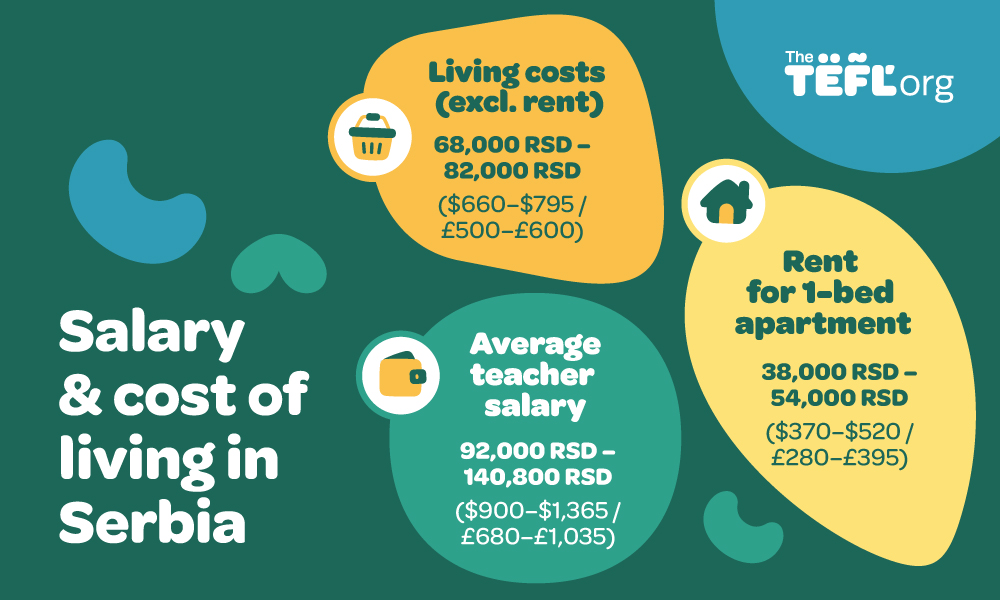
Teaching salaries in Serbia isn’t a one size fits all. While the average salary for TEFL teachers ranges from 92,000–140,800 РСД ($900–$1,365 / £680–£1,035) per month, it depends on factors like your experience, qualifications, nationality and teaching job.
- Experience & qualifications: Teachers with advanced qualifications like a master’s or postgraduate qualification in teaching or years of experience can exceed the average salary significantly.
- Nationality: It’s possible to teach abroad as a non-native speaker in Serbia, but some employers prefer native English speakers – who may receive higher salaries.
- Teaching job: Generally, international school jobs pay the most for TEFL teachers, but these teachers have advanced qualifications like a master’s degree and teaching licence. Public and private language school jobs pay a salary consistent with the industry average.
| Restaurants | RSD | USD | GBP |
|---|---|---|---|
| Inexpensive restaurant meal | |||
| Domestic beer (0.5 litre) | |||
| Regular cappuccino | |||
| Water (0.33 litre) | |||
| Markets | RSD | USD | GBP |
| Regular milk (1 litre) | |||
| Loaf of white bread | |||
| Regular eggs (1 dozen) | |||
| Apples (1 kg) | |||
| Transportation | RSD | USD | GBP |
| One-way ticket (local transport) | |||
| Monthly pass (regular price) | |||
| Taxi start (normal tariff) | |||
| Gasoline (1 litre) | |||
| Utilities | RSD | USD | GBP |
| Electricity, heating, cooling, water, and garbage (for a regular apartment) | |||
| Regular prepaid monthly mobile tariff with 10GB+ data | |||
| Internet (60 Mbps, unlimited data, cable/ADSL) | |||
| Clothing and shoes | RSD | USD | GBP |
| Pair of jeans (Levis 501 or something similar) | |||
| Summer dress in a chain store | |||
| Nike running shoes (mid-range) | |||
| Men's leather business shoes |
How much does it cost to live in Serbia?
Serbia offers affordable living for English teachers, with the average local spending 109,780–123,504 РСД ($1,080–$1,215 / £800–£900) per month, including rent. But if you live in cities like Belgrade, you can expect to spend a little more.
Despite a low cost of living, entry-level teachers need to adopt mindful spending habits if they want to save up. Or, you may want to maximise your savings while teaching. Here are some of the best ways to stretch your budget in Serbia:
- Live outside the city center: Living outside the city center can save you up to ~20,000 РСД ($200 / £150) per month. This money can cover your monthly transport pass, gym membership, and so much more.
- Use public transport: If you took our previous tip, consider getting around using public transport – not only is it extensive, but it’s free! Transport networks in cities like Belgrade and Niš are completely free for residents and visitors, making it affordable and easy to get around.
- Split the rent: You can save plenty of money by sharing accommodation with other locals, expats, or teachers. While a 1-bed apartment costs around ~70,000 РСД ($680 / £515) in Belgrade, a 3-bed apartment costs around ~45,000 РСД ($435 / £330) per person, per month.
- Shop at a Pijaca: Instead of buying imported food at supermarkets, consider shopping at a Pijaca – a local farmer’s market or bazaar that offers local fresh produce at a much cheaper price.
- Use international cards: Using an international card like Monzo, Revolut, or Wise can help minimise transaction or withdrawal fees before you open your bank account in Serbia.
English Teaching Jobs in Serbia
English language is taught from the first grade in Serbia, so schools look for qualified teachers to work with young students all the way up to the end of high school level. But most teaching jobs exist in private schools, so there’s a variety of options for TEFL teachers in Serbia.
You can apply for teaching jobs on platforms like The TEFL Org Job Centre, or, if you’re adventurous and have enough savings, you can apply for jobs “boots on the ground” style.
Public schools
Public school jobs are less common for TEFL teachers, as most vacancies are reserved for local teachers who speak the Serbian language. However, it’s still possible to teach at public schools, mainly through volunteer organisations or EU-funded programmes as a language assistant.
What to expect teaching at public schools in Serbia:
- Language assistant roles through volunteering organisations or government programmes
- Teaching large classrooms
- Following the national curriculum
Private language schools
Private language schools are popular among students who are studying or working and want to improve their English with a specific goal in mind. Language goals can vary from improving academic English for studying abroad purposes, or business English skills to improve career prospects.
What to expect teaching at private language schools in Serbia:
- Evening and weekend classes
- A wide range in student ages
- Focus on ESP (English for Specific Purposes) subjects like business English, exam preparation, and so on
- Year-round hiring and flexible entry requirements
International schools
International schools cater to students from expat families, and teachers follow a British, American, or International Baccalaureate (IB) curriculum. Since English is taught as the primary language, language skills are advanced at these schools.
Most international school jobs exist in the capital, Belgrade. These jobs are very competitive, and teachers often need a master’s degree, teaching licence from their home country, and 2–3 years of teaching experience.
What to expect teaching at international schools in Serbia:
- Teaching international students
- Following a British, American, or IB curriculum
- High salary and benefits, but positions are very competitive
Private tutoring
English tutors can supplement their income by teaching during their free time. Many students look to improve their language skills through private lessons, whether they’re aiming for better conversational, academic English, or business English skills.
Teaching English in Major Cities
Here are the most popular places for English teachers to consider in Serbia.
Teach English in Belgrade
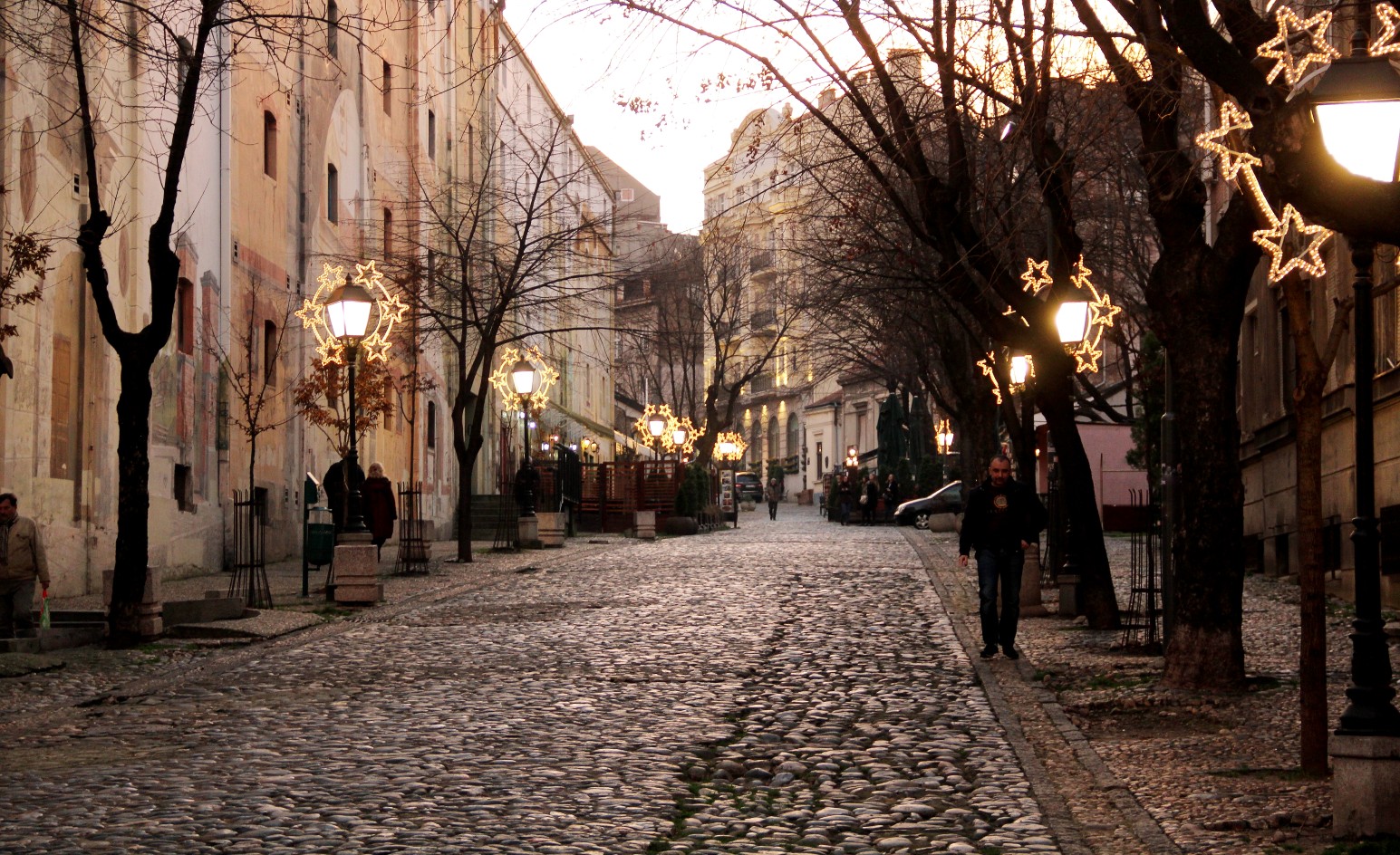
Nestled on the meeting point of the Danube and Sava rivers, Serbia’s capital Belgrade is packed with variety. With elements of Soviet, Ottoman, and Habsburg at every corner, the city offers mixed history and style, from the brutalist architecture to stylish boutiques and cobblestone streets.
As the capital city with 2 million people, it’s also where teachers will find career opportunities. Although English speakers are common in the capital, eager students seek additional English education to improve their language skills within academia and professional environments.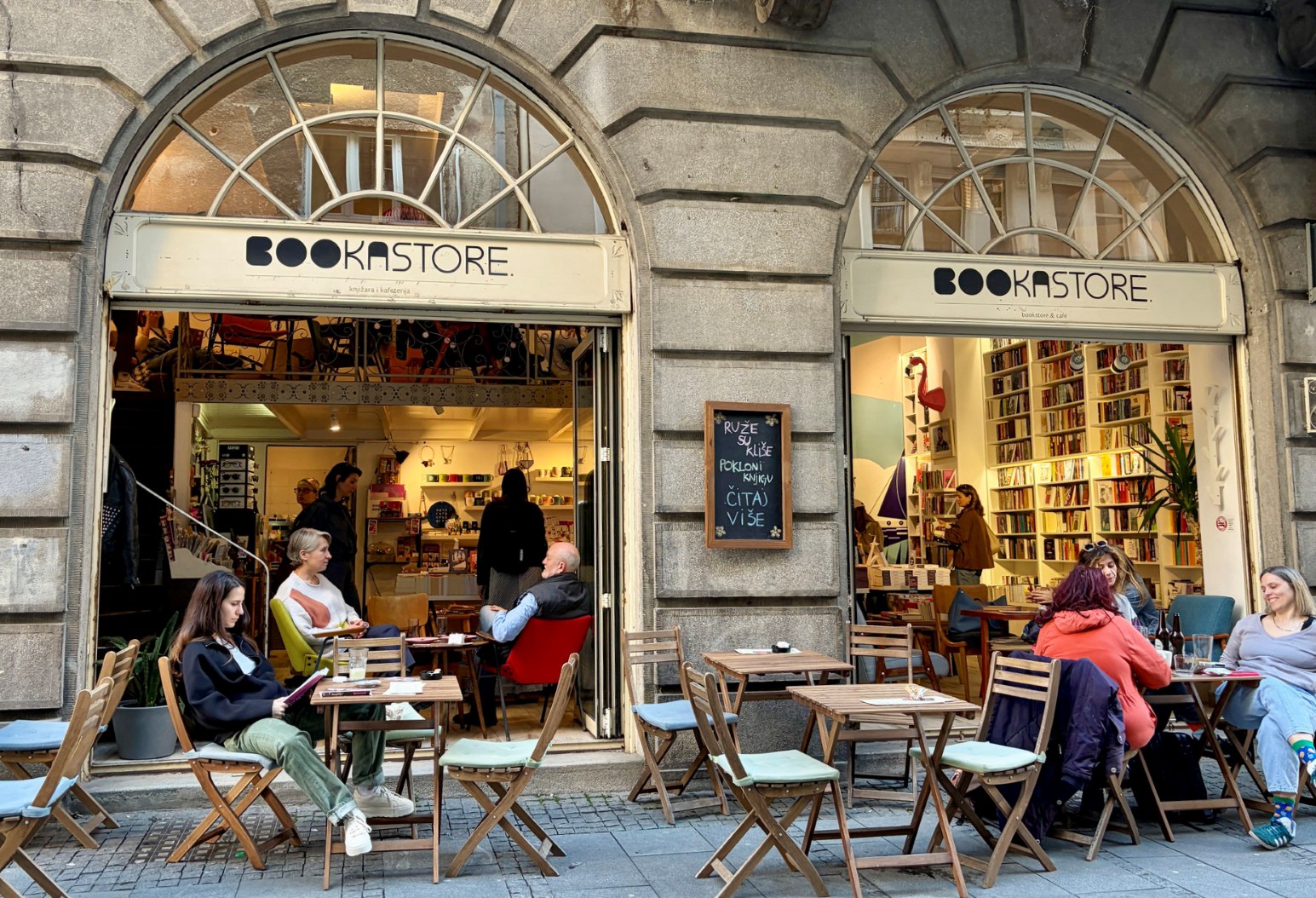
When you’re not teaching, stroll along the River Danube – or gaze at it from the historic Belgrade Fortress. Planning a European trip? You’re only a short journey away from Hungary, Romania, Bosnia, and Montenegro.
Teach English in Novi Sad
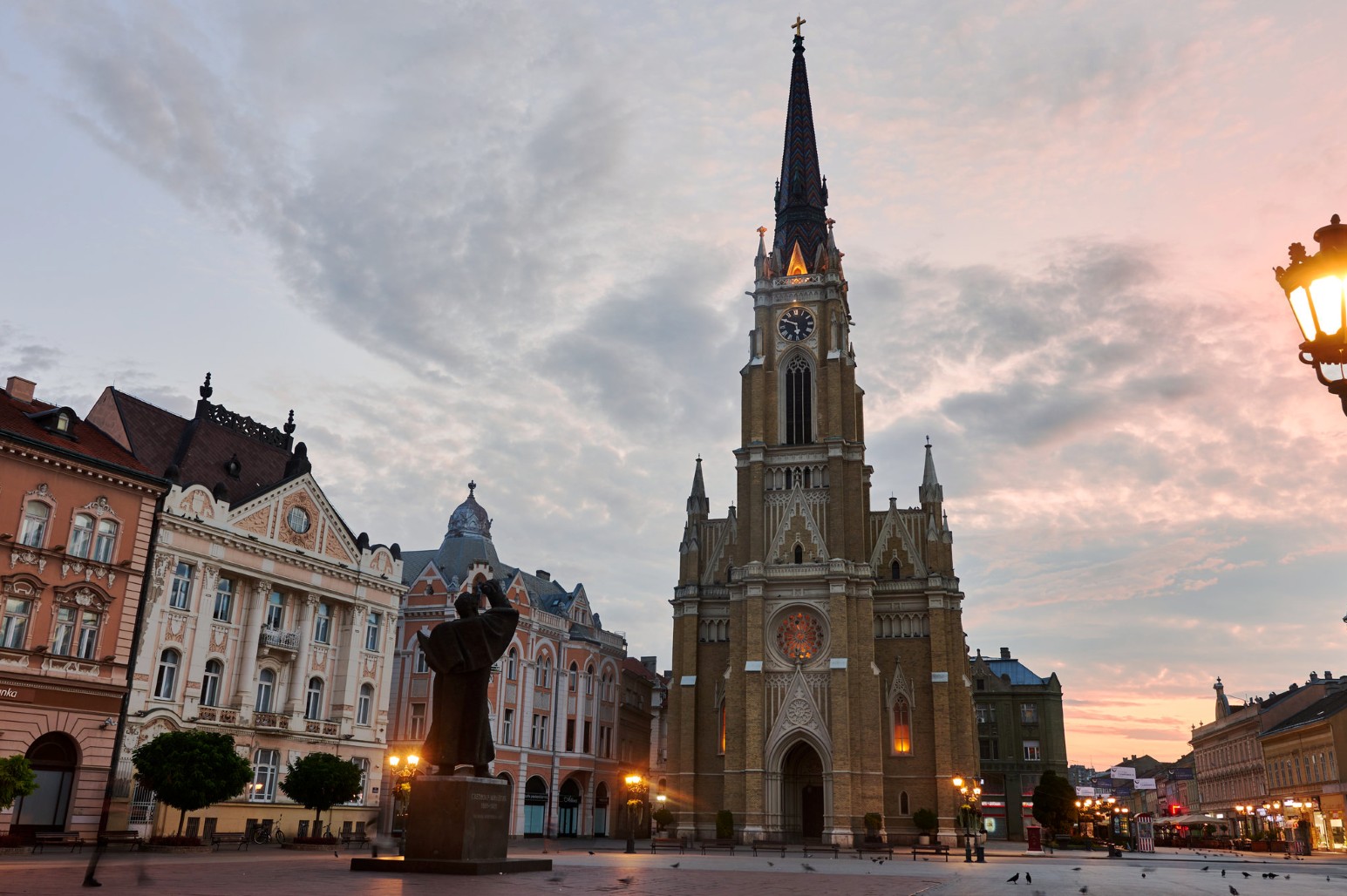
Further up the Danube river lies Novi Sad, the European Capital of Culture in 2021 and Serbia’s second-largest city. Novi Sad is the smaller, relaxed counterpart to Belgrade’s busy capital vibe.
Although the city is more affordable than Belgrade, a lower population means that the teaching market is smaller in Novi Sad. But teachers can still set up base and thrive in this laid-back city.Outside the classroom, soak up history at the Petrovaradin Fortress, the City Museum, or the Museum of Vojvodina. If you’re looking to unwind or let loose, pick your choice between the strolling through the Old Town or relaxing at Danube riverside bars, restaurants, or cafes.
Ready to Teach Abroad? Get TEFL Certified Today
Before you book your flight, you’ll need to have the relevant qualifications to teach English abroad. With a TEFL certificate, you’re not only gaining access to job opportunities across the globe, but you’re building the essential skills to lead a classroom. As a TEFL certified teacher, you’ll enter the classroom with the confidence that will benefit not only your students but also your experience teaching abroad.
Get certified today with our 120-hour TEFL course.
Frequently Asked Questions
Q. Do you need a degree to teach English in Serbia?
Yes, you generally need a bachelor’s degree in any subject to teach English teacher in Serbia. Teachers can find teaching jobs at private language institutions, which generally require a bachelor's degree and a TEFL certificate. Teaching experience is preferred, but not essential.
Q. How can I teach English as a foreign language in Serbia?
To teach English as a foreign language in Serbia, you’ll need a TEFL certificate and a bachelor’s degree. You’ll need to find a job before entering the country so you enter on the Single Permit which is essential for working legally.
Q. Can I teach as a non-native speaker in Serbia?
Yes, you can teach English abroad as a non-native speaker in Serbia. You’ll need a TEFL certificate, bachelor's degree, and proof of your English proficiency through an IELTS or CEFR certificate, for example.
Q. Can I teach English in Europe as an American?
Yes, you can teach English in Europe as an American. It’s usually much easier for EU citizens to teach English in Europe, and Americans need to get a visa and work permit to teach English legally. Some American teachers join teaching programmes and work part-time on student visas.