









Located between Sicily and North Africa, Malta blends European and Arabic influences to form a Mediterranean jewel. With historic cities, medieval fortresses, and crystal-clear coastlines, Malta draws travellers, retirees, and teachers alike for its serene surroundings.
English is one of Malta's official languages alongside Maltese, and its reputation for high-quality education means that teachers need to compete in a busy market. Read on for The TEFL Org guide to teaching English in Malta, from the teaching jobs, salary expectations, visa process, and more.
Key Takeaways
- Maltese and English are both official languages, so the demand isn't too high for English teachers, but jobs do exist for TEFL teachers.
- English teachers generally need a TEFL certificate and a bachelor's degree to qualify for the ELT permit to teach in Malta.
- Most teaching jobs in Malta come in the private sector at language schools or international schools.
- The average salary for a TEFL teacher in Malta ranges from between €800–€1,200 ($920–$1,385 / £690–£1,035) per month.
- EU teachers don't need a visa to teach in Malta, but non-EU teachers need a single permit and ETC employment license.
Requirements for Teaching English in Malta
The national curriculum in Malta teaches English at all levels of education, which means that aspiring teachers need to plan carefully and come prepared to find the right teaching job on this island.
Here's everything you need to know about the requirements for teaching in Malta.
Do I need a TEFL certificate to teach English in Malta?
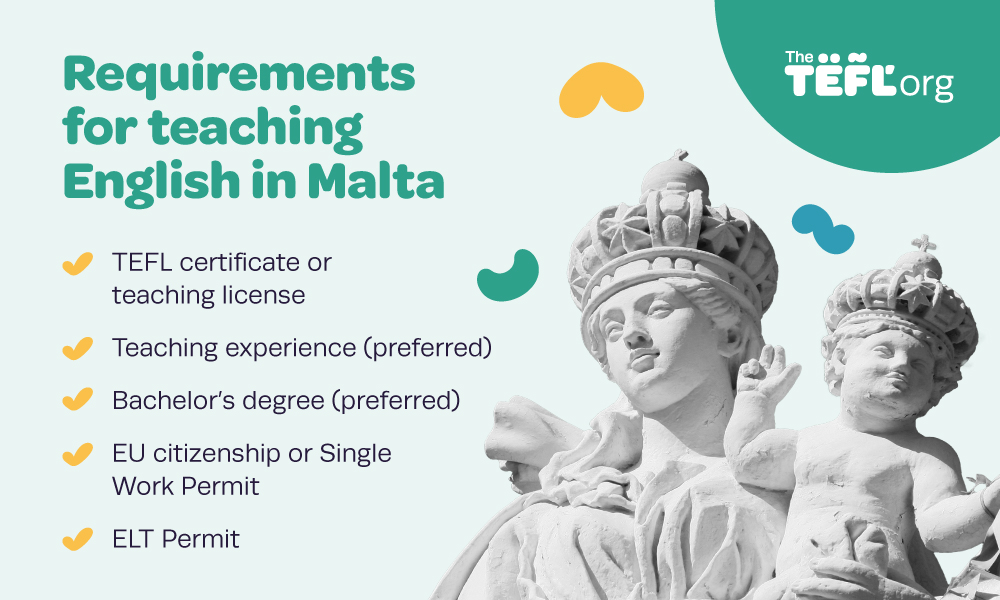
Yes, you need a TEFL certificate to teach English in Malta. While a 120-hour TEFL course is usually enough for teaching jobs in other countries, you'll need at least a Level 5 TEFL course to teach English in Malta.
The Level 5 TEFL course meets the Malta Qualifications Framework (MQF) criteria for teaching jobs, and then you need to apply for an ELT (English Language Teaching) Permit from the Maltese ELT Council. This permit is essential to teaching in Malta, whether you work at a public school, private language school, or as a private tutor.
Will I need a degree to teach English in Malta?
Yes, you need a degree to teach English in Malta, and a degree earned outside Malta may need to be recognised by the Malta Qualifications Recognition Information Centre (MQRIC).
There may be opportunities to teach English abroad without a degree in Malta if you're an EU citizen with teaching experience and TEFL qualifications, but non-EU teachers will struggle to find work without a degree. But don't worry, you can still teach English abroad without a degree in other European countries (and beyond).
Can I teach English in Malta without experience?
Yes, you can teach English abroad without experience in Malta, especially with a degree and a TEFL certificate. With a TEFL and a degree, you can then get the ELT Permit to teach English in Malta. EU teachers will find the process easier teaching in Malta without experience, because they don't need a sponsored work permit.
Visa requirements for teaching English in Malta
Malta is a member of the European Union, so EU teachers don't need a visa to teach here legally. EU law also means that employers need to justify hiring non-EU teacher, so you'll need to show a special set of skills to find a job if you're not from an EU country.
Non-EU teachers need a Single Work Permit – which combines your work and residence permit – and an ETC employment license. To get the visa and work permit, you'll also need to complete a Pre-Departure Integration Course on job-related skills, cultural awareness, and English proficiency.
Or you can apply for an EU Blue Card, but the work permit is generally the most common route for English teachers in Malta. Your Maltese employer will sponsor your single permit application and ETC employment license application, and you'll also need to submit:
- A completed application form
- Proof of job contract with Maltese employer
- A clear criminal background check
- A letter from your employer justifying the need for your role
- Proof of academic and professional qualifications, and potentially MQRIC evaluation of these documents
Download our Teaching English in Europe Guide
Everything you need to know about teaching English abroad in Europe

Salary and Cost of Living
Whether you're after saving potential or affordability and a comfortable lifestyle, here's everything you need to know about the cost of living and teacher salaries in Malta.
How much can you earn teaching English in Malta?
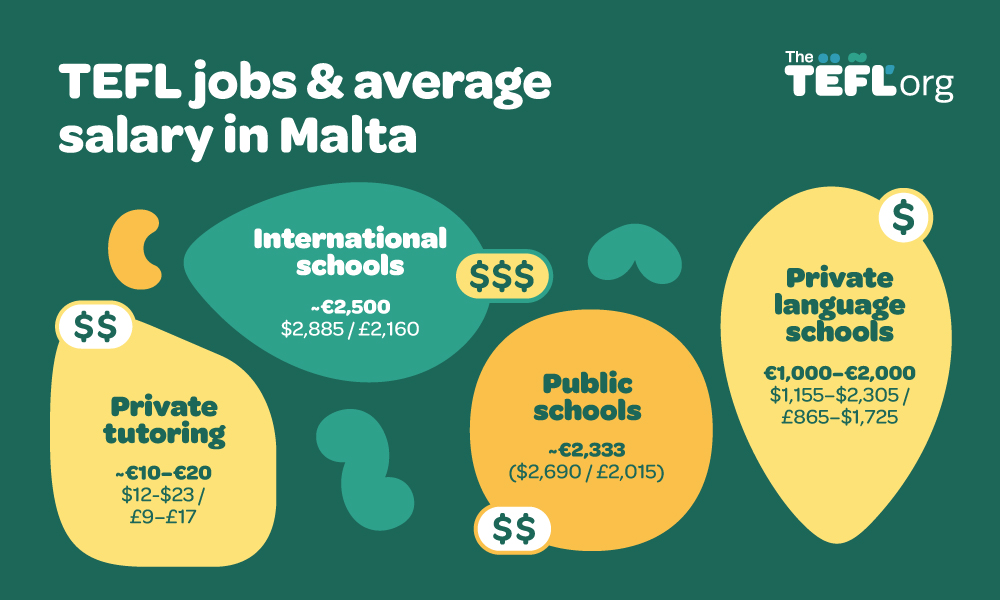
The average salary for a TEFL teacher in Malta is lower than the national average, ranging from €800–€1,200 ($920–$1,385 / £690–£1,035) per month. But teaching salaries depend on factors like your experience, qualifications, and job type.
Here's a closer look at how salary varies between different jobs:
- Public school: Public school salaries start at around ~€2,333 ($2,690 / £2,015) per month, but these jobs are reserved for highly qualified teachers, and Maltese fluency is often preferred.
- Private language schools: Salaries at private language schools usually range from €1,000–€2,000 ($1,155–$2,305 / £865–£1,725) depending on experience. Some teachers might be guaranteed a monthly salary, but others might be paid by the hour. Teaching specialist subjects (like business English) can pay more due to a higher demand from corporate clients.
- International schools: International school teachers often earn the highest salaries at around ~€2,500 ($2,885 / £2,160) per month or more at elite institutions.
- Private tutoring: If your contract or visa status allows, you could do private tutoring outside your typical working hours. Private lesson fees range between ~€10–€20 ($12–$23 / £9–£17) per hour depending on experience and qualifications.
Tip: If you're working at language schools or private tutoring, teaching Business English can pay more due to a demand from corporate workers.
How much does it cost to live in Malta?
A single person spends around ~€1,865 ($2,150 / £1,600) per month living in Malta, which goes beyond the salary for lower level roles if you're not careful with your money.It shouldn't be a surprise that a Mediterranean island popular among travellers, expats, and retirees has a relatively high cost of living. But there are plenty of ways to live comfortably and stretch your teaching salary in Malta:
- Split rent: Sharing accommodation with other locals, expats, or teachers can slash your rent significantly. A 1-bed city-centre costs €1,000 ($1,500 / £1,120) per month, whereas a 3-bed costs around €585 ($675 / £505) per person per month.
- Be mindful of location: Jobs in certain locations may pay more, but it might be offset by the cost of living. Expat or travel hubs like Valletta, Sliema, or St. Julian's are expensive, whereas areas like Gozo, Msida, or Gżira are cheaper.
- Buy local meals: Buying local meals instead of imported food will save you money, especially on an island nation. Pastizz pastries from local bakeries can cost as little as €0.60 ($0.70 / £0.50), or grab a ħobż biż-żejt (bread with tomato, capers, and olive oil) for €3 ($3.50 / £2.60).
- Choose daily set menus: When eating food out, choose lunch over dinner and keep an eye out for "Menu of the Day" which includes 2–3 courses, a drink and a coffee for around €12–€20 ($13.80–$23 / £10–£17).
- Use public transport: Use public transport like Malta Public Transport (MPT) or get a Tallinja App to use transport at a discounted rate.
| Restaurants | EUR | USD | GBP |
|---|---|---|---|
| Inexpensive restaurant meal | |||
| Domestic beer (0.5 litre) | |||
| Regular cappuccino | |||
| Water (0.33 litre) | |||
| Markets | EUR | USD | GBP |
| Regular milk (1 litre) | |||
| Loaf of white bread | |||
| Regular eggs (1 dozen) | |||
| Apples (1 kg) | |||
| Transportation | EUR | USD | GBP |
| One-way ticket (local transport) | |||
| Monthly pass (regular price) | |||
| Taxi start (normal tariff) | |||
| Gasoline (1 litre) | |||
| Utilities | EUR | USD | GBP |
| Electricity, heating, cooling, water, and garbage (for a regular apartment) | |||
| Regular prepaid monthly mobile tariff with 10GB+ data | |||
| Internet (60 Mbps, unlimited data, cable/ADSL) | |||
| Clothing and shoes | EUR | USD | GBP |
| Pair of jeans (Levis 501 or something similar) | |||
| Summer dress in a chain store | |||
| Nike running shoes (mid-range) | |||
| Men's leather business shoes |
English Teaching Jobs in Malta
Most teaching jobs for foreign English teachers in Malta are in the private sector, and cities near Valletta (the capital) like St. Julian's and Sliema are where most jobs are. You can apply for schools directly or browse job forums like The TEFL Org Jobs Centre, or if you're an EU citizen you could apply for jobs boots on the ground.
You'll find options in private language schools, universities and international schools, and private tutoring. Around 25% of the population are migrants, some who don't speak English at all so they might study at private language schools or find a private tutor to improve job prospects.
Public schools
Public school education uses Maltese as their primary language, teaching positions usually require at least a master's degree, teaching experience, and fluency in Maltese is often preferred. However, in expat-heavy regions like Sliema, San Gwann, Pembroke, and so on, the primary language might be English. The academic year runs from September to June, so it's best to apply towards the school year's end in anticipation of the next term.
What to expect at public schools in Malta:
- Larger classrooms
- Teaching multiple subjects; requires fluency in Maltese in most cases
- High entry requirements, including degree in education and teaching licence
Private language schools
Migrants and also Maltese people are looking to improve career prospects, so many TEFL jobs come in the form of private language schools. Student ages can range from young learners to adults, with subjects covering general English, academic English, or business English depending on the unique course.
While private language schools don't tend to pay as much as state or international schools, these roles are more accessible to inexperienced TEFL teachers.
What to expect at private language schools in Malta:
- Teaching in the evening and on weekends
- Teaching a range of subjects, from exam preparation to business English
- Lower salary than public or international schools, but lower entry requirements and year-round hiring
International schools
With English as a main language, international schools are less common in Malta, but they exist in cities popular with expats such as Valletta, Pembroke, Sliema, Gzira, or St Julians.
At an international school, you'll teach international students from expatriate families following an international curriculum, unlike public schools which follow the National Curriculum Framework (NCF).What to expect at international schools in Malta:
- Teaching international students
- Smaller class sizes with excellent facilities
- Delivering lessons from an international curriculum
- Excellent salary and benefits
- High requirements and expectations
Summer camps
As a Mediterranean island, Malta is an excellent spot for summer camps. At a summer camp in Malta, you can teach English to students in a more active and adventurous classroom. Parents send their children to summer language camps to practice conversational English and also to engage in team-building exercises, hiking and other outdoor activities.What to expect at summer camps in Malta:
- Informal and active-based learning
- Leading large groups of students
- Volunteer based or a small monthly salary with free accommodation provided
Teaching English in Major Cities
Here are some of the best places for teaching English in Malta.
Teach English in Valletta
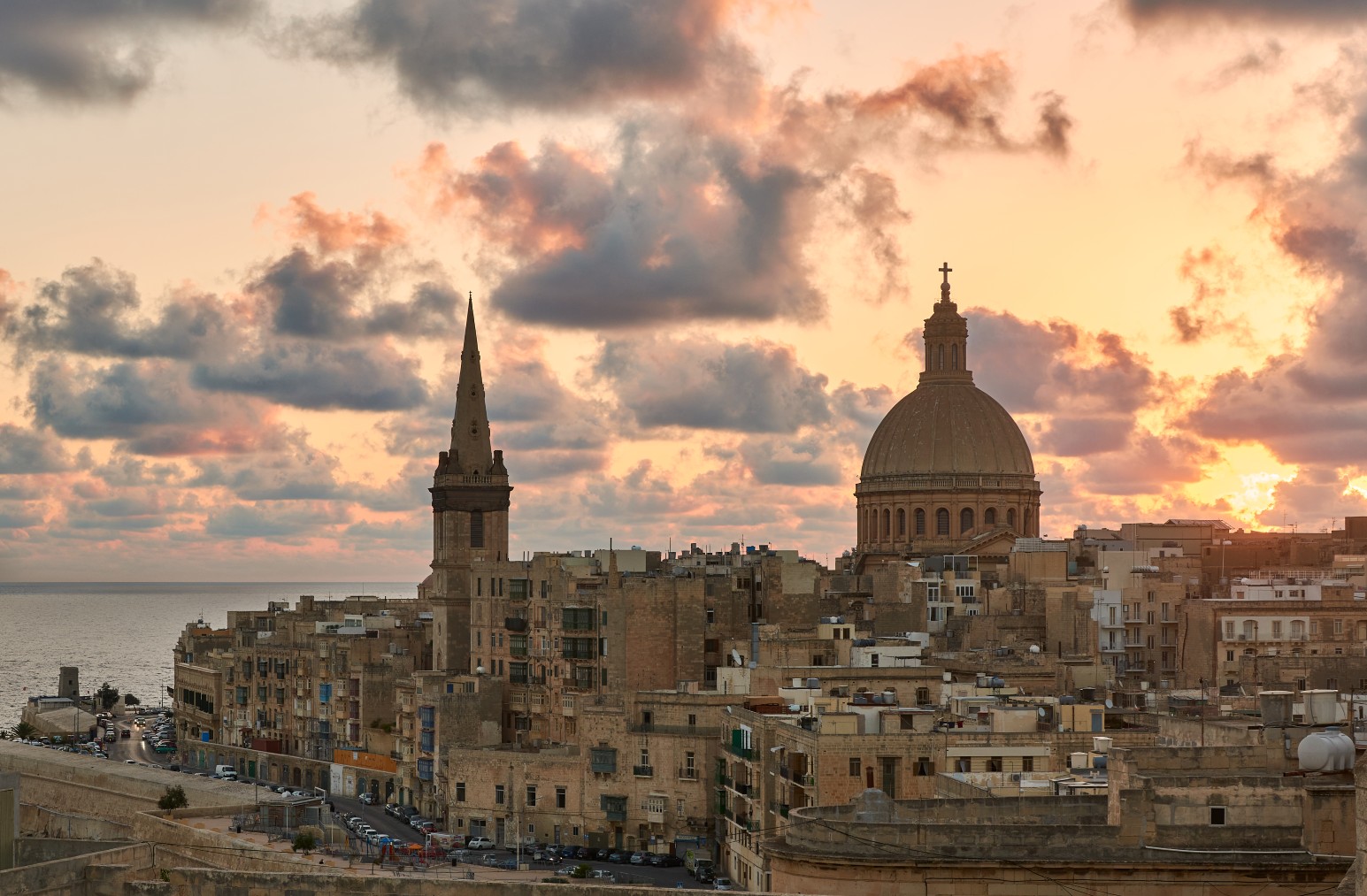
Malta's capital is a UNESCO world heritage site, and it's also Europe's smallest capital city. As the smallest capital, Valletta is surrounded by other areas like The Three Cities (Vittoriosa, Senglea, and Cospicua), Gzira, Sliema, and St. Julian's, which host plenty of job opportunities for expats and teachers.

So while you may not live or teach directly in the centre of Valletta, there's plenty going on in and around this city of narrow streets, harbours, and 16th century architecture. When you're not teaching, head to the National Museum or Archaeology, gaze at Baroque chapels or the City Gate, or bask in one of Malta's finest beaches.
TEFL Org Teacher Story
What's it like teaching English in Malta? Here's what Rachael had to say about teaching at a summer camp in Malta.
Rachael in Malta
"My first day as a teacher was both exhilarating and nerve-wracking. Stepping into a classroom filled with eager students from different corners of the world, I realised the huge responsibility I had undertaken. However, over time, I found my footing, and the experience has been so rewarding and well worth the extra weeks of study.
During my first two months, I worked at Embassy Summer, a summer camp organised by EC Malta where teenagers come from around the world to improve their English language skills. I worked from 9 a.m. to 4 p.m., Monday through Friday, which gave me plenty of free time to explore the picturesque, Mediterranean island.
Life was good and I was getting more and more confident in my teaching skills every day. I made friends with some amazing teachers who provided me with a wealth of knowledge and made the experience even better.
From exploring the traditional town of Mdina (shout out to all my Game of Thrones fans) to snorkelling in the crystal-clear waters of Markasala, sunrise yoga in Sliema to admiring Caravaggio paintings in Valetta, life in Malta has been truly unforgettable."
Ready to Teach English in Malta? Get TEFL Certified Today.
While a TEFL certificate will help you qualify for teaching opportunities across the globe, it allows you to become a professional in the classroom. With a TEFL course, you'll develop essential skills from planning and delivering lessons to classroom management and more.
Not only will you enjoy your teaching journey more, you'll feel confident in what you do and your students will benefit from your expertise. Why not get started today with our 120 hour TEFL certificate to launch your career teaching abroad?
Frequently Asked Questions
Q. Can I teach English in Malta as a non-native speaker?
You can teach English as a non-native speaker in Malta, provided you can ascertain fluency. Completion of an IELTS or TOEFL certificate, or a bachelor's degree from an English language institution is demonstrable evidence.
Q. Are English teachers in demand in Malta?
Yes, English teachers are in demand in Malta, where English is widely spoken. The state education system teaches English from an early age, and it's a compulsory subject. The tourism industry in Malta, especially in the busy summer months, is also considerable and creates a need for English proficiency.
Q. How much do English teachers make in Malta?
The average salary for a TEFL teacher in Malta ranges from between €800–€1,200 ($920–$1,385 / £690–£1,035) per month depending on your experience and job type.
Q. How can I become a teacher in Malta?
The best route to becoming a teacher in Malta is through TEFL certification. Many jobs will also require a bachelor's degree, but previous teaching experience isn't always required. If you're a new teacher, summer camps are a great option.
Q. Is €1000 enough to live in Malta?
€1000 per month is on the low end of the scale when it comes to budgeting in Malta. However, if you share accommodation with others, live outside city centres, eat local food and cook at home, it's possible.
Q. Can I live in Malta if I only speak English?
Yes, you can live in Malta if you only speak English. Malta is a bilingual country, and while most schools prefer candidates who are Maltese citizens fluent in the local language, you can find job prospects at private schools.