









From marine life and long beaches to colonial buildings and rugged mountains, the Dominican Republic combines European and Caribbean flair within a single island. And beyond its travel appeal, it’s a great spot for teachers looking to combine work with a gap-year style adventure.
Tourism is a huge part of the economy, creating a demand for English teachers, but salaries are modest, so it’s not the best choice if saving money is your end goal. Read on for The TEFL Org’s guide to teaching English in the Dominican Republic, from the top jobs, requirements, salaries, visa process, and more.
Key Takeaways
- The Dominican Republic’s official language is Spanish, and a growing tourist scene means there’s a relatively high demand for English teachers.
- You need a TEFL certification and a bachelor’s degree to find Dominican Republic teaching jobs.
- Foreign English teachers earn around RD$ 43,750–58,280 ($750–$1,000 / £555–£740) per month, but international school teaching jobs pay much more.
- Teaching jobs can be found at public schools, private language schools, international schools, and also volunteer programmes.
- Teachers need a work visa, known as the Temporary Worker Permit.
- Top locations include Santo Domingo and Santiago de los Caballeros.
Requirements for Teaching English in the Dominican Republic
With a huge tourist scene and a moderate English proficiency level, teaching jobs in the Dominican Republic aren’t as competitive as in other countries in Latin America. But there are still plenty of teachers who’d love to teach in such an idyllic country, so you can’t show up unqualified and expect a job.
Here’s everything you need to know about the requirements for teaching English in the Dominican Republic.
Do I need a TEFL certificate to teach English in the Dominican Republic?
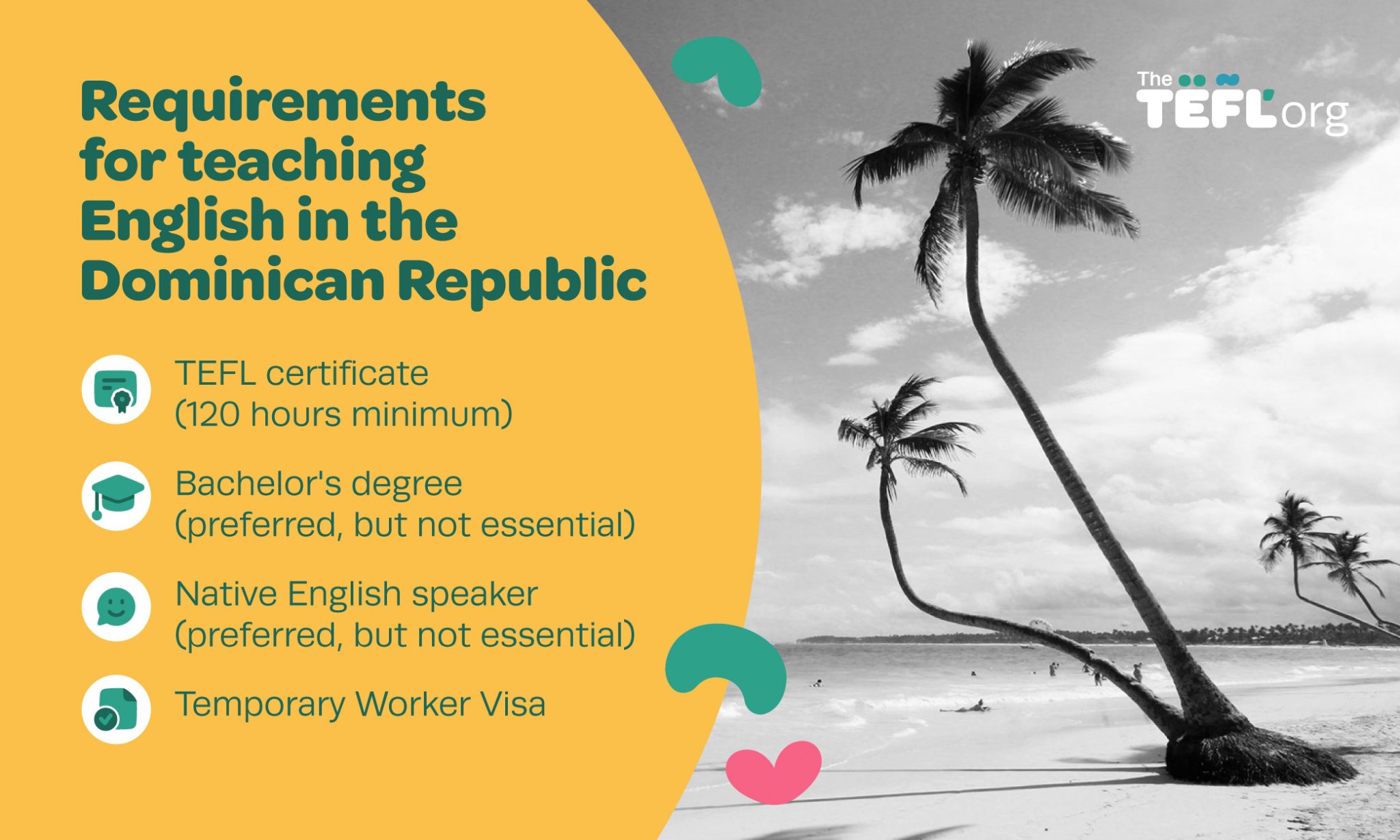
It’s not a legal requirement, but you’ll struggle to find teaching jobs in the Dominican Republic without a TEFL certificate. Unless you want to volunteer for free, you’ll need a minimum of a 120-hour TEFL certificate for most teaching jobs.
Employers look for TEFL certified teachers because it shows that they’ve studied the essentials of teaching English as a foreign language. And by becoming certified with the feedback of expert tutors, it shows that you’re classroom-ready.
Can I teach in the Dominican Republic without a degree?
In most cases, you’ll need a degree (in any subject) to teach English in the Dominican Republic. It’s not a strict legal requirement, but it’s a requirement for most employers. If you have a degree in English or education, you’ll be highly valued by employers and can earn a higher salary.
Don’t have a degree? Don’t panic — you can still teach English without a degree in Latin America, Europe, and Asia.
Do I need experience to teach in the Dominican Republic?
A lack of teaching experience won’t stop you from finding a job in the Dominican Republic, especially if you have a degree and a TEFL certificate.But if you’re looking to teach English without experience, your salary potential will be much lower — and you’ll need to spend more time sending off applications before you find the right job.
Can I teach in the Dominican Republic as a non-native speaker?
It’s possible to teach abroad as a non-native speaker in the Dominican Republic, but most employers look for native English speakers from the US, UK, Australia, New Zealand, Ireland, or South Africa.
But again, it’s still possible, especially at a private language school or on a volunteer programme.
Visa requirements for teaching English in the Dominican Republic
To teach English in the Dominican Republic legally, you’ll need the right paperwork and visa. In this case, you’ll need to apply for the Temporary Worker Visa (or Trabajador Temporario) and the Temporary Worker Permit. It’s valid for a year and can be renewed if you want to work for the same employer for longer.
But you can’t apply for the permit without having a job in the first place, and only then can you apply using the online visa portal. Here’s what you need to get the permit:
- Proof of a signed employment contract with a local employer
- Passport with at least 18 months’ validity
- Proof of academic and professional qualifications (TEFL certificate, bachelor’s degree)
- Medical certificate
Download our Teaching English in Latin America guide
Everything you need to know about teaching English in Latin America

Salary and Cost of Living
As one of the cheapest countries in the Caribbean and Latin America, it’s easy to get by on a budget in the Dominican Republic. But you also need to take into account how much you’ll earn on a teacher’s salary.How much can you earn teaching English in the Dominican Republic?
TEFL teachers earn around RD$ 43,750–58,280 ($750–$1,000 / £555–£740) per month teaching in the Dominican Republic. But asking how much teachers earn is like asking “how long is a piece of string?”
It depends on your experience, qualifications, job type, and potentially on your nationality and accent. The more experience and higher qualifications (bachelor’s degree, TEFL, teaching licence, etc.) you have, the higher the salary you’ll earn.
International school teachers — who usually have years of experience and a master’s degree or a teaching licence — earn much more than teachers working at public schools or private language schools.
Tip: To cover expenses, you can teach English online or do private tutoring during your free time.
How much does it cost to live in the Dominican Republic?
English teachers spend around RD$ 52,500–87,500 ($900–$1,500 / £665–£1,095) per month, but again it depends on things like your lifestyle and location. While the Dominican Republic is seen as a budget travel destination, it also has luxury travel spots, so be careful where you choose to teach.
It’s important to create a realistic budget where you can live comfortably and fall back on savings should any unexpected costs pop up.
Here’s how to enjoy a comfortable lifestyle on a teacher’s salary in the Dominican Republic:
- Skip the tourist spots: Tourist spots like Cap Cana, Casa de Campo, or Punta Cana can be expensive for people on a local teacher’s salary.
- Travel during the low season: An underrated benefit of teaching abroad is being able to travel during the low season. You don’t need to rush to tick off your “sights to see” list, and travelling during the low season can save you money on travel, accommodation, and other expenses.
- Split the rent: Many teachers decide to share accommodation with other teachers or expats to save money. For example, rent for a 1-bed apartment in the capital (Santo Domingo) averages around RD$ 30,000 ($515 / £380) per month, but a 3-bed apartment costs around RD$ 21,000 ($360 / £265) per person, per month — which leaves you around RD$ 9,000 ($155 / £115) extra per month.
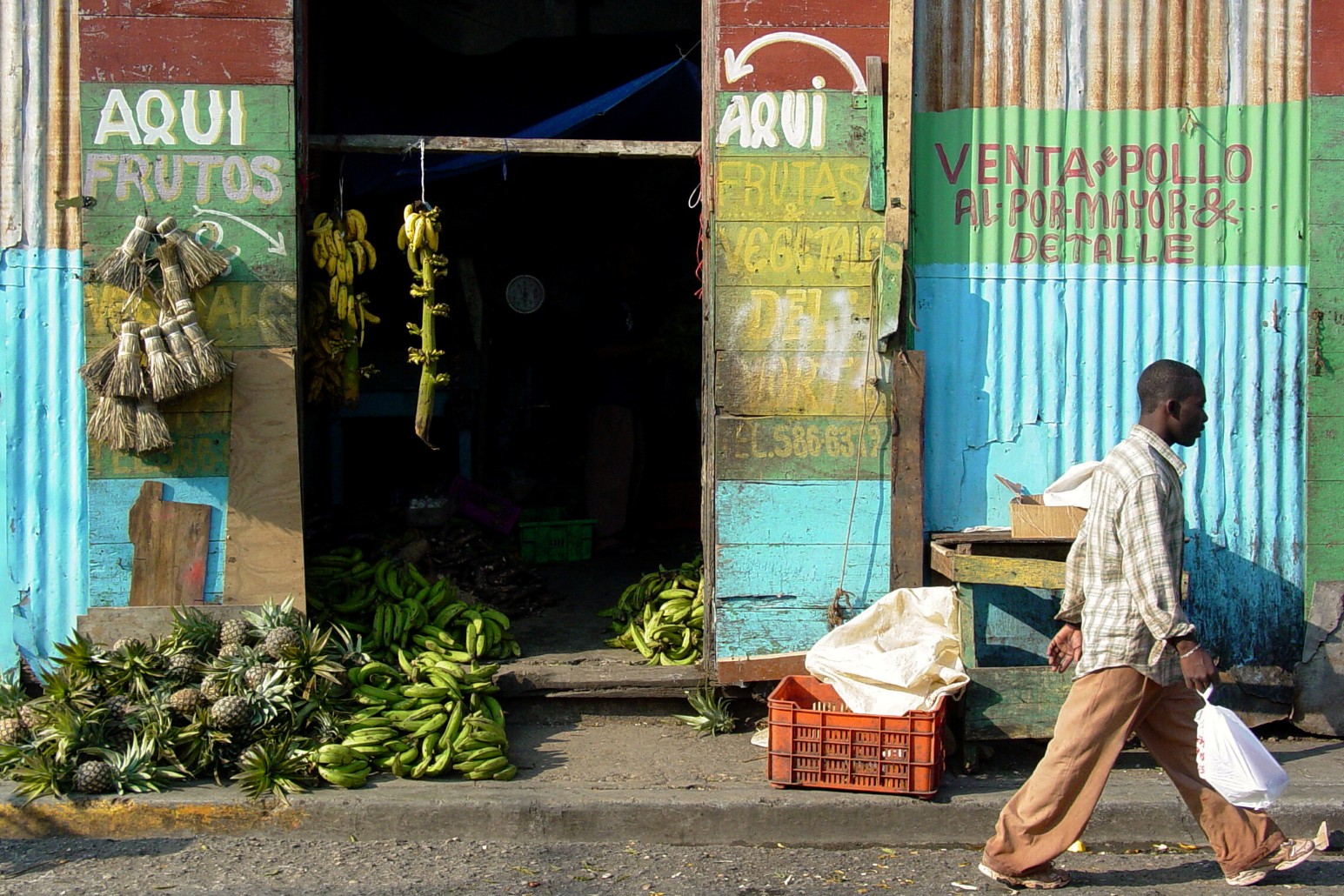
- Eat like a local: Choose local eateries and open-air markets instead of Western restaurants or big supermarkets that import most of their ingredients. On a Caribbean island, buying local produce will save you plenty of money in the long run.
| Restaurants | DOP | USD | GBP |
|---|---|---|---|
| Inexpensive restaurant meal | |||
| Domestic beer (0.5 litre) | |||
| Regular cappuccino | |||
| Water (0.33 litre) | |||
| Markets | DOP | USD | GBP |
| Regular milk (1 litre) | |||
| Loaf of white bread | |||
| Regular eggs (1 dozen) | |||
| Apples (1 kg) | |||
| Transportation | DOP | USD | GBP |
| One-way ticket (local transport) | |||
| Monthly pass (regular price) | |||
| Taxi start (normal tariff) | |||
| Gasoline (1 litre) | |||
| Utilities | DOP | USD | GBP |
| Electricity, heating, cooling, water, and garbage (for a regular apartment) | |||
| Regular prepaid monthly mobile tariff with 10GB+ data | |||
| Internet (60 Mbps, unlimited data, cable/ADSL) | |||
| Clothing and shoes | DOP | USD | GBP |
| Pair of jeans (Levis 501 or something similar) | |||
| Summer dress in a chain store | |||
| Nike running shoes (mid-range) | |||
| Men's leather business shoes |
English Teaching Jobs in the Dominican Republic
While many teaching positions are voluntary, you can still find paid English teaching jobs in the Dominican Republic. Many are at faith schools, where teachers are expected to support students’ religious and spiritual development as well as their education. But not all schools are religious, with private schools placing less emphasis on the spiritual side.
You can find some teaching jobs online (especially for international or private language schools), but many jobs are advertised locally. If you have savings, you could try to find work in-country.
The school year runs from August to June, so you’ll need to time your applications in the lead-up to August. But many private schools also hire year-round.
Public schools
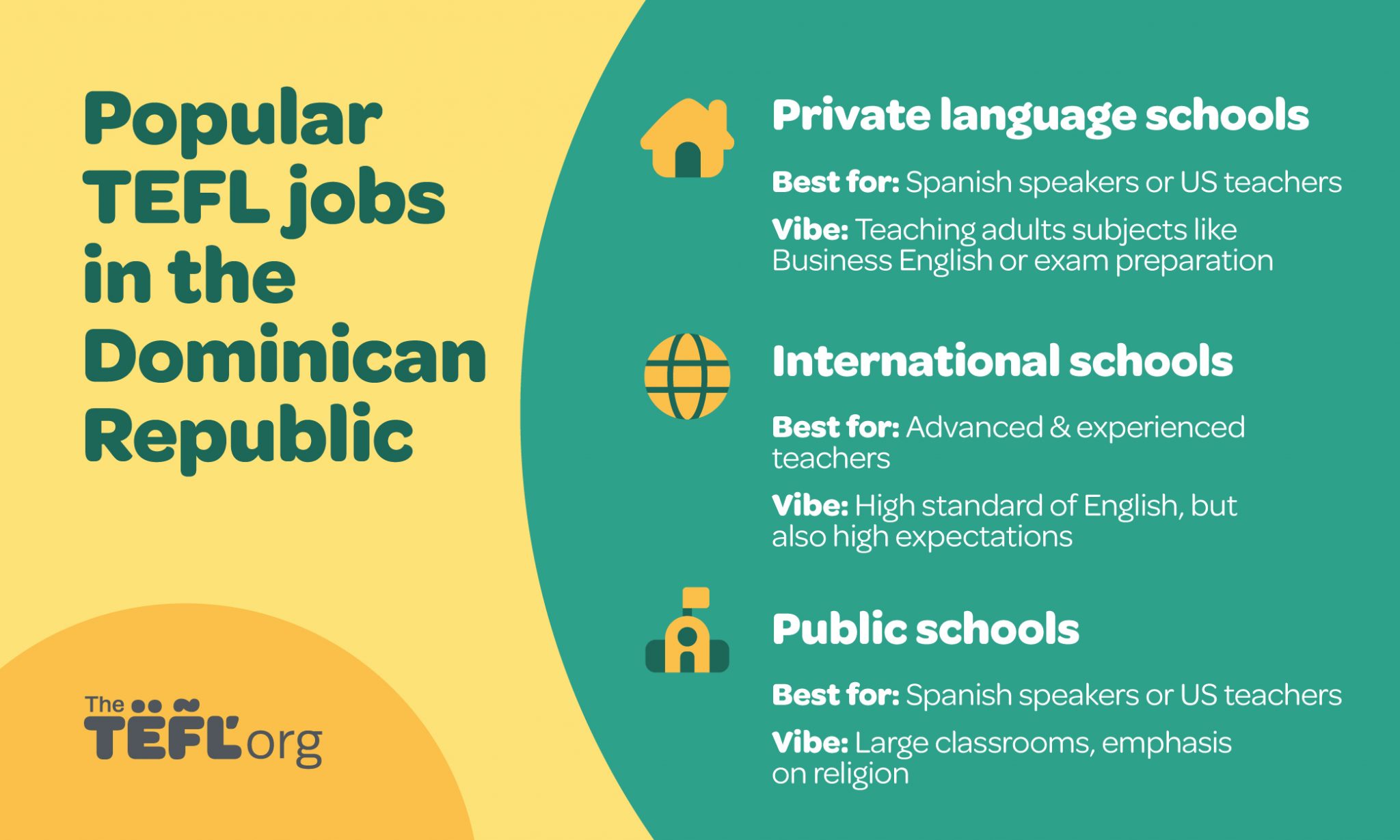
Public schools in the Dominican Republic have direct ties to the Roman Catholic Church, and while it’s not an essential requirement, some schools might want you to show some religious affiliation or commitment to Catholicism. The Ministry of Education has also teamed up with partners like the Peace Corps and the U.S. Embassy to increase language and cultural exchange.
You’ll follow the national curriculum, where English is taught as a core foreign language. Most public school jobs go to locals, but you can boost your chances if you’re fluent in Spanish.
What to expect at public schools in the Dominican Republic:
- Larger classrooms and modest facilities
- Often based on Catholic teachings (but parents can opt students out of religious classes)
- Following the national curriculum with English as a foreign language
Private language schools
Private language schools cater to students who want to learn English on top of their current work or education. Usually, these students have a specific goal in mind, like passing a Cambridge or IELTS exam or learning English for corporate environments. Students might be young learners, teenagers, or adults depending on the course.
What to expect at private language schools:
- Evening and weekend classes
- Students ranging from children and teenagers to adults
- Teaching ESP (English for Specific Purposes) like Business English and Exam Preparation
International schools
International schools offer education in English as a primary language (entirely, or alongside another language in “bilingual schools”), and they’re desirable for international students.
With high tuition fees, salaries and benefits are excellent for teachers, but expectations for students to perform well are high. Many international schools offer a British, American, or International Baccalaureate curriculum, and sometimes employers prefer specific accents to match the curriculum.
What to expect at international schools:
- Teaching international students (mostly)
- Following an international curriculum (US, UK, or IB)
- Modern classroom facilities
- Small class sizes
- Excellent salary and benefits, but very high entry requirements and expectations
Volunteering
There are many volunteer programmes in the Dominican Republic that are great for younger travellers, non-degree holders, or any traveller who doesn’t want to commit to a semester of teaching (or longer). These programmes are usually aimed at underprivileged students, and while some sessions may take place in the classroom, they might focus more on informal lessons like arts and crafts, sports, and so on.
What to expect as a volunteer:
- Unpaid work, but you often receive accommodation
- Short-term positions from 2+ weeks
- Working in low-income communities
Teaching English in Major Cities
From urban centres to beach resorts, job opportunities exist all across the country, and while you might have your eyes set on an idyllic resort town, you’ll have more luck in bigger cities like Santo Domingo and Santiago.

Teach English in Santo Domingo
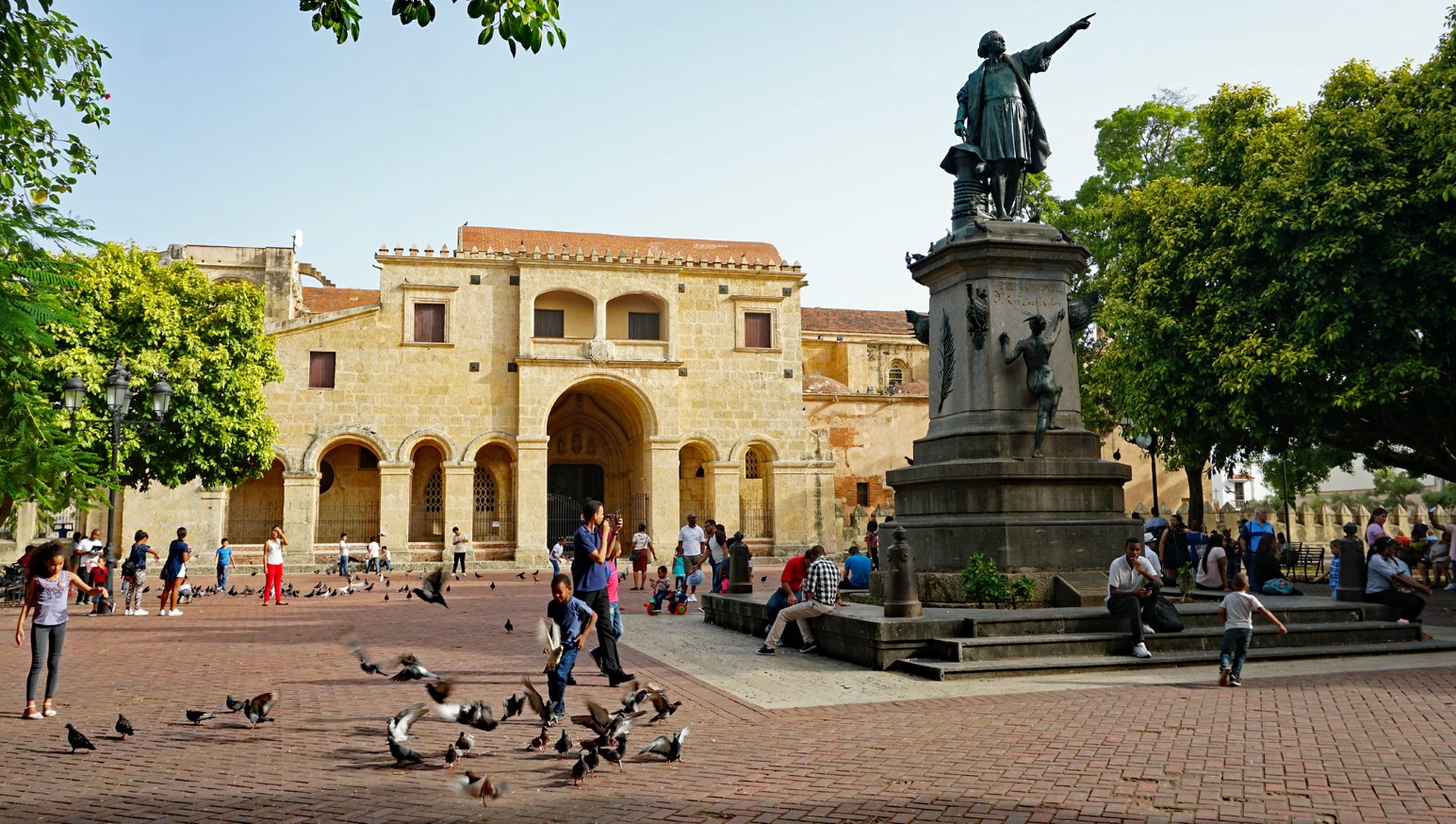
Santo Domingo, or La Capital, is the Dominican Republic’s largest city and its main political and economic hub, making it the best place to look for English teaching jobs. With the biggest choice of jobs in the country, you’ll find opportunities across private language schools, international schools, public schools and also through private tutoring.
There’s plenty to keep you busy outside the classroom in this safe and lively city. If you’re interested in history and culture, head to the old town — known as the Colonial Zone (or Zona Colonial) — for its UNESCO World Heritage sites and fortresses, have dinner in underground caves or head to the coast if you want a change of scenery. With a free afternoon, you can head to beaches like Boca Chica, or head to Juan Dolio if you don’t have weekend plans.
Teach English in Santiago de los Caballeros
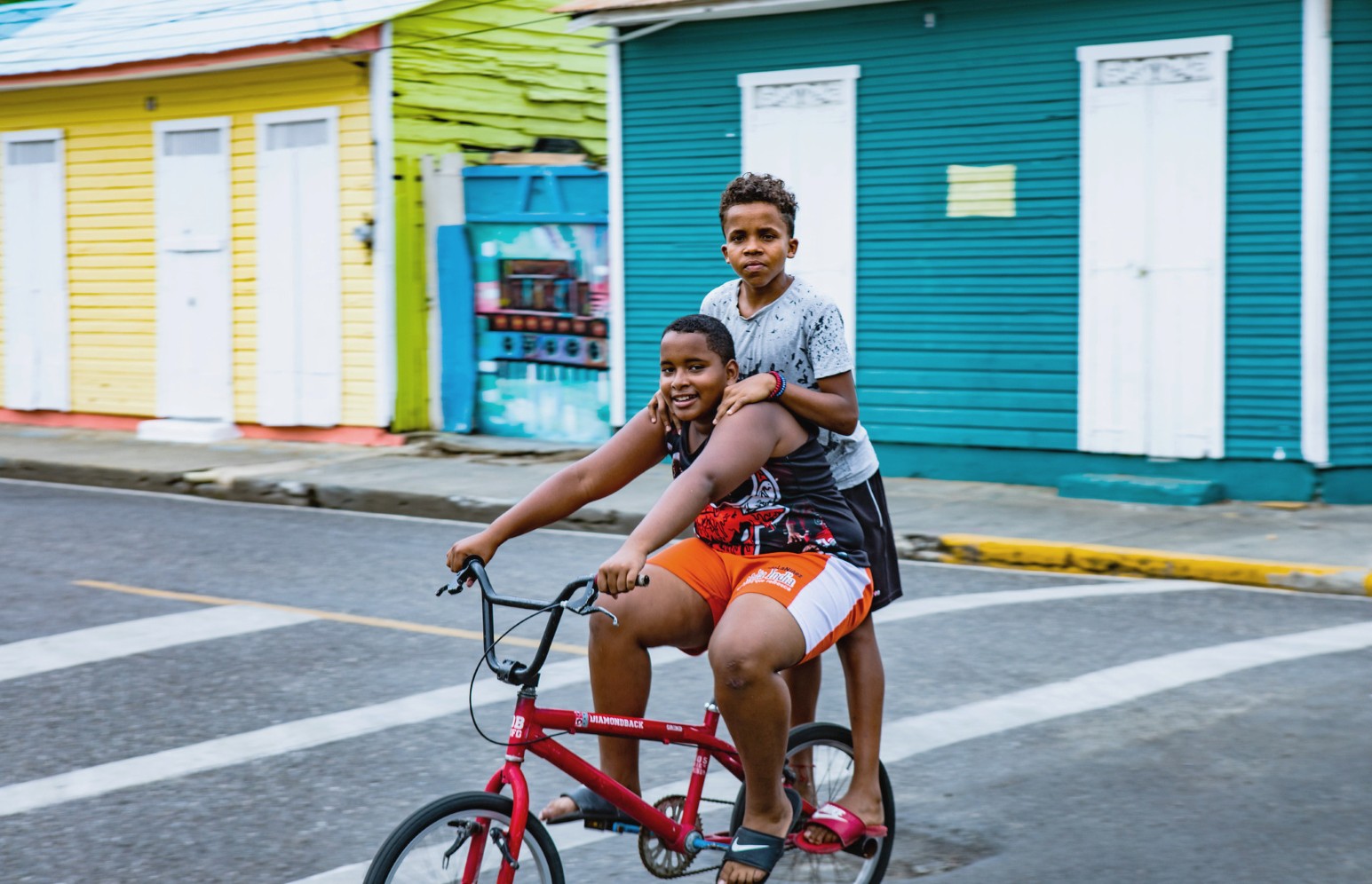
Santiago de los Caballeros is the Dominican Republic’s second-largest city and an important business centre, making it another great option for English teachers. Although less touristy than spots like Punta Cana and Santo Domingo, you’ll still find plenty of teaching opportunities in different schools.
When you leave the classroom, Santiago offers a more mountainous inland escape than the capital. Visit the Monument to the Heroes of the Restoration for panoramic views across the city, explore the historic centre or head into the surrounding hills for hiking. With Puerto Plata and other northern attractions and islands within reach, there’s plenty to explore when you have a weekend free.
Ready to Teach English Abroad? Don’t Forget Your TEFL Certificate
Teaching English abroad without a TEFL certificate is like trying to run before you can walk. Not only does the qualification help you qualify for international teaching jobs, but you’ll develop plenty of skills and confidence in your abilities through TEFL training. From differentiating abstract and concrete nouns to learning to manage large classrooms, you’ll learn the ins and outs of teaching English as a foreign language.
Get started today with our 120-hour TEFL course.
Frequently Asked Questions
Q. Are TEFL teachers in demand in the Dominican Republic?
Yes, English teachers are in demand, but salaries are low and it can be hard to find the right job. Teaching opportunities exist in public schools and private schools, and there are also volunteer opportunities for teachers who have less experience or don’t want to commit to longer contracts.
Q. How much does an English teacher make in the Dominican Republic?
Less experienced TEFL teachers in the Dominican Republic earn around RD$ 43,750–58,280 ($750–$1,000 / £555–£740) per month, but international school teachers can earn more.
Q. What do you need to teach English in the Dominican Republic?
To teach English in the Dominican Republic, you need a TEFL certificate and a bachelor’s degree in most cases. It’s possible to teach without experience, a degree, or as a non-native speaker, but it’ll be more difficult to find work. If you find a job, you’ll need the Temporary Worker Permit to work legally.
Q. Do I need to speak Spanish to teach in the Dominican Republic?
No, you don’t need to speak Spanish to teach in this Caribbean country, but it can help your application for ESL jobs in public schools and it can increase how much you engage with the local culture.