






From rolling dunes to skyscrapers and tax-free salaries, the United Arab Emirates is a top spot not just for travellers but also professionals. From a career or financial outlook, the UAE offers some of the best opportunities in the world.
Arabic is the official language, but the English language plays an enormous role in this business and international hub. With start-up businesses, expats, and booming industries in oil, tourism, construction, and real estate, English teachers are in high demand in the UAE.Read on for The TEFL Org’s guide to teaching English in the UAE, from the salary, requirements, visa process, and more.
Key Takeaways
- There’s a high demand for English teachers in the UAE, with many jobs in public and private schools, vocational colleges, international schools, and universities.
- Having a TEFL certificate and bachelor’s degree at minimum is a must; many jobs require a government teaching licence from your home country, and a master’s degree.
- Experienced and licensed teachers can find work at public schools or international schools, whereas private language schools are suitable for less experienced teachers.
- Teachers can expect to earn an untaxed salary of AED 7,800–25,000 ($2,100–$6,800 / £1,590–£5,100) per month in the UAE.
- Dubai and Abu Dhabi are among the top locations for TEFL teachers, but Sharjah, Ajman, Umm Al Quwain, Ras Al Khaimah and Fujairah offer teaching jobs too.
- You’ll need to secure a job to get a visa for teaching English in the United Arab Emirates.
Requirements for Teaching English in the UAE
The UAE is made up of seven Emirates, and while you’ll hear plenty of people speaking English in Dubai or Abu Dhabi, the English proficiency score is low to moderate. Generally, the requirements for teaching in the UAE are strict, but they can also vary from one Emirate to another.
But it’s still possible to become a successful English teacher in this Gulf state with the right skillset.
Do I need a degree to teach English in the UAE?
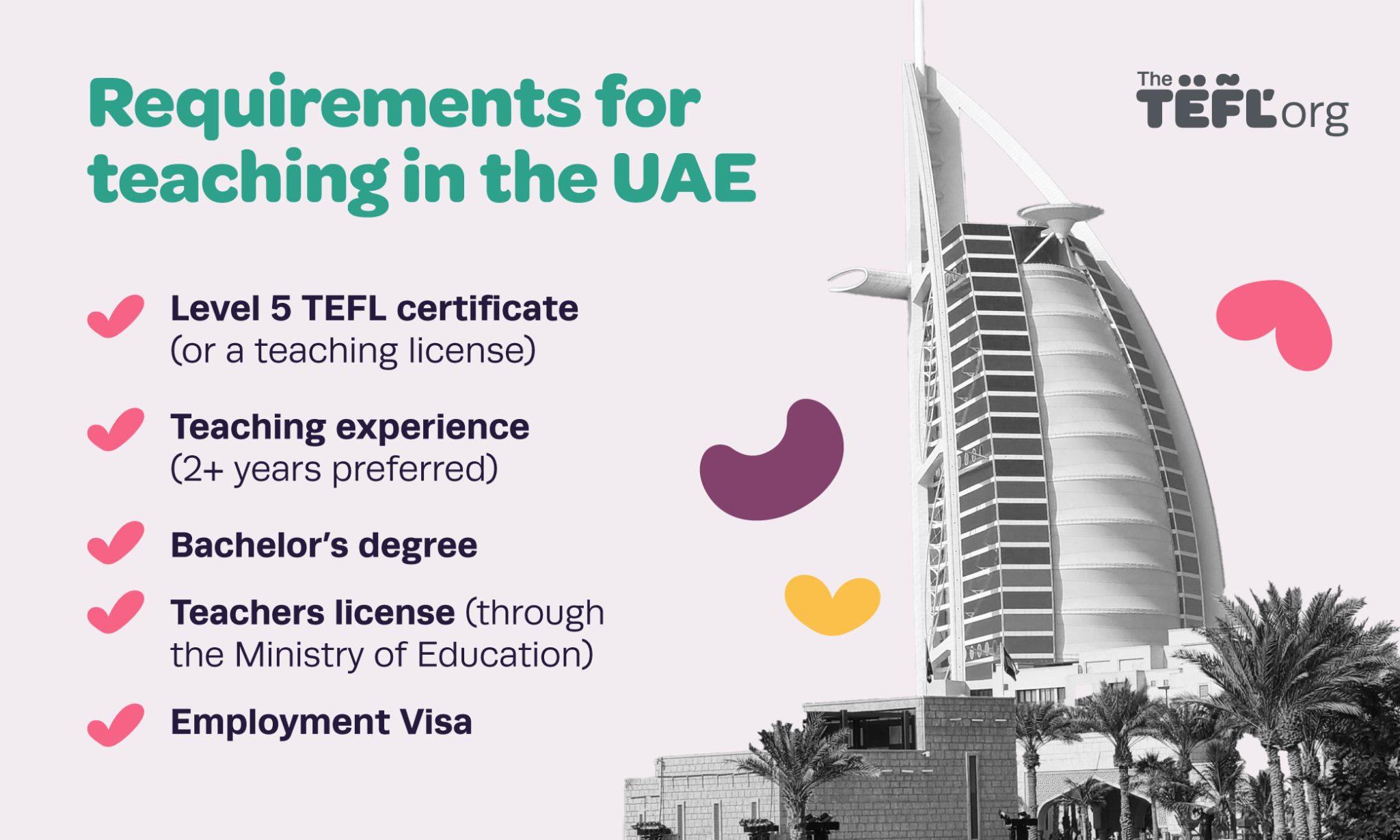
To work as a K12 teacher (kindergarten to 12th grade) or in any form of education, you need a bachelor’s degree to get the Teaching Licence through the UAE’s Ministry of Education.
Your degree can be in any subject, but employers at secondary schools and private international schools prefer teachers with a degree in English, education, or the specific subject you want to teach.
If you don’t have a degree, don’t worry! It’s still possible to teach English abroad without a degree in Europe, Asia, or Latin America.
Do I need a TEFL certificate to teach in the UAE?
Schools and employers in the UAE have very high standards, and a 120-hour TEFL certificate is not enough in most cases. While you might find a job at a private language school with 120 hours of TEFL training, many schools in Dubai or Abu Dhabi require a Level 5 TEFL course (at minimum) or a teaching licence.
Advanced TEFL courses like The TEFL Org’s teaching young learners or Business English course can help if you want to specialise in teaching specific age groups.
Can I teach in the UAE without experience?
It’s not impossible to teach English without experience in the UAE, but you might struggle to find a job teaching unless you’ve got advanced qualifications. While most jobs require at least 1–2 years of previous teaching experience, some teaching assistant jobs at nursery schools are open to inexperienced teachers.
Generally, if you don’t have classroom experience, you’ll need any of these instead:
- Degree in English, education, or early childhood studies
- CACHE qualification
- Teaching licence or a Level 5 TEFL course with classroom experience
Tip: Teachers who identify as LGBTQ+ should carefully research the cultural and legal landscape to ensure a smooth transition in the UAE.
Can I teach English as a non-native speaker in the UAE?
It’s possible to teach English as a non-native speaker in the UAE if you have a degree, experience, and proof of fluency through a language certificate (IELTS, CEFR, TOEFL) or a degree from an English-speaking country. But generally, many employers prefer native speakers.

Visa requirements for teaching in the UAE
Laws in the UAE are strict, so you’ll need to organise your work visa before arrival.
You’ll need a standard Employment Visa, which your school will sponsor after you’ve agreed to a job offer. Your employer will also process your work permit application, and you’ll apply for your Emirates ID once you arrive in the UAE.
The work visa is valid for up to 2 years and can be extended depending on whether your employer wants to continue working with you. It’s important to remember that your visa and work permit are tied to your specific employer, so you’ll need to re-apply if you find a new job in the UAE.
You’ll need to submit the following:
- University degree certificate
- Clean criminal background
- TEFL certificate or teaching licence
- Medical fitness report from the UAE
- Legalised degree and teaching certificates (notarised, legalised, and authenticated)
Download our guide to teaching English in the Middle East
Everything you need to know about teaching English in the Middle East

Salary and Cost of Living
With competitive tax-free salaries, housing allowances, comprehensive medical insurance, and more, teaching English in the UAE is a lucrative opportunity. But while teaching salaries are among the best in the UAE, you’ll need to understand the living costs to get a full picture of how much you’ll spend and save.
How much can you earn teaching English in the UAE?
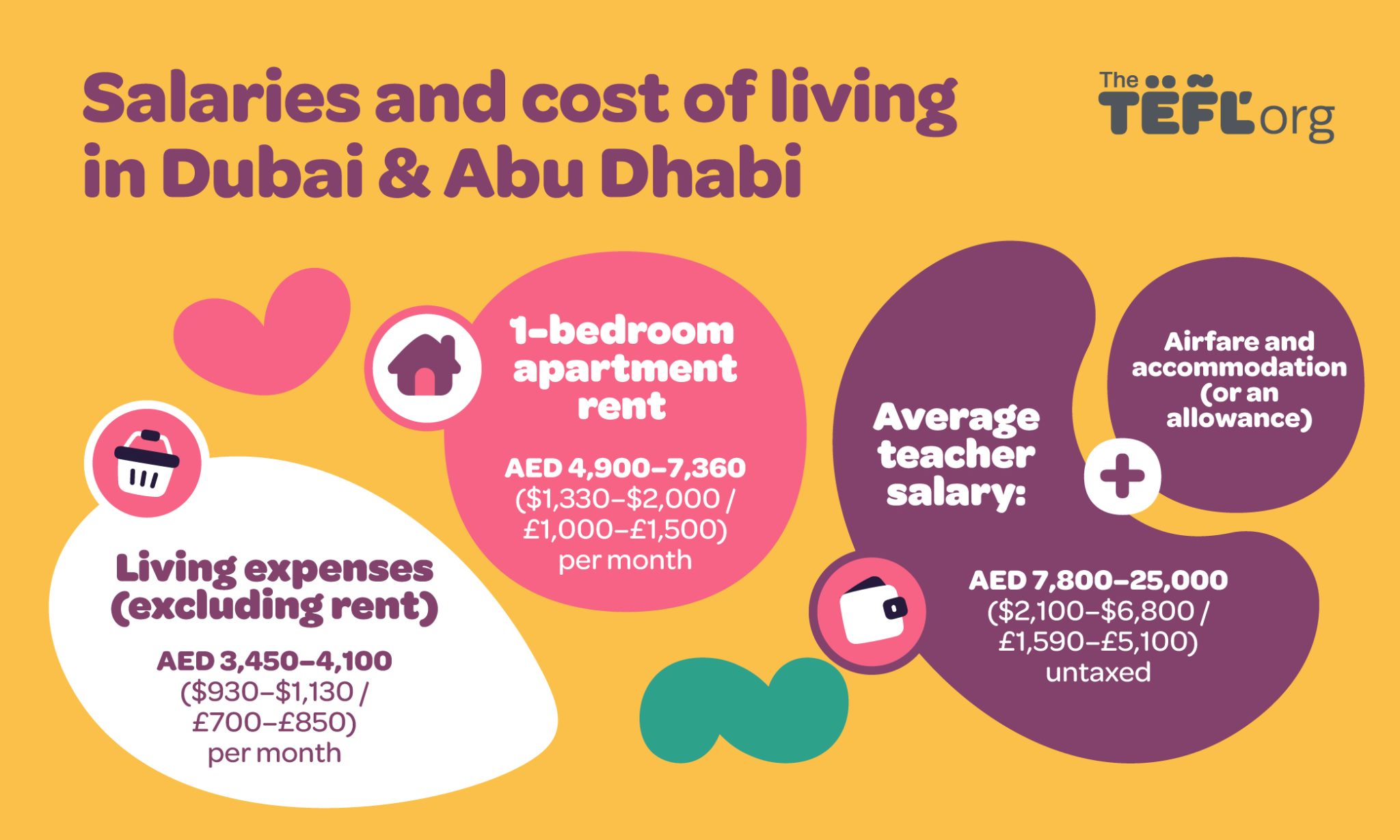
The UAE is one of the highest paying countries for TEFL teachers. The average salary for a full-time English teacher sits somewhere between AED 7,800–25,000 ($2,100–$6,800 / £1,590–£5,100) depending on experience and the job type. Remember, this salary is untaxed!
Salaries are higher in cities like Dubai and Abu Dhabi and at schools with higher ratings. How do you know if a school has a higher rating? It’s set by the local education authority in that Emirate, like KHDA (in Dubai) and ADEK (in Abu Dhabi).
Alongside an untaxed salary, teachers often receive:- Reimbursed airfare
- Free accommodation or a housing allowance
- Visa sponsorship
- Health insurance
- Arabic lessons
- Paid vacation days
- End-of-contract bonuses
How much does it cost per month in the UAE?
As a luxury destination, you’d expect the UAE to be an expensive place to live. And it can be, but some teachers receive attractive benefits like a housing allowance, which offsets one of their biggest monthly expenses.A 1-bed apartment in Dubai or Abu Dhabi costs around AED 4,900–7,360 ($1,330–$2,000 / £1,000–£1,500) per month, but living expenses excluding rent sit at around AED 3,450–4,100 ($930–$1,130 / £700–£850) per month. Many teachers use the money saved on rent to improve their lifestyle or savings while teaching abroad.But it can be easy to get sucked into a lifestyle of luxury in the UAE, so here’s how you can save money as a teacher:
- Look beyond Dubai: Salaries in Dubai might be high, but don’t rule out other areas in the UAE that also offer high salaries and a good lifestyle. Monthly living costs in Dubai are around AED 2,000 ($545 / £400) higher than Abu Dhabi, or twice as much as cities like Ras Al Khaimah or Sharjah.
- Live outside the city centre: Living outside the city centre can save you plenty of money. For example, 1-bedroom city centre apartments in Dubai are around AED 3,000 ($815 / £600) more expensive than apartments outside the centre.
- Compare job benefits: Don’t just think about the salary — consider the job benefits. One teaching job might offer a higher salary, but another might offer free accommodation.
- Use public transport: With extensive bus, metro, and tram networks, you don’t need to pay for taxis or lease a car while you’re teaching in the UAE. A monthly bus pass costs around AED 175 ($47 / £34), saving you plenty of money for other expenses.

| Restaurants | AED | USD | GBP |
|---|---|---|---|
| Inexpensive restaurant meal | |||
| Domestic beer (0.5 litre) | |||
| Regular cappuccino | |||
| Water (0.33 litre) | |||
| Markets | AED | USD | GBP |
| Regular milk (1 litre) | |||
| Loaf of white bread | |||
| Regular eggs (1 dozen) | |||
| Apples (1 kg) | |||
| Transportation | AED | USD | GBP |
| One-way ticket (local transport) | |||
| Monthly pass (regular price) | |||
| Taxi start (normal tariff) | |||
| Gasoline (1 litre) | |||
| Utilities | AED | USD | GBP |
| Electricity, heating, cooling, water, and garbage (for a regular apartment) | |||
| Regular prepaid monthly mobile tariff with 10GB+ data | |||
| Internet (60 Mbps, unlimited data, cable/ADSL) | |||
| Clothing and shoes | AED | USD | GBP |
| Pair of jeans (Levis 501 or something similar) | |||
| Summer dress in a chain store | |||
| Nike running shoes (mid-range) | |||
| Men's leather business shoes |
English Teaching Jobs in the UAE
Teaching jobs in the UAE vary in their requirements, roles, salary and benefits, so it’s important to understand what you’re applying for.
Teachers can find jobs in public education or the private sector, from language schools, vocational schools, and international schools. English language is taught as a second language in the national curriculum, but it’s taught as a primary language in many private international schools.
Generally, the requirements for public schools and international schools are among the strictest, so teachers who have less experience or lower qualifications can find positions at language schools.
You can apply for jobs using platforms like The TEFL Org Jobs Centre, or by applying directly on the school’s website.
Public schools
Literacy rates at public schools in the UAE have improved significantly over the past few decades, and many gender-segregated schools are moving towards co-education and inclusivity.
UAE public school jobs offer a high salary, but also have very high requirements, requiring a bachelor’s in Education or a bachelor’s and a teaching licence. Degrees in education, English, maths, or science are beneficial when it comes to finding public school jobs in the UAE.
What to expect at public schools in the UAE:
- Teaching larger classrooms; students may be more disruptive
- Teaching around 30 lessons per week
- Average monthly salary from AED 10,000–20,000 ($2,720–$5,430 / £2,040–£4,075)
- Benefits may include paid flights, housing support, national holidays
Language academies
Language academies are perfect for students looking to improve their English outside of their work or study schedule. The UAE has many independent language centres or academies catering to students chasing specific goals like exam preparation, business English, and more. These schools generally hire teachers throughout the year, and they offer more flexible entry requirements.
What to expect at private language schools in the UAE:
- Teaching a range of ages in the afternoon, evening, and weekends
- Variety in student ages
- Teaching various subjects like exam preparation or business English
- Average monthly salary from AED 8,000–20,000 ($2,170–$5,425 / £1,630–£4,075)
International schools
With a high expat population, there are plenty of international schools in the UAE following curriculums regulated by the British Schools Overseas (BSO) or Office of Overseas Schools (OAS). While teachers work in small classrooms and have access to excellent classroom facilities and teaching materials, job requirements and responsibilities are high.
Teachers need at least a master’s, a teaching licence (like a PGCE), a TEFL qualification, and prior teaching experience.
What to expect at international schools in the UAE:
- Working from around 7:30am–4:30pm
- Smaller classrooms of Emirati and international students
- Teaching a range of subjects from an international baccalaureate, US, or British curriculum
- Average monthly salary ranging from AED 10,000–25,000 ($2,730–$6,800 / £2,050–£5,100)
- Benefits may include housing support and flight reimbursement
Vocational schools
Vocational schools are catered towards workers learning English within a specific industry. Teachers who come from a specialised background (like business or engineering) can work at these UAE government-regulated schools to teach ESP (English for Specific Purposes) subjects to help workers improve language skills in the workplace.
What to expect at vocational schools in the UAE:
- Teaching in evenings or weekends to university students and adults
- Focusing on and using real-life industry examples
- Salary varies depending on how many hours you teach
- Developing and marking assessments that comply with existing standards
Universities
The UAE’s universities are highly regarded and attract international students from all over the world, with many programmes being taught entirely in English. If you have a master’s degree or PhD and a few years of teaching experience, you could be working at a university in the UAE.
What to expect at universities in the UAE:
- Fewer contact hours per week, but potentially more preparation
- More focus on lecture-based learning
- Salary ranging from AED 15,000–30,000 ($4,090–$8,125 / £3,070–£6,100) depending on the school
Recruiters in the UAE
With high job requirements, recruiters offer job placement support for licensed teachers to find jobs in public and private schools across the United Arab Emirates.
To narrow down your search, here’s a list of some of the best recruiters:
- Gulf Education connects native English speakers from the UK, US, Australia, New Zealand, Ireland, and South Africa with job openings across the Middle East, including the United Arab Emirates.
- Taaleem hires qualified candidates to work in international schools across the United Arab Emirates and deliver English, American, International, and French curricula.
- Arabian Teacher Recruitment helps foreign teachers find job opportunities in Dubai, Abu Dhabi, Sharjah, and more.
- Teachers in UAE is an Ireland-based recruitment agency connecting ESL teachers with schools in the UAE and other countries in the Middle East.
- Footprints Recruiting have supported the teaching journeys of 10,000+ ESL teachers abroad, including the United Arab Emirates, since 2001.
Teaching English in Major Cities
Here are some of the most popular cities for English teachers in the UAE.
Teach English in Dubai

It’s estimated that around 90% of Dubai’s population come from overseas, with plenty of teaching positions in this multicultural hub. There are plenty of teaching opportunities in Dubai, but competition is heavy because the city draws qualified teachers for its luxurious lifestyle and high salaries.

Dubai offers plenty of things to do when you’re not teaching English, ranking among the World’s Best Cities for 2026 (not just the Arab world). You can peer from the Burj Khalifa (the tallest building in the world), dine at world-class restaurants, embark on desert adventures, or embrace the nightlife in the UAE’s party capital.
Teach English in Abu Dhabi

While Dubai is the UAE’s entertainment and glamour hub, Abu Dhabi is its quieter and more conservative sibling (despite being the capital city). Home to the Sheikh Zayed Grand Mosque, Abu Dhabi is a growing hub of international business and culture, with its own Louvre, stunning malls and gorgeous beach views.
Like Dubai, the city has a big market for English teaching. With a thriving economy that attracts business professionals from all over the world, there are many jobs for teachers through the Abu Dhabi Department of Education and Knowledge (ADEK).
Tip: Cities like Ras Al Khaimah, Sharjah and Ajman offer a less competitive teaching market for inexperienced teachers.
Ready to Teach Abroad? Don’t Forget Your TEFL Certification
Before you start applying for teaching positions in the Persian Gulf, don’t forget your TEFL certificate. With a TEFL course, you’ll learn essential skills from teaching complex grammar rules to managing large groups and more, and you’ll start teaching with confidence in your knowledge.
Get started today with our 120-hour TEFL course or our Level 5 TEFL course.
Frequently Asked Questions
Q. What qualifications do I need to teach English in the UAE?
Each school has a different set of requirements. To teach English in the United Arab Emirates, most schools require a BA or MA degree, teaching experience, and a teaching certificate or licence.
Q. Do I need to know Arabic to teach English in the UAE?
No, you don’t need to know Arabic to teach English in the United Arab Emirates. However, it’ll benefit your application and experience if you learn Arabic phrases, and some teaching jobs even offer Arabic lessons.
Q. Are work visas provided for English teachers in the UAE?
Yes, the schools sponsor work visas for English teachers before they arrive in the UAE after they have been offered a job.
Q. Are teaching salaries in the UAE tax-free?
Yes, teaching salaries in the UAE are tax-free, making it a very desirable teaching abroad location.
Q. What additional benefits do schools provide?
Teaching jobs in the UAE often provide benefits such as health insurance, flight reimbursement, housing or an allowance, visa sponsorship, and Arabic lessons.
Q. Are English teachers in demand in the UAE?
English teachers are in high demand in the UAE. The country welcomes a high number of tourists and is home to many international businesses, creating a high demand for English-speaking workers.
Q. How much can you make teaching English in the UAE?
Depending on your experience, qualifications, and school type, you can make between AED 7,800–25,000 ($2,100–$6,800 / £1,590–£5,100) per month teaching English in the UAE, with teaching jobs in Dubai and Abu Dhabi offering higher salaries.
Read more: How much can you earn teaching English in the UAE?