











From the grand boulevards of Paris to the French Alps, France shines on the global stage. Whether you're a film buff, outdoor enthusiast, or just daydreaming riverside coffee and croissants, France is hard to beat.
Despite a high English proficiency score, France has a world-leading travel industry and is one of Europe's largest economies, which means it has a constant demand for English teachers. Read on for The TEFL Org's guide to teaching English in France, from the job requirements, salaries, visa process, top locations, and more.
Key Takeaways
- France has a high English proficiency score, but there's still a high demand for English teachers.
- English teachers will need a TEFL certificate and a bachelor's degree to teach in a competitive market.
- The average salary for English teachers in France ranges between €800–€2,000 ($930–$2,320 / £695–£1,730).
- Advanced teachers at international schools can earn around €2,000–€4,000 ($2,320–$4,640 / £1,730–£3,460).
- Top TEFL locations in France include Paris, Marseille, and Lyon.
- EU teachers don't need a visa, but non-EU teachers will need either a work visa or student visa to teach in France.
Requirements for Teaching English in France
France offers teaching opportunities that appeal to both entry-level and experienced teachers. Here's everything you need to know about the requirements for teaching English in France.
Do I need a TEFL certification to teach English in France?
Yes, you need a TEFL certificate to teach English in France. France has a high availability of English teachers, so you'll need to come prepared and qualified. A 120-hour TEFL course is enough for many jobs, but some employers might even require a Level 5 TEFL qualification. You'll learn practical skills like lesson planning, classroom management and teaching students with different learning styles.
Do I need a degree to teach English in France?
In most cases, you need a degree to teach English in France, as most employers list a bachelor's degree (in any subject) as a requirement. But it's still possible to teach English without a degree in France as a language assistant or at a summer camp as long as you're TEFL certified.
Can I teach English in France without experience?
Yes, you can teach English without experience in France. While international school jobs require prior teaching experience, entry-level teachers can work at kindergartens, private language academies, and summer camps as long with a TEFL certification. You'll just need to bear in mind that entry-level teacher jobs pay lower salaries.
Visa requirements for teaching English in France
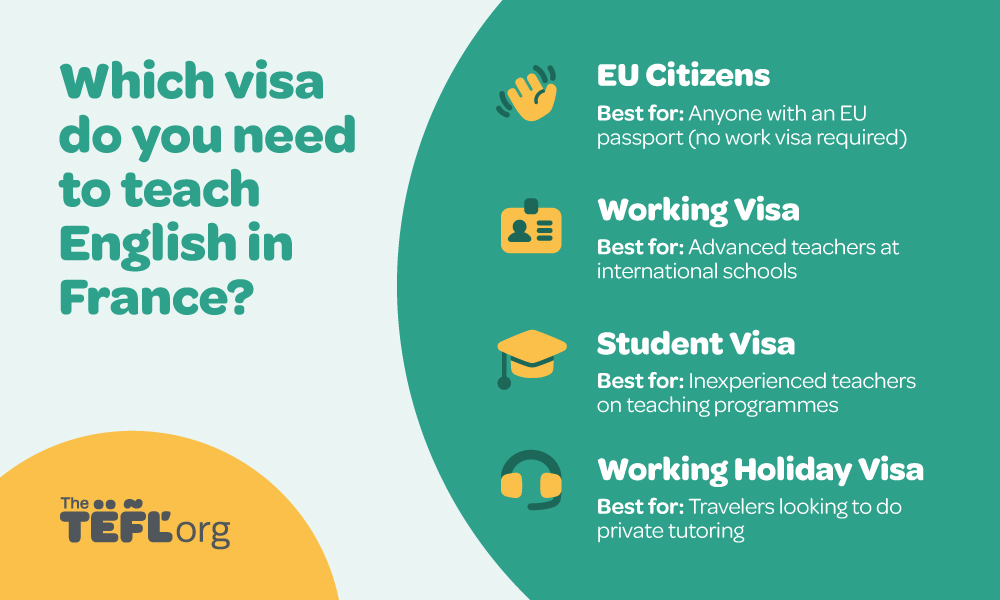
France is a member of the European Union, and teachers with EU citizenships don't need a work visa. It's as easy as becoming TEFL certified, securing a job, and flying to France!
However, non-EU teachers need to plan carefully for their TEFL career in France. Generally, it's easier for non-EU teachers to work through English teaching programmes which offer visa support and job placements. But, experienced teachers can find work independently with an international school that offers visa sponsorship.
Non-EU teachers usually have three visa options:
Work Visa
It can be tricky for non-EU teachers to get a work permit to teach in Europe because schools can hire EU teachers without the hassle or expense of sponsoring a visa and work permit.
Some international schools and private language schools sponsor visas, although competition can be strong. Here's what you'll need:
- Proof of employment in France
- Proof of qualifications (including degree, TEFL)
- Clear criminal background check
- Apostilled and notarised documents (including degree, TEFL, criminal record check)
- Health insurance
Student Visa
Most non-EU teachers enter France on a long-stay student visa to teach abroad. The student visa allows you to work up to 20 hours per week during term-time.
Many teaching programmes support your application to study part-time at a local university and also a job placement. Typically, teachers on student visas work as a language assistant at a public school or a private language academy.
To qualify for the student visa, you'll need the following:
- Proof of enrollment (arranged by programme)
- Proof of accommodation (typically arranged by programme)
- Valid passport
- Clean criminal background check
- €99 ($115 / £85) visa fee
Working Holiday Visa
Travellers on the working holiday visa can engage in part-time work while in France, like private tutoring. This visa is valid for up to 1 year, but your primary reason for entering France must be tourism, not employment, which limits your options.
To qualify for this visa, you must meet the following:
- Be 18 to 30 years of age (35 for Canada)
- Never have already partaken of the working holiday programme
- Have a return ticket or affidavit to leave France
- Travel insurance
- Have sufficient funds to cover your stay
- Be a citizen of: Argentina, Australia, Brazil, Canada, Chile, Colombia, Ecuador, South Korea, Hong Kong, Japan, Mexico, Peru, New Zealand, Russia, Taiwan, Uruguay
Salary and Cost of Living
How much can you earn as a teacher in France? And, more importantly to others, how much can you save? Here's everything you need to know about the teaching salary and cost of living in France.
How much can you earn teaching English in France?
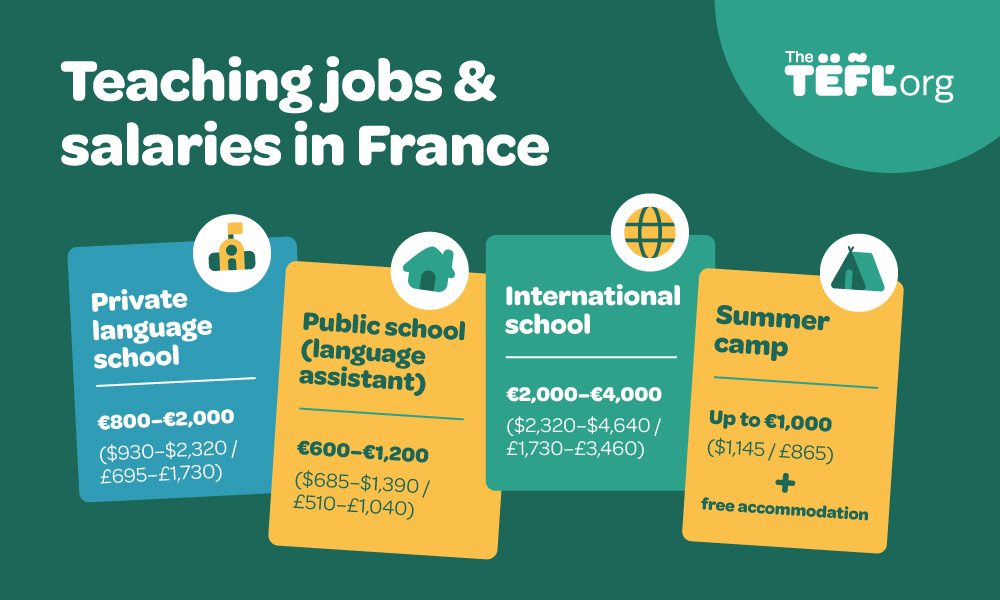
Salaries depend on where you teach and your level of experience, but English teachers can typically expect around €800–€2,000 ($930–$2,320 / £695–£1,730) per month. Here are some of the factors that you need to consider that'll affect your salary:
- Experience & qualifications: Teachers with university degrees, TEFL qualifications, and previous teaching experience can expect a higher salary teaching in France.
- Teaching job: Teaching at international schools offers the best salary for English teachers, averaging at around €2,000–€4,000 ($2,320–$4,640 / £1,730–£3,460). Teaching programmes and language assistant roles offer lower salaries of around €600–€1,200 ($685–$1,390 / £510–£1,040).
- Visa: Teachers on student visas earn less due to the 20-hour work-week schedule.
- Nationality: Some employers prefer native English speakers, particularly for private language schools. However, non-native speakers with recognised qualifications and strong English proficiency can still find opportunities.
How much does it cost to live in France?
Monthly living costs in France range between €850–€950 ($990–$1,105 / £740–£825) excluding rent. Rent for a 1-bed apartment ranges from €600–€770 ($695–$895 / £520–£670), so you'll spend around ~€1,450 ($1,680 / £1,255) per month without applying mindful spending habits.
Living costs can fluctuate significantly depending on your lifestyle and location, so here are our budgeting tips if you're looking to save up as a teacher in France:
- Consider smaller cities: Some teachers fixate on locations like Paris, but higher salaries don't necessarily mean better saving potential. Be open to teaching in other French cities; rent in Paris ranges from €1,040–€1,380 ($1,205–$1,600 / £900–£1,200), but it's as low as €400–€500 ($465–$580 / £350–£430) in cities like Limoges, Saint-Etienne, and Nancy.
- Look for a menu du jour: When eating out, consider a set menu or menu du jour – three courses for as little as €15 ($17 / £13). Or, head to your local bakery or boulangerie for fresh but cheap pastries.
- Split the rent: Living with other teachers, expats, or locals can reduce costs significantly. While rent averages at around €600–€770 ($695–$895 / £520–£670), rent for a 3-bed apartment costs around €400 ($465 / £350).
- Use public transport: France's public transport network is extensive, convenient, and affordable; one-way tickets cost around €1.90 ($2.20 / £1.65) while monthly passes cost ~€50 ($58 / £44).
- Embrace cheap or free activities: You don't need to spend money to embrace the local culture, whether you sunbathe on the beaches of Marseille, stroll through Aix-en-Provence's lavender fields, or picnic beneath the Eiffel Tower.
| Restaurants | EUR | USD | GBP |
|---|---|---|---|
| Inexpensive restaurant meal | |||
| Domestic beer (0.5 litre) | |||
| Regular cappuccino | |||
| Water (0.33 litre) | |||
| Markets | EUR | USD | GBP |
| Regular milk (1 litre) | |||
| Loaf of white bread | |||
| Regular eggs (1 dozen) | |||
| Apples (1 kg) | |||
| Transportation | EUR | USD | GBP |
| One-way ticket (local transport) | |||
| Monthly pass (regular price) | |||
| Taxi start (normal tariff) | |||
| Gasoline (1 litre) | |||
| Utilities | EUR | USD | GBP |
| Electricity, heating, cooling, water, and garbage (for a regular apartment) | |||
| Regular prepaid monthly mobile tariff with 10GB+ data | |||
| Internet (60 Mbps, unlimited data, cable/ADSL) | |||
| Clothing and shoes | EUR | USD | GBP |
| Pair of jeans (Levis 501 or something similar) | |||
| Summer dress in a chain store | |||
| Nike running shoes (mid-range) | |||
| Men's leather business shoes |
English Teaching Jobs in France
English teaching jobs in France can be found across the country, from language assistant programmes, private schools, international schools, summer camps and universities. You can find teaching jobs in France by searching job boards like The TEFL Org Job Centre, applying to teaching programmes or directly to schools.
Public schools
Most public school teaching opportunities in France come through the TAPIF (Teaching Assistant Program in France). TEFL teachers at primary or secondary public schools often work as a language assistant, supporting the local French teacher rather than leading independently.
Language assistant programs like TAPIF typically partner with those run by the French government and offer a monthly stipend, visa assistance, and housing support through some host schools.
What to expect at public schools in France:
- Monday to Friday schedule
- 10–20 teaching hours per week at primary or secondary schools
- Supporting the homeroom teacher and students rather than leading lessons independently
- Relaxed entry requirements, typically requires working on student visa
- Receiving a monthly stipend of around €600–€1,200 ($685–$1,390 / £510–£1,040)
Private language schools
Private language schools are one of the most common employers of TEFL teachers in France, especially in major cities. Many language schools cater to students with specific goal like passing an IELTS exam or developing business English skills.
Requirements vary from one school to another but are generally relaxed, with many French employers accepting a degree in any subject or a TEFL certificate in place of teaching experience.
What to expect at private language schools in France:
- Teaching in the evenings and on weekends
- Student variety; teaching young learners, teenagers, or adults
- Teaching a range of subjects, from academic English, exam preparation, to business English
- Competitive salaries depending on your contract (monthly or hourly pay)
International schools
International schools in France offer some of the best salaries and benefits but usually require qualified teachers with years of experience. These schools follow international curricula and are mainly found in larger cities and expat hubs. Students at these schools are both French students and international students, and you'll likely teach English as a primary language in various subjects. Some of the best international schools include American School Paris, ICS Paris, and the International School of Lyon.
What to expect at international schools in France:
- Monday to Friday schedule
- Teaching French and international students following an international curriculum
- Excellent salary and benefits
- High entry requirements, including a master's, TEFL or teaching licence, and teaching experience
Universities
Teachers with advanced academic qualifications, like a master's degree, PHD, and significant teaching experience, can potentially work at French universities. Many English-taught courses exist in major cities like Paris, Lyon, Marseille, and other education hubs.
What to expect at universities in France:
- Lecture-based teaching
- More emphasis on academic research and career development
- Fewer contact hours but more preparation
- High entry-requirements
Summer camps
At a summer camp, you'll teach English in a more engaging environment focused on outdoor, team-building, or activity-based learning. English summer camps offer short-term teaching opportunities during school holidays, and are an excellent way for new teachers to gain experience without long-term commitment, or for teachers to bridge employment gaps between contracts. Popular summer camps include American Village or Anglophiles.What to expect at summer camps in France:
- Informal and activity-based learning
- Low entry-requirements
- High-energy activities
Private tutoring
Private tutoring is a popular way to supplement income, especially for teachers on student visas capped at 20 hours per week. Teachers typically charge €15–€25 per hour, with demand from students, professionals, and families across the country.
Download our Teaching English in Europe Guide
Find out how teaching English in France compares to other European countries.
Teaching Programmes in France
France has several teaching programmes designed for language assistants. Most programmes – like TAPIF and British Council – partner with the France Éducation International (FEI) to increase cultural and language exchange.
These programmes are appealing to new or inexperienced teachers who want to gain work experience in France without jumping into the deep end or signing a long-term contract.
France Éducation International (FEI)
TAPIF and the British Council places teachers aged 20–35 in French public schools on seven-month contracts from October to April, working as language assistants rather than leading lessons independently, working part-time on a student visa.
Teachers receive a stipend of around ~€730 ($850 / £630) per month depending on their location and experience, and some teachers receive accommodation. These programmes are highly competitive, with around 1,000 placements annually, and you can't guarantee a placement even if you meet the requirements.
To qualify for the TAPIF or British Council programme in France, you'll need the following requirements:
- Valid passport from a qualifying country
- Bachelor's degree (or have completed 2 years of study)
- B-1 level French
- TEFL certificate (preferred)
- Native English proficiency
Teaching English in Major Cities
France is home to fascinating cities that boast history and vibrant social communities. Here are some of the most popular TEFL locations in France.
Teach English in Paris

During the Age of Enlightenment, Paris was seen as an intellectual hub, and now it's a global economic, gastronomic, fashion, and artistic hub that draws millions of tourists annually. Whether you know it as the City of Lights or the City of Love, Paris is an enchanting and romantic getaway destination for travelers, but you could stay for the long-haul by teaching English in Paris.
Today, the city is home to some of the best universities in the world, 700,000+ students, and teaching opportunities in public schools, ESP (English for Specific Purposes) language schools, and international schools. When you're not in the classroom, sit beneath the Eiffel Tower, let your eyes feast at the Louvre, or stroll along the river Seine while enjoying fresh pastries.
Teach English in Marseille

If you want to be closer to the Mediterranean sea, consider Marseille. As the second largest city in France with 26 miles of coastline, Marseille offers a coastal and metropolitan lifestyle for TEFL teachers.
With such a multicultural population and top universities, TEFL teachers can find plenty of work in Marseille. From language academies that teach exam preparation and business English to international schools and universities, the TEFL market in Marseille is thriving.
Although an international hub, the city is praised for its authenticity and vibrant atmosphere. When the clock strikes, you can head to one of Marseille's Plage du Prado beach, the Noailles district, or the colourful Bohemian quarters.Teach English in Lyon

Being the culinary capital of France is no easy feat, but Lyon has established itself firmly on the top of the list. Alongside a mouthwatering culinary scene, Lyon is renowned for its Gothic and Romanesque architecture, art, scene, and UNESCO-listed Roman ruins.
With around 200,000 students, TEFL teachers can find work in public and private sectors to establish a career in this varied city. On the weekend, you can walk along riverfront promenades, navigate the flea markets and art galleries, or head for a sunset stroll along the River Rhône.
Ready to Teach English in France? Get TEFL Certified Before You Go
Before you start planning life teaching abroad in France, don't overlook your TEFL qualification. It might seem like just another requirement on the checklist, but a TEFL certificate is one of the biggest investments you can make as a teacher.
A TEFL certificate can help you secure teaching jobs in France, but also helps you feel like you belong and excel in the classroom. From lesson planning and classroom management to understanding how to teach English effectively to non-native speakers, TEFL training prepares you for the realities of teaching abroad.Get TEFL certified today and start your teaching journey in France with The TEFL Org's 120 hour TEFL course today!
Frequently Asked Questions
Q. Is teaching a good career in France?
Teaching English in France is an excellent way to gain international experience, learn French, and integrate with a foreign culture. Whether you're after a short-term or long-term experience, there are plenty of job opportunities in France that can lead to a rewarding career.
Q. Is there a demand for English teachers in France?
Yes, there's a high demand for English teachers in France. While English speakers are common in France, the influx of international tourists, migrants, and businesses mean that France needs an English speaking workforce, especially in education, hospitality, and international business.
Q. What are the requirements to be an English teacher in France?
Requirements vary from one teaching job to another, but teachers generally need a TEFL certificate, bachelor's degree, and native English proficiency (or proof of fluency). Language assistant roles are entry-level friendly, whereas advanced teachers with a master's and experience can work at international schools.
Q. How much do English teachers get paid in France?
The average salary for teaching English in France ranges from €800–€2,000 ($930–$2,320 / £695–£1,730). However, advanced teachers at more reputable private and international schools can earn around €2,000–€4,000 ($2,320–$4,640 / £1,730–£3,460).
Q. Can I teach English in France as a non-native speaker?
Yes non-native speakers can teach English in France. You'll need to show English fluency through a certificate like IELTS or CEFR or education at an English speaking university.
Q. Do I need to speak French to teach in France?
No, you don't need to speak the French language to become an ESL teacher in France. However, learning the language can help you experience French culture at a deeper level.