





While Brazil and Argentina usually gather the most attention, Uruguay quietly offers one of South America’s best lifestyles. With Atlantic beaches, café culture, progressive politics, and pioneering LGBTQ+ rights in Latin America, it’s an ideal destination if you’re looking for a slower pace of life abroad.
While the job market is smaller than much of Latin America, demand for English continues to grow across business, education and international trade, creating opportunities for qualified TEFL teachers. Read on for The TEFL Org’s guide to teaching English in Uruguay, from the job requirements, salaries, visa process, and more.
Key Takeaways
- Spanish is the main language, but demand for English continues to grow in business and education.
- Most jobs require a TEFL certification, while a degree, experience, and native English proficiency are preferred.
- Teachers earn around $U30,000–50,000 ($745–$1,245 / £555–£930) per month, or up to $U50,000–90,000 ($1,245–$2,235 / £940–£1,670) at international schools.
- Uruguay is one of the most expensive countries in South America.
- Most TEFL job opportunities are in private language schools, international schools and private tutoring.
- Teachers need the temporary residence permit to work legally in Uruguay.
Requirements for Teaching English in Uruguay
Uruguay has one of Latin America’s strongest education systems, with free public education and one of the region’s highest literacy rates. With initiatives like Plan Ceibal, each student and teacher at public schools receives a laptop to make learning easier.
So despite the fact that its English proficiency isn’t the highest, Uruguay takes education seriously. Don’t expect to walk into school and to be given a teaching job with minimal qualifications.
Here’s everything you need to know about the requirements for teaching abroad in Uruguay.

Do I need a TEFL certificate to teach English in Uruguay?
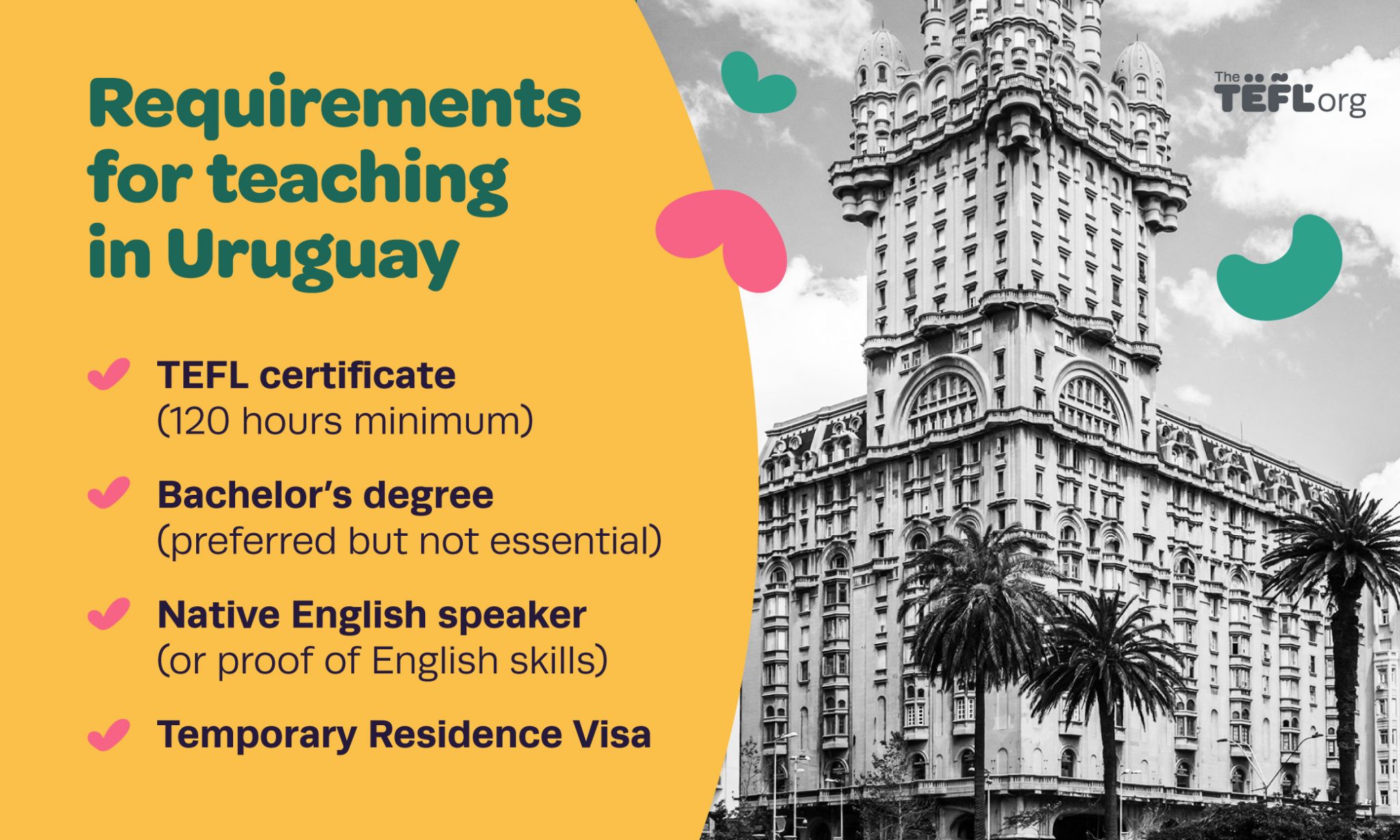
Yes, you need a TEFL certificate to teach English in Uruguay. While it’s not a legal requirement, it’s an essential aspect that employers look for when hiring foreign teachers. In some cases, it’s more important than having a degree.
120 hours of TEFL training is usually enough to find teaching jobs in Uruguay, but some private and international schools might require a Level 5 TEFL certificate or even a teaching licence and experience.
Tip: Uruguay has a strong tech sector and emphasises digital literacy — specialising in using AI in the classroom or highlighting any tech experience could benefit your application!
Can I teach English without a degree in Uruguay?
Yes, you can teach English without a degree in Uruguay, but you’ll probably spend more time looking for jobs and have to settle for one that offers a lower salary. Thankfully it’s not a legal requirement, so non-degree holders can still find work especially at private language schools which are generally more flexible.
Will I need teaching experience to teach in Uruguay?
You can teach English without experience in Uruguay, and private language schools are usually the easiest place to get started. Teaching experience isn’t essential for your first job, but it gives you access to higher-paying positions at international schools.
Can I teach in Uruguay as a non-native speaker?
Yes, you can teach English as a non-native speaker in Uruguay, especially if you speak Spanish. You’ll just need to prove to employers your English skills in the form of a language certificate like CEFR, IELTS, or TOEFL.
Tip: Mention your Spanish level on your CV — even basic conversational Spanish can reassure employers that you’ll settle into daily life more easily.
Visa requirements for teaching English in Uruguay
You’ll need to find a job before you can get the documents to work in Uruguay. Once you’ve found a teaching job in Uruguay, you’ll need the Temporary Residence Visa and the Cédula de Identidad (an identity card).
Many teachers begin the residency process after entering Uruguay as a visitor, while others arrange their employment before they travel. But the exact process depends on your nationality and employment status.
To get the temporary residence visa, you’ll need the following:
- Proof of a signed job offer from a Uruguayan employer
- Clear criminal background check
- Valid passport and copies
- Proof of academic and professional qualifications
Download our guide to teaching English in Latin America
Everything you need to know about teaching English in Latin America

Salary and Cost of Living
Although it’s an off the beaten track location compared to other countries in South America, Uruguay isn’t the cheapest place to live. Here’s everything you need to know about the cost of living and teacher salary in Uruguay.
How much can you earn teaching English in Uruguay?
Most TEFL teachers earn around $U30,000–50,000 ($745–$1,245 / £555–£930) per month. This is the average salary for teachers who are less experienced but have a TEFL certificate.
More experienced teachers can earn up to $U50,000–90,000 ($1,245–$2,235 / £940–£1,670) per month at certain private language schools or international schools.
Tip: Locals in Uruguay are keen to improve their English, so if your regular job doesn’t cover your living costs, you can do private tutoring or teach English online in your free time.
How much does it cost to live in Uruguay?
Uruguay isn’t the cheapest place to live in South America, but you can still enjoy an excellent lifestyle here. Teachers can expect to spend around $U55,000–65,000 ($1,365–$1,670 / £1,020–£1,245) per month on rent, bills, food, entertainment, and so on, but it isn’t one size fits all.
There are plenty of factors to consider like your location, lifestyle, budgeting mindset, and so on. Want your salary to go further? Here are a few local tips:
- Be flexible with location: You might fancy teaching in Montevideo, but don’t rule out other locations. While teaching jobs in the capital might offer higher salaries, the cost of living might offset this in bigger cities.
- Live outside the centre: Living outside the touristy centre is a great way to save money, not just live in a more “authentic” area. In Montevideo, you can save around $U10,000 ($250 / £185) per month by living beyond the city centre.
- Split the rent: To save money (and to socialise), many teachers live with other expats or teachers. A 1-bed apartment in the capital costs around $U25,000 ($620 / £465) per month, but a 3-bed apartment costs around $U14,000 ($350 / £260) per person, per month.
- Use public transport: Public transport is reliable in Uruguay, and one-way tickets cost around $U61 ($1.50 / £1).
- Enjoy the menú ejecutivo: Many restaurants offer affordable fixed-price lunch menus aimed at workers during the week. It’s a great way to try local favourites like asado, capeletis a la Caruso, or arroz con leche without overspending.
- Shop seasonally: Farmers’ markets offer excellent local fruit, vegetables and beef at much lower prices than imported groceries, especially during the summer harvest.
| Restaurants | UYU | USD | GBP |
|---|---|---|---|
| Inexpensive restaurant meal | |||
| Domestic beer (0.5 litre) | |||
| Regular cappuccino | |||
| Water (0.33 litre) | |||
| Markets | UYU | USD | GBP |
| Regular milk (1 litre) | |||
| Loaf of white bread | |||
| Regular eggs (1 dozen) | |||
| Apples (1 kg) | |||
| Transportation | UYU | USD | GBP |
| One-way ticket (local transport) | |||
| Monthly pass (regular price) | |||
| Taxi start (normal tariff) | |||
| Gasoline (1 litre) | |||
| Utilities | UYU | USD | GBP |
| Electricity, heating, cooling, water, and garbage (for a regular apartment) | |||
| Regular prepaid monthly mobile tariff with 10GB+ data | |||
| Internet (60 Mbps, unlimited data, cable/ADSL) | |||
| Clothing and shoes | UYU | USD | GBP |
| Pair of jeans (Levis 501 or something similar) | |||
| Summer dress in a chain store | |||
| Nike running shoes (mid-range) | |||
| Men's leather business shoes |
English Teaching Jobs in Uruguay
The school year in Uruguay runs from March to November, so it’s best to apply for jobs in the lead up to these months. But English teaching jobs in Uruguay also come in the private sector, with language schools often hiring all year round.
To apply for teaching jobs in Uruguay, you can visit job forums like The TEFL Org Job Centre or Serious Teachers. But many schools recruit locally rather than advertising online, so teachers who already have savings and can spend a few weeks applying in-person often have the greatest success.
Public schools
Public education in Uruguay is among the best in Latin America, with high literacy rates, compulsory learning, and also an emphasis on digital learning. The country’s Plan Ceibal initiative means that students receive a laptop (or another digital device) for learning and studying, so there’s a huge emphasis on tech and digital literacy in the classroom.
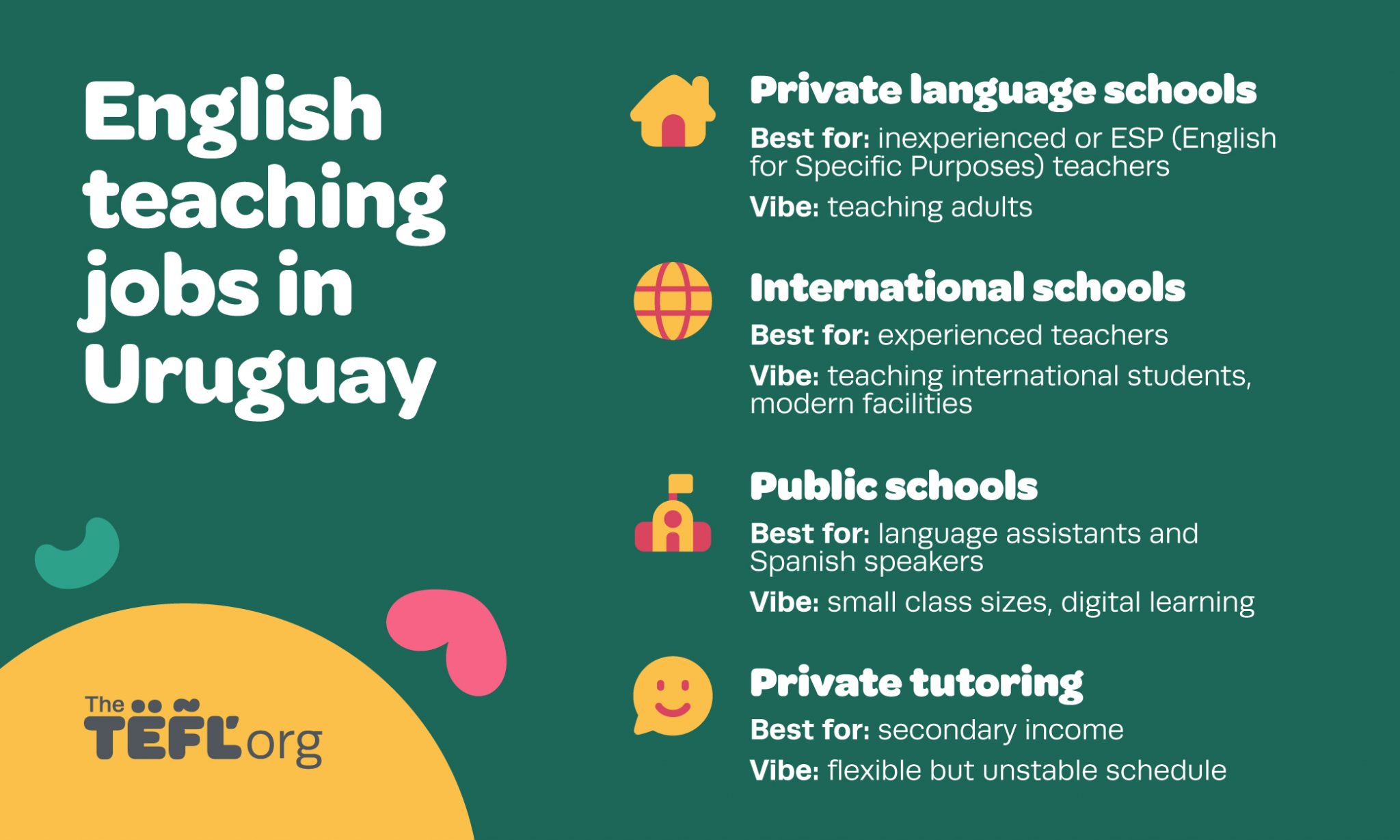
Most jobs go to local teachers, but you can still find positions through language assistant programmes like Fulbright. Most public school jobs require a bachelor’s degree, TEFL certificate, and teaching experience (unless you’re applying as a language assistant). Spanish fluency is also preferred.
What to expect at public schools in Uruguay:
- Small class sizes and a low student-to-teacher ratio
- Emphasis on digital learning
- English taught as a foreign language in the national curriculum
- Teaching during the school year from March–December
Private language schools
Private language schools are a common entry point for TEFL teachers in Uruguay because requirements are generally flexible and some schools hire year-round. Most are based in bigger cities like Montevideo where you’ll find more students learning English to improve study and career prospects at international companies.
Students range from young learners to adults, and subjects can range from general English to ESP (English for Specific Purposes) like Business English, Exam Preparation, and so on. Evening and weekend classes are common, especially when teaching adult learners.
What to expect at private language schools in Uruguay:
- Evening and weekend classes
- Student ages ranging from children, teenagers, and adults
- Teaching courses from general English to specific subjects like Business English or Exam Preparation
International schools
International schools offer the highest salaries and benefits, but they’re less common in Uruguay and are competitive. Most are located in Montevideo and follow an international, American, or British system, to local and international students.
While salaries are high, so are job responsibilities and requirements. Schools typically expect teachers to hold a teaching licence, a bachelor’s or master’s degree, and at least 2–3 years of classroom experience.
What to expect at international schools in Uruguay:
- Teaching international or bilingual curricula
- Small class sizes and modern classroom facilities
- Higher salaries and benefits than language schools
- Competitive entry requirements, including teaching qualifications and experience
Private tutoring
Private tutoring is a popular way to supplement your income in Uruguay, particularly in Montevideo, where demand comes from university students, business professionals, and families seeking extra English tuition. Building a client base often comes through recommendations and social media.
What to expect from private tutoring in Uruguay:
- Flexible hours around your main teaching job
- One-to-one or small group lessons
- High demand for Business English and exam preparation
- Finding students through referrals, local networking, and online advertising
Teaching English in Major Cities
English teaching jobs can also be found across Uruguay, but you’ll find most in its condensed capital city.

Teach English in Montevideo

Home to over 40% of Uruguay’s population, Montevideo offers the widest range of teaching opportunities in the country, whether it’s in private language schools, international schools, universities, or through private tutoring.
With neoclassical and modernist architecture, leafy plazas, independent cafés, busy markets, and more, Montevideo combines both European and South American charm.

When you’re done teaching, cycle along the city’s 14-mile waterfront promenade, La Rambla, or join one of the many free outdoor music events that turn streets into dancefloors. If you’ve got a free weekend, head to Punta del Este or Carmelo for a coastal getaway.
Tip: Unlike many South American countries, Uruguay experiences warm summers and cool winters, so prepare for seasonal changes!
Ready to Teach English Abroad? Don’t Forget Your TEFL Certificate
Before you start your search for a job teaching English abroad, you’ll need the right qualifications and training. Studying a TEFL course not only helps you find jobs across the world, but you’ll develop essential teaching skills, from teaching online, classroom management, lesson planning and more.
Get started today with our 120-hour TEFL course to launch your career and become skilled and confident in the ESL classroom.
Frequently Asked Questions
Q. How much do English teachers make in Uruguay?
Teachers earn around $U30,000–50,000 ($745–$1,245 / £555–£930) per month working at English language schools, or up to $U50,000–90,000 ($1,245–$2,235 / £940–£1,670) at international schools.
Q. Is English taught in Uruguay?
Yes, English is taught in Uruguay. But many students lack the confidence to speak English, so they seek extra English language instruction especially if they want to study abroad or work for international companies.
Q. Is it cheap to live in Uruguay?
Uruguay is more expensive than other countries in South America, so you’ll need to be mindful of your spending as an English teacher.
Q. Is it hard to get a job in Uruguay?
It can be difficult to find a job in Uruguay because many jobs aren’t posted online. Some teachers build up savings before entering Uruguay as a visitor and apply for jobs in-person.