






From Big Ben, medieval castles, and gorgeous green moors, the United Kingdom welcomes plenty of visitors each year. But with one of the world’s largest economies, it’s home to millions of foreign workers whose second (or third) language is English. Many travel to the UK for work but don’t necessarily have fluent English skills, creating TEFL — or English as a Second Language (ESL) — opportunities in the UK.

Whether you’ve spent a few years overseas or you’re just starting your teaching career, read on for The TEFL Org’s guide to teaching English in the UK, from the jobs, salary expectations, top locations, and more.
Key Takeaways
- Most British TEFL teachers teach English abroad, but there’s also a demand for ESL (English as a Second Language) lessons in the UK too.
- Most positions for ESL / TEFL teachers come through private language schools, private tutoring, summer camps, and online English teaching.
- Public schools and international schools offer the highest salaries, but teachers generally need a postgraduate teaching certificate to work here.
- Teachers generally need TEFL certification and a bachelor’s degree to work as a TEFL / ESL teacher.
- Salaries range from around £2,000–£6,500 ($2,665–$4,875) per month depending on the school.
- Native English speakers from Australia, New Zealand, and Canada can enter on the Youth Mobility Scheme. Irish teachers don’t need a visa.
- Top locations include London, Manchester, and Birmingham because of their large economies and diverse populations.
Requirements for Teaching English in the UK
The requirements for teaching English in the UK depend on many factors, like whether you have your eyes set on public or private education.
If you want to work as a traditional teacher in a public school, you’ll need to get a postgraduate teaching qualification (PGCE) with Qualified Teacher Status (QTS). But this is catered to teaching English speakers in different subjects.
But the requirements to teach English to speakers of other languages are more relaxed. Here’s everything you need to know.
Tip: TEFL refers to teaching English in a foreign country. ESL (English as a Second Language) refers to teaching foreign students in an English-speaking country.
Do I need a TEFL certificate to teach English in the UK?
You don’t necessarily need a TEFL certificate to teach English in the UK, but it definitely helps if you’re teaching students whose first language isn’t English. Speaking English fluently is one thing, but teaching it to non-English speakers is another.
With a 120-hour TEFL certificate or Level 5 TEFL (Diploma) certificate, you could find jobs teaching at private language schools, summer camps, or through volunteer programmes. But public schools and international schools often require a teaching licence like a PGCE, so a TEFL certificate won’t qualify you for all English teaching jobs.
Can I teach English without a degree in the UK?
It’s not impossible to teach English without a degree in the UK, but it’s challenging. You won’t find work as the main teacher in a public or international school classroom, but opportunities exist for non-degree holders as an assistant teacher/support assistant, private tutor, or a summer camp worker.
Don’t have a degree? You can still teach English abroad in other countries in Europe (like Spain).
Do I need teaching experience to teach in the UK?
You don’t need experience to teach English as a foreign language in the UK. There are plenty of ways to teach English without experience in the UK, from teaching online, at summer camps, as a private tutor, or at a language centre. This is especially true if you have a TEFL certificate and a bachelor’s degree.
Can I teach in the UK as a non-native speaker?
It’s very difficult to teach English as a non-native speaker in the UK because there’s already a high number of English-speaking teachers, and not many non-English speaking students.
But it’s not impossible, as long as you already have British residency status and perfect English skills. Teaching English to migrants, for example, is a possible avenue for non-native speakers if you speak the same language as the students.
Visa requirements for teaching English in the UK
To teach English in the UK, you’ll need to be in the country already in most cases. If you’re an Irish teacher, you don’t need a visa to work in the UK.
An English-speaking country doesn’t have a demand for international English teachers, so unless you’re already in the UK as a resident, it’s unlikely that you’ll find a job willing to sponsor your visa.But some teachers from other English-speaking countries like Australia, New Zealand, Canada, or the US can enter on a Youth Mobility Scheme Visa (valid up to 2 years) or Skilled Worker Visa.
Download our guide to teaching English worldwide
Everything you need to know about teaching English in the UK and around the world

Salary and Cost of Living
The cost of living can be high across the UK, but not everywhere. But teaching salaries can also be high, so it’s important to do your research to get a full picture of how much you’ll earn, spend, and save as a TEFL teacher in the UK.
How much can you earn teaching English in the UK?
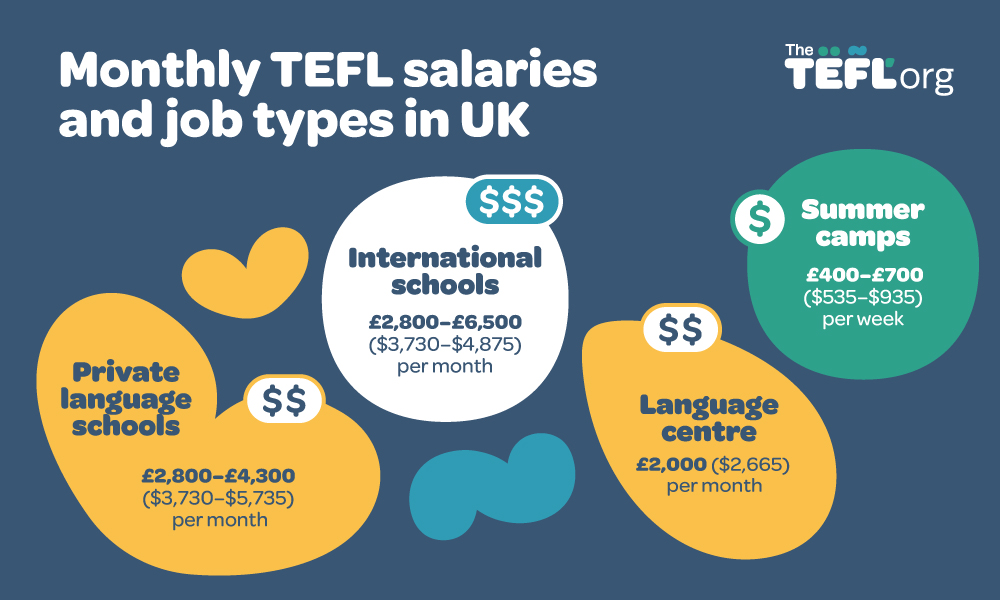
The salary for teaching English in the UK varies significantly depending on your job type and experience. English teacher salaries — not including public school salaries — range from around £2,000–£6,500 ($2,665–$4,875) per month depending on the institution.
While some public school teachers help foreign students with EAL (English as an Additional Language), they’re typically trained to teach more than just English. So generally, TEFL or ESL teachers work at private language centres, international schools, summer camps, or as private tutors or online teachers.
Here’s a rough breakdown of teaching salaries for different jobs:
- Public school teacher: Public school teachers in the UK generally earn from £2,800–£4,300 ($3,730–$5,735) per month in addition to excellent pension benefits. But again, requirements include a postgraduate teaching qualification.
- International school teacher: International school salaries can range from £2,800–£6,500 ($3,730–$4,875) per month depending on the school’s reputation and your experience.
- Language centre: Private language centres (or language schools) are more entry-friendly, but salaries vary. Full-time teachers earn around £2,000 ($2,665) per month at these schools, but some contracts are on a part-time basis.
- Private tutor: Tutors can set their own rates, usually from £20–£50 ($26–$66) per hour or more if you have experience and a degree in English or education.
- Summer camp: Summer camps usually pay teachers £400–£700 ($535–$935) per week depending on the placement, but contracts usually only last a few months.
- Online teacher: Online English teachers average between £8–£20 ($10–$26) per hour depending on whether they work independently or with a language platform. Online platforms often take a cut of your earnings, lowering the hourly rate.
How much does it cost to live in the UK?
The UK can be an expensive place to live, but it varies significantly across the country. The national average ranges from £1,500–£2,000 ($2,000–$2,665) per month including rent, food, and other services. But it doesn’t give a full and accurate picture depending on where you’re living.
| Restaurants | GBP | USD | EUR |
|---|---|---|---|
| Inexpensive restaurant meal | |||
| Domestic beer (0.5 litre) | |||
| Regular cappuccino | |||
| Water (0.33 litre) | |||
| Markets | GBP | USD | EUR |
| Regular milk (1 litre) | |||
| Loaf of white bread | |||
| Regular eggs (1 dozen) | |||
| Apples (1 kg) | |||
| Transportation | GBP | USD | EUR |
| One-way ticket (local transport) | |||
| Monthly pass (regular price) | |||
| Taxi start (normal tariff) | |||
| Gasoline (1 litre) | |||
| Utilities | GBP | USD | EUR |
| Electricity, heating, cooling, water, and garbage (for a regular apartment) | |||
| Regular prepaid monthly mobile tariff with 10GB+ data | |||
| Internet (60 Mbps, unlimited data, cable/ADSL) | |||
| Clothing and shoes | GBP | USD | EUR |
| Pair of jeans (Levis 501 or something similar) | |||
| Summer dress in a chain store | |||
| Nike running shoes (mid-range) | |||
| Men's leather business shoes |
Living in major hubs like London is significantly more expensive than living in Newcastle or Liverpool, for example, and southern cities (closer to London) are generally more expensive (but not always).

Here’s how the cost of living compares across different cities in the UK:
- London: £3,340
- Edinburgh: £2,120
- Cardiff: £1,760
- Belfast: £1,745
- Manchester: £2,100
- Glasgow: £1,835
- Liverpool: £1,730
- Newcastle: £1,760
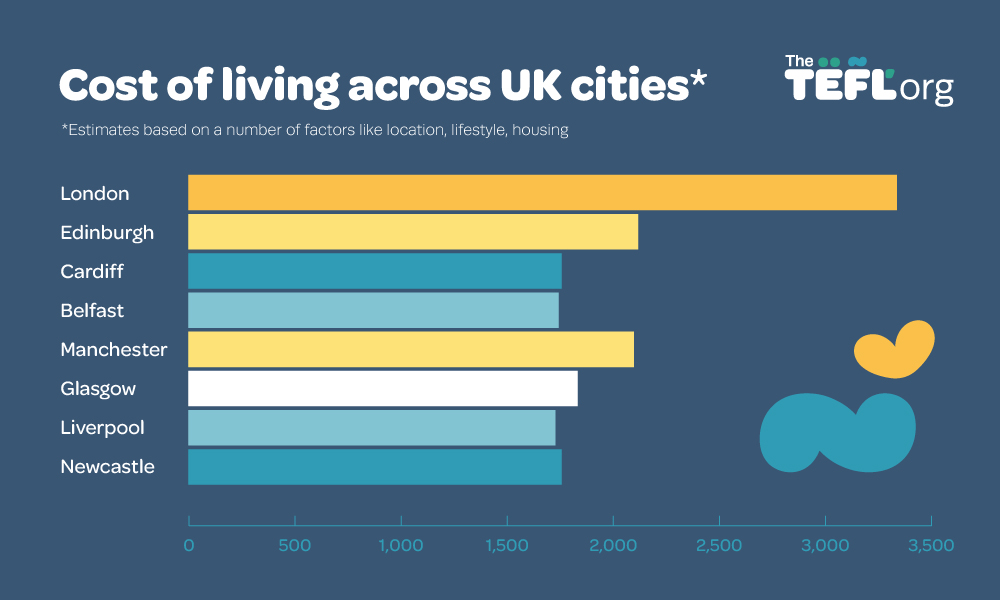
Remember, these are estimates based on a number of factors like location, lifestyle choices, and more. You can spend much less (or more) depending on your lifestyle and budget.
English Teaching Jobs in the UK
With a big migrant population, there are plenty of English teaching jobs in the UK. While summer jobs and many language schools in the UK are great for entry to mid-level TEFL teachers, international schools are more suited for experienced and more qualified teachers with a QTS qualification.
If money isn’t a priority, there are plenty of volunteering opportunities for teaching English in the UK, too. You can find plenty of jobs on platforms like The TEFL Org Jobs Centre, Indeed, LinkedIn, and so on.
Private language schools
Private language schools or language centres are a great way for students to learn additional English language skills. Generally, these students are migrants who are learning Academic English or Business English to improve their comprehension in the classroom or at work.
Student ages vary from young learners to adult professionals, and lessons usually take place after school or work in the evening and on weekends.
What to expect at private language schools in the UK:
- Smaller classrooms
- Teaching general and ESP (English for Specific Purposes) subjects to migrants
- Evening and weekend work
- Mainly adult students
International schools
International schools are popular among students from expat families. These international students want to study at a school that offers an excellent standard of teaching and small class sizes. While many international schools in the UK follow the British national curriculum, others follow an American or International Baccalaureate curriculum.
Tuition fees are high at these private schools, as are expectations of students and from teachers.
What to expect at international schools in the UK:
- Teaching international students
- Following a British, American, or International Baccalaureate curriculum
- Excellent salary and benefits
- High workload
Private tutoring
If you’ve got a degree in English, education, or just the enthusiasm for teaching, you could do freelance private tutoring. The flexibility to set your own hours and rates comes at a trade-off for preparing your lesson materials to each student or group. You’ll also need to market yourself to students, and earnings can be slow to begin with as you gather a client base, reviews, and testimonials.
What to expect as a private tutor in the UK:
- Flexibility in setting your own hours and rates
- Marketing yourself to students
- Planning your own lessons and materials
Summer camps
Many international students or foreign students join summer camps to improve their English skills, make friends, and develop confidence. While some summer schools have traditional classroom settings, most focus on engaging and team-building activities while learning English in a less formal environment.

This is an excellent way to gain experience or fill your time if you’re a TEFL teacher keeping yourself occupied and earning money over the summer break.
What to expect at a summer camp in the UK:
- Teaching English in less formal settings
- Short-term contracts
- Emphasis on team-building and outdoor activities
Teaching English Online in the UK
Teachers with British accents are in high demand across the world, especially on online learning platforms. With huge markets of students in China, India, Thailand, Indonesia, Brazil, and beyond, there are plenty of opportunities to teach online from the UK.
Teach English online independently
As an online English teacher, you can do it independently by marketing yourself online and hosting your own lessons on Zoom. However, this requires a lot of work, from setting up your own profile or website, advertising yourself to students, setting up lessons and your own curriculum, and so on.Or, you can join a third-party platform like Preply where you can set up your teacher profile and connect with students. It’s essentially a teaching marketplace; while you’re in complete control of the curriculum and lesson planning, the platform takes a small percentage of your earnings.
Teach English online with online ESL platforms
This is the most convenient way to teach English online because most ESL companies organise the curriculum, lesson materials, and schedule for you. They also assign your students, which means you don’t need to market or recruit students yourself. Popular examples include:
Teach English online as a volunteer
If you’re looking to make a difference by volunteering with asylum seekers, refugees, and other students in need, you can volunteer online. Here are some of the best online ESL volunteering opportunities:
- RefuNet: RefuNet connects online teachers to volunteer with asylum seekers and refugees, one hour per week for a minimum of three months.
- Breaking Barriers is based in London, but experienced teachers can volunteer to teach English online to groups of refugee learners. Lessons can range from general English, Business English, writing skills, IELTS preparation and English for the workplace. Courses run for up to 10 weeks, with two-hour lessons on Saturday mornings or weekday evenings. Volunteers must commit to at least two courses.
- Bristol Refugee Rights offers opportunities to support English learners through one-to-one tuition, group classes and online lessons. Check its volunteering page for current roles and requirements.
- Refugee Action lists organisations you can contact to find out more about volunteering to teach English in the UK.
- ENGin is a nonprofit organisation that offers free English lessons to refugees from Ukraine online. As a teacher with ENGin, you’ll teach weekly lessons with students looking for conversational lessons.
Teaching English in Major Cities
From the White Cliffs of Dover to the highlands in Scotland, there are plenty of cities with diverse populations to consider teaching English. Whether you’re after a cool art scene, hiking trails and green spaces, or some of the best footballing cities, the UK has it all.
Opportunities are available in colleges, universities, language centres, charities, and so on. While options range from England, Wales, Scotland, and Northern Ireland, we’ve narrowed it down to the cities that offer the best job market for TEFL teachers.
Teach English in London

London is one of the world’s most internationally diverse cities, home to people of all backgrounds and welcoming around 22+ million people per year. As a political, financial, and cultural capital, many international students and workers head to “The Big Smoke” to improve their career prospects and earning potential.
Around 40% of London’s population come from outside of the UK. And while most migrants already speak English, many want to improve conversational and technical English skills, creating TEFL / ESL jobs at language centres, international schools, private tutoring or summer camp opportunities.Teach English in Manchester

Home to Oasis, football heritage, picturesque canals and lively pubs, Manchester is the UK’s unofficial Capital of the North. The city has a large international population, and many migrants look to improve their English to navigate daily life, pursue further education and find work.
With plenty of teaching opportunities, you could teach learners with different levels of English, from beginners building basic communication skills to more confident speakers working towards employment or study goals.
Teach English in Birmingham

Located in the West Midlands, Birmingham is one of the UK’s most diverse cities and also a huge economic hub. With a multicultural population, there are plenty of foreign-born students and workers looking for private tutors and language courses to supplement their English education.
Ready to Start Teaching? Don’t Forget Your TEFL Certificate
Whether you’re setting up shop to teach in the UK or teach English abroad, you’ll need a TEFL certificate to get started. While it’s a technical requirement from many employers, it’s also a practical one in the classroom. From classroom management to lesson planning and more, studying a TEFL course will help you become an effective and engaging leader in the classroom.
And whether you’re contemplating teaching in the UK or teaching abroad, you’re certified for life! Get started today with our 120-hour TEFL course.Frequently Asked Questions
Q. How to become an ESL teacher in the UK?
You’ll need to become TEFL certified, and a degree isn’t essential but will boost your application and qualify you to teach full-time in many schools. You don’t need teaching experience to start, but many employers require it.
Q. What is the average salary for an ESL teacher in the UK?
ESL or TEFL teachers can earn around £2,000–£6,500 ($2,665–$4,875) per month depending on their experience, qualifications, and the type of school they work in.
Q. Are ESL teachers still in demand?
ESL and TEFL teachers are in high demand globally, and the UK is home to millions of workers and students whose first language isn’t English.
Q. What qualifications do you need to teach ESL?
English as a Second Language teachers generally need a TEFL or a TESOL certificate, and a bachelor’s degree is highly preferred. If you want to earn the highest salaries, you’ll need a teaching licence, previous teaching experience and a degree in English or education.