









The Philippines attracts millions of tourists every year with its tropical islands and colonial architecture. After the Spanish-American War, this vibrant archipelago of over 7,000 islands adopted a Western-style education system, with English becoming the primary language of instruction.
Today the Philippines has a very high level of English proficiency, making it hard for foreign teachers to find work. As a result, demand and salaries for TEFL teachers are lower than other Asian countries - but it's still possible to find jobs. Find out how in The TEFL Org's guide to teaching English in the Philippines!
Key Takeaways
- English and Filipino are the country's official languages, making the English teaching market competitive.
- Labour laws in the Philippines protect local workers, so TEFL teachers need qualifications such as a bachelor's degree and TEFL certification to teach.
- The average monthly salary for foreign English teachers ranges from ₱40,000–₱100,000 ($670–$1,670 / £495–£1,230).
- Most jobs for foreign English teachers exist in private language academies and international schools.
- The capital city, Manila, offers the busiest TEFL market.
- Teachers need a 9G Pre-Arranged Employment Visa and an Alien Employment Permit to teach legally.
Requirements for Teaching English in the Philippines
Many Filipinos learn the English language from an early age, making it difficult to break into the TEFL scene in the Philippines without qualifications and teaching experience on your side.
Do I need a TEFL certification to teach in the Philippines?
An accredited TEFL certificate is essential to teaching in the Philippines, with most schools requiring at least 120 hours of TEFL training. The country has a "Filipino first" policy, so employers need to prove that you're a qualified teacher to sponsor your visa.Tip: While a 120-hour TEFL is the minimum requirement, you can improve your skills with TEFL Org's Level 5 TEFL course, or specialise in teaching business English which is desirable in the Philippines.
Can I teach English in the Philippines without a degree?
You'll need a bachelor's degree to secure a paid teaching job in the Philippines. Considering the existing level of English proficiency in the Philippines, a degree and TEFL training will help you succeed in a competitive market.
Read more: How to teach English abroad without a degree
Can I teach in the Philippines without experience?
Yes, it's possible to teach English in the Philippines without teaching experience. However, while inexperience won't completely rule you out of teaching jobs in the Philippines, many schools (particularly international schools) prefer experienced teachers for paid positions.
Tip: You can make up for a lack of experience by taking an in-person TEFL course that includes teaching practice.

Visa requirements for teaching in the Philippines
To find a paid teaching role in the Philippines, you'll need a 9G Pre-Arranged Employment Visa. This means securing a job before arrival, and your employer will sponsor your work visa and help you get an Alien Employment Permit (AEP).
The AEP requires proof that no qualified Filipino can fill the role, reflecting the country's "Filipino First" policy, which prioritises local workers. Because English is widely spoken, foreign teachers typically need strong qualifications or experience to meet this requirement.
To apply for a visa to teach English in the Philippines, you'll need the following:
- 9G Visa application form
- Job contract from a Filipino employer
- Proof of academic qualifications and training, like your bachelor's degree and TEFL certificate
- Valid passport
- Clear criminal background check
Important: Immigration rules can change! The information above is not intended as legal or visa advice; to comply with regulations, be sure to check the Bureau of Immigration Philippines website for updated rules.
Read more: Teaching English abroad visas
Recap: Everything you need to teach English in the Philippines
Here's everything you need to become an English teacher in the Philippines:
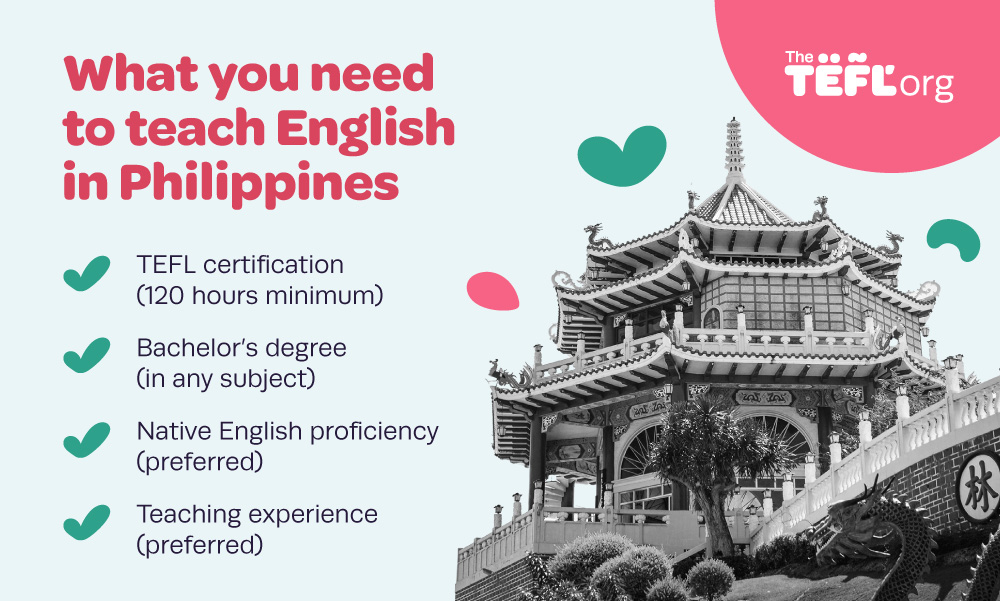
- TEFL certification (120 hours minimum)
- Bachelor's degree (in any subject)
- Native English proficiency (preferred)
- Teaching experience (preferred)
Download our guide to teaching English in Asia
The ultimate guide to life, culture and work as a TEFL teacher in Asia.
Salary and Cost of Living
To consider how much you'll earn and spend as a teacher in the Philippines, you'll need to consider many variables.
How much can you earn teaching English in the Philippines?
The average salary for English teachers in the Philippines ranges from around ₱40,000–₱100,000 ($670–$1,670 / £495–£1,230). While it's a big range, it depends on multiple factors.
- Experience & qualifications: Having a TEFL certificate and a degree is essential to maximising your teaching salary. Advanced qualifications like a teaching licence or a university degree in education will lead to a much higher salary.
- Location: Manila offers some of the highest salaries for English teachers in the Philippines. While teaching jobs exist on the islands, many of these roles will be through volunteer projects.
- Teaching job type: Public and private schools offer the average salary, whereas international school teachers can earn as much as ₱80,000–₱150,000 ($1,335–$2,500 / £985–£1,840).
Find out how much you can earn as an English teacher abroad
How much does it cost to live in the Philippines?
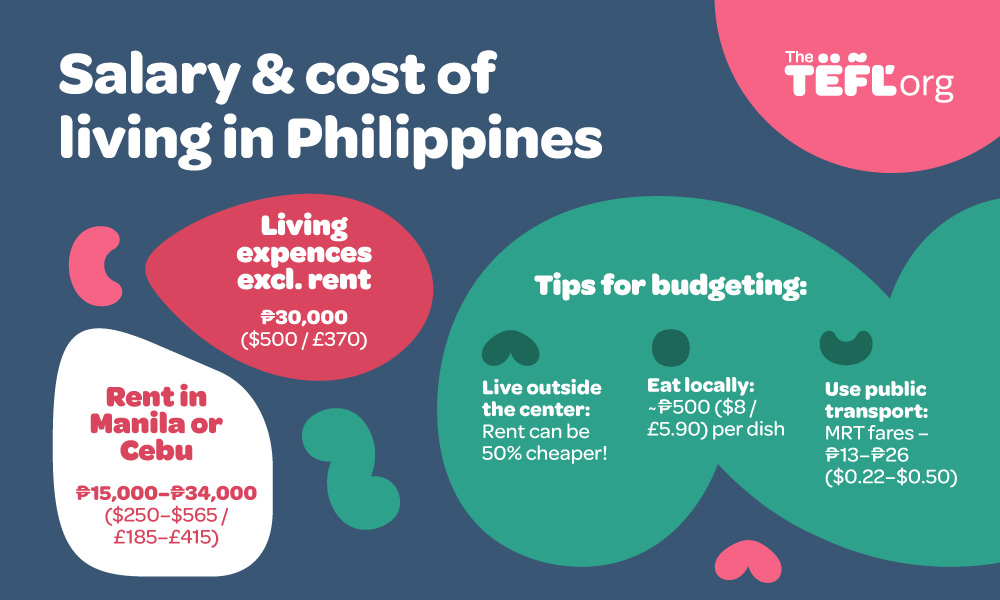
The Philippines boasts a low cost of living, with the average person spending around ₱30,000 ($500 / £370) per month excluding rent. Rent for a one bedroom apartment in popular cities such as Manila or Cebu ranges from ₱15,000–₱34,000 ($250–$565 / £185–£415) per month.
| Restaurants | PHP | USD | GBP |
|---|---|---|---|
| Inexpensive restaurant meal | |||
| Domestic beer (0.5 litre) | |||
| Regular cappuccino | |||
| Water (0.33 litre) | |||
| Markets | PHP | USD | GBP |
| Regular milk (1 litre) | |||
| Loaf of white bread | |||
| Regular eggs (1 dozen) | |||
| Apples (1 kg) | |||
| Transportation | PHP | USD | GBP |
| One-way ticket (local transport) | |||
| Monthly pass (regular price) | |||
| Taxi start (normal tariff) | |||
| Gasoline (1 litre) | |||
| Utilities | PHP | USD | GBP |
| Electricity, heating, cooling, water, and garbage (for a regular apartment) | |||
| Regular prepaid monthly mobile tariff with 10GB+ data | |||
| Internet (60 Mbps, unlimited data, cable/ADSL) | |||
| Clothing and shoes | PHP | USD | GBP |
| Pair of jeans (Levis 501 or something similar) | |||
| Summer dress in a chain store | |||
| Nike running shoes (mid-range) | |||
| Men's leather business shoes |
Here's how you can stretch your salary as a teacher in the Philippines:
- Live outside the city centre: Living outside the city centre can reduce your rent by up to 50%. In Manila, expensive areas include Makati and Taguig, while other areas like Las Piñas, Marikina, and Valenzuela offer much more affordable living.
- Opt for shared housing: Shared housing can reduce your rent significantly. To find housemates in the Philippines, you can check out local Facebook groups or websites like Homates, Dormy.ph, and Coliving.com.
- Use public transport: Instead of taxis, use Jeepneys and the MRT/LRT trains in Manila. MRT fares range from ₱13–₱26 ($0.22–$0.50) in Manila.
- Eat like a local: Eating local food is always cheaper than imported food. Visit local markets when you can, but if you decide to eat out, local eateries called carinderias offer dishes for as little as ₱500 ($8 / £5.90).
English Teaching Jobs in the Philippines

The local education system hires local teachers more often than not, meaning that most teachers will find their work in the private sector.
The private sector offers the highest demand for foreign English teachers, particularly in private language academies and international schools. Teaching opportunities are strongest in major cities like Manila, Cebu, and Quezon, where English is widely used in business and education.
Private language schools
Private language schools range from teaching young learners to delivering vocational and business English for professionals. With many international companies outsourcing to English-speaking workers in the Philippines, demand for English language skills in the workplace remains strong, especially in customer-facing industries like Business Process Outsourcing.
Typical expectations of teaching in private language schools in the Philippines:
- Weekend and evening classes
- Teaching young learners and/or adults
- Teachers specialising in business English or exam preparation
International schools
Due to strong Western influence, international schools are widespread and cater to expat and affluent local families, often following British or American curricula. These roles offer the highest salaries, best facilities, and strong benefits, but require advanced qualifications, such as a degree in education, a teaching licence or advanced TEFL, and prior teaching experience.
Many schools have religious or international roots, particularly Catholic, but teachers aren't required to follow a specific faith.
Typical expectations of teaching in international schools in the Philippines:
- Teaching local and foreign students
- Excellent classroom facilities and an international curriculum
- High expectations and responsibilities, 25+ teaching hours per week
Teaching English in Major Cities
With so many popular islands and bustling cities, it can be difficult knowing where to start in the Philippines.
Teach English in Manila
As the capital and financial hub, Manila offers the strongest job market for TEFL teachers. Influenced by Spanish, Chinese, and American cultures, it's a multicultural city where English is widely spoken, making it easy to navigate.Despite this, there is strong demand for advanced English skills in multinational companies, creating opportunities in corporate training programmes and international schools. Reputable international schools include British School Manila, ILAM, and Canadian American School.
Outside the classroom, Manila offers a mix of colonial history, Baroque churches, local markets, and modern districts like Bonifacio Global City, as well as access to the world's oldest Chinatown.
Teach English in Cebu
Cebu offers a more relaxed alternative to Manila, with opportunities in private language schools and international schools. With a significant Korean and Chinese student population, there are many international students looking to improve their English in Cebu.
Vocational English training is also popular, especially in business and IT sectors, with notable language centres including GLC, B'Cebu, and Genius ESL.
In your free time, you can explore historical sites like the Basilica Minore del Santo Niño and Magellan's Cross, discover Chinese heritage with Taoist Temples, and enjoy easy access to beaches and island destinations such as Moalboal.
Ready to Teach English Abroad? Don't Forget Your TEFL Certificate
Whether you're teaching English in the Philippines or elsewhere in the world, you'll need to have the right skills and qualifications to teach English as a foreign language.
A TEFL course doesn't just check boxes — you'll feel prepared for a career in the classroom. From teaching methods, classroom management, lesson planning and more, you'll lead the classroom with confidence with a TEFL certificate.Courses at the TEFL Org can be completed online or in-person in as little as 4–6 weeks. To meet the minimum requirements in this industry and gain access to TEFL jobs across the globe, check out our 120-hour TEFL to get started!
Read more about teaching English in the Philippines:
Frequently Asked Questions
Q. How much do English teachers make in the Philippines?
The average salary for English teachers in the Philippines ranges from ₱40,000–₱100,000 ($670–$1,670 / £495–£1,230). Teachers with advanced TEFL qualifications, a degree in education, and experience can earn even more. Find out more about teaching salaries across the world.
Q. Are English teachers in demand in the Philippines?
There isn't a significant demand for English teachers in the Philippines, as English is an official language. However, foreign teachers can find a paid English teaching job with the right qualifications such as a TEFL certificate and a university degree.
Q. What are the requirements to be a teacher in the Philippines?
To teach English in the Philippines, you'll need a degree (in any subject) and an accredited TEFL certificate.
Q. Can foreigners teach in the Philippines?
Yes, foreigners can teach in the Philippines provided they meet the criteria for a working visa. Labour laws in the Philippines mandate a preference for local teachers, so foreign teachers need qualifications such as a bachelor's degree or accredited TEFL certificate.
Q. Can non-native speakers teach in the Philippines?
Non-native speakers can teach in the Philippines, but they'll face far more competition than native English speakers. Non-native speakers can find teaching positions particularly if they have a TEFL, teaching licence, and years of experience.