










From Machu Picchu and the Amazon rainforest to colourful colonial cities, Peru is one of South America's most popular countries. But while many head to Peru for its awe-inspiring sceneries and indigenous history, it’s also a great place to launch your TEFL career.
While Peru isn’t the most lucrative TEFL location, its colourful festivals and flexible entry-requirements might be enough to convince you to stay for the long haul. Read on for The TEFL Org guide to teaching English in Peru, from the requirements, salary expectations, top locations, visas, and more!
Key Takeaways
- Peru has a high demand for English teachers, especially in larger cities like Lima, Cusco, and Arequipa.
- Teachers need a TEFL certificate to teach in Peru; most employers prefer teachers with university degrees, teaching experience, and native English proficiency, but they’re not always essential.
- TEFL teachers in Peru can earn around S/.1,500–3,500 ($440–$1,030 / £330–£775) per month at language centres, or up to S/.5,000–9000 ($1,470–$2,650 / £1,105–£1,990) at international schools.
- Most teaching jobs come in the private sector at language centres and international schools.
- English teachers need the resident work visa to teach in Peru legally.
Requirements for Teaching English in Peru
Peru has moderate English speaking levels, and you can get by with just English in popular cities like Lima, Cusco, or Arequipa. While public schools include English in the national curriculum, not much time is spent on the subject which means many Peruvians lack conversational English skills. This means that the competition from local teachers is lower than in other countries.
That said, you still need to meet certain benchmarks. Here’s everything you need to know about the requirements for teaching abroad in Peru.
Do I need a TEFL certification to teach English in Peru?
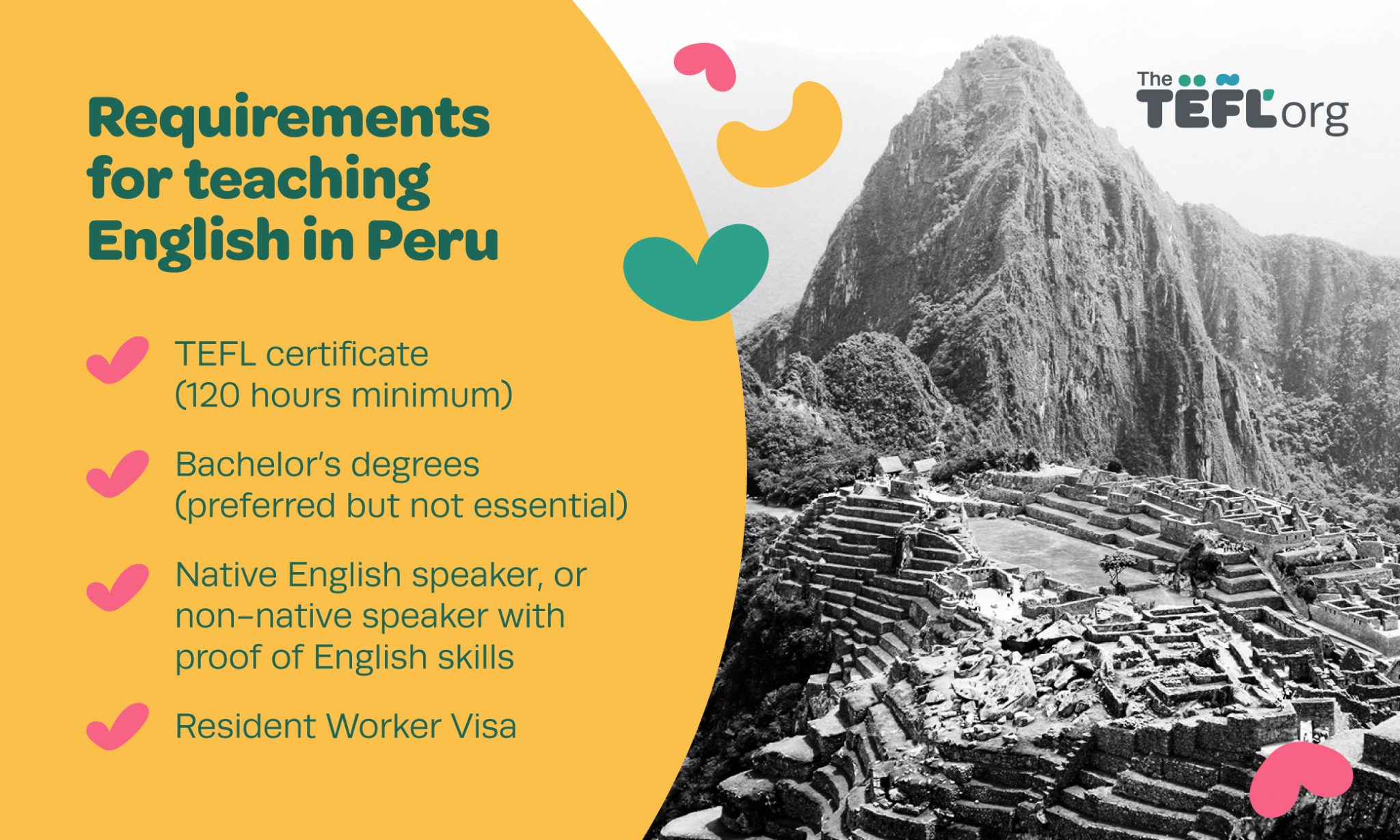
It’s not a legal requirement, but a TEFL certificate is essential to your teaching career in Peru. In most cases, a 120-hour TEFL certificate is enough for TEFL jobs in Peru, but some employers at higher paying jobs might prefer teachers with a Level 5 TEFL certificate or a teaching license.
A TEFL course isn’t just a formality for employers, it’ll give you the classroom management skills and lesson planning abilities needed to have a successful teaching career in Peru and wherever you go next.Can I teach English without a degree in Peru?
If you’re a non-graduate, you can still teach abroad without a degree in Peru. But you might need to spend more time on your job search or settle for a lower salary. Most employers prefer teachers who have a university degree in any subject, but teachers with a degree in English or education can find higher paying jobs.
Do I need teaching experience to teach in Peru?
Because there’s a high demand for English teachers, Peru is a welcoming destination for entry-level teachers, so you can teach English without experience here, just as long as you’re TEFL certified. But inexperienced teachers might find themselves working for lower salaries until they gain enough classroom experience.
Can I teach in Peru as a non-native speaker?
Yes, you can teach abroad as a non-native speaker in Peru, especially if you can speak Spanish. If you’re a non-native speaker from outside of Peru, you’ll need to prove to employers that you have native English fluency in the form of an IELTS, CEFR, or TOEFL certificate.
Visa requirements for teaching English in Peru
You'll need a Resident Worker Visa to teach English legally in Peru. Most reputable language schools and international schools will sponsor your application once you've accepted a job offer. Although many teachers enter Peru on a tourist visa to search for work, you shouldn't teach until your work visa has been approved.
To get the resident work visa, you’ll need to meet the following requirements:
- Show proof of a flight ticket or reservation
- Signed job contract with a Peruvian employer
- Clear criminal background check
- Proof of academic and professional qualifications
- Health insurance
- Completed visa application form
If you’re from Canada, the U.S., or the U.K., you can enter Peru on a 90-day visa exemption (or a tourist visa) and search for work in-country. Once you’ve found the right teaching job, you’ll need to leave and re-enter Peru – this is called a “visa run”.
Download our Teaching English in Latin America Guide
Everything you need to know about teaching English in Latin America

Salary and Cost of Living
As far as South America goes, Peru is a budget-friendly travel destination, but you’ll need to compare the teacher salary with living expenses to see whether you can save.How much can you earn teaching English in Peru?
Teaching English in Peru won't make you rich, but most teachers earn enough to live comfortably. The average teacher salary in Peru ranges from S/.1,500–3,500 ($440–$1,030 / £330–£775) per month, and this salary should cover rent, transport and other everyday expenses.
Teachers at international schools can earn up to S/.5,000–9000 ($1,470–$2,650 / £1,105–£1,990), but you’ll need a bachelor’s degree, TEFL or teaching license, and years of teaching experience to qualify.
Tip: Bring savings with you to Peru, not just because you’ll wait a month or two before receiving your first payment, but you’ll also need a safety net while finding your feet in a new country.
How much does it cost to live in Peru?
Compared to Argentina or Chile, Peru is around 15–30% cheaper, and western countries like the UK and US are around twice to three times more expensive than living in Peru. But that doesn’t mean that you should spend money aimlessly once you get your first paycheck.
English teachers can expect to spend between S/.2,750–3,625 ($810–$1,065 / £605–£800) per month depending on their lifestyle, and cities like Lima can be more expensive, so you might need to apply some mindful spending habits to save money.
Here’s how to get more bang for your Peruvian sol:
- Be flexible with location: Don’t fixate on specific cities like Lima, be open-minded when it comes to location. Other cities like Arequipa offer an excellent lifestyle and rent that is around 40% cheaper than in the capital city.
- Split the rent: Living with other people is a great way to branch out and make friends, and it’s an effective money-saving tactic. A 1-bed apartment in Lima costs around S/.1,700 ($500 / £375), but a 3-bed apartment costs around S/.1,100 ($325 / £245) per person per month.
- Shop at local markets: Ditch the imported products and shop at local markets. From fresh fruit and vegetables to street food stalls, you can find plenty of Peruvian treats whether you want to cook at home or eat on the go.
- Find the set-price menú del día: If you do eat out, choose lunch over dinner! Some eateries offer a set-price menú del día or lunch menu for around S/.12 ($3 / £2.25) which includes a starter, main course, and a drink.
| Restaurants | PEN | USD | GBP |
|---|---|---|---|
| Inexpensive restaurant meal | |||
| Domestic beer (0.5 litre) | |||
| Regular cappuccino | |||
| Water (0.33 litre) | |||
| Markets | PEN | USD | GBP |
| Regular milk (1 litre) | |||
| Loaf of white bread | |||
| Regular eggs (1 dozen) | |||
| Apples (1 kg) | |||
| Transportation | PEN | USD | GBP |
| One-way ticket (local transport) | |||
| Monthly pass (regular price) | |||
| Taxi start (normal tariff) | |||
| Gasoline (1 litre) | |||
| Utilities | PEN | USD | GBP |
| Electricity, heating, cooling, water, and garbage (for a regular apartment) | |||
| Regular prepaid monthly mobile tariff with 10GB+ data | |||
| Internet (60 Mbps, unlimited data, cable/ADSL) | |||
| Clothing and shoes | PEN | USD | GBP |
| Pair of jeans (Levis 501 or something similar) | |||
| Summer dress in a chain store | |||
| Nike running shoes (mid-range) | |||
| Men's leather business shoes |
English Teaching Jobs in Peru
English teaching jobs in Peru exist across the country, but most can be found in larger cities like Lima, Cusco, and Arequipa. Most TEFL teachers will find work in private language schools, because public school jobs are generally reserved for locals with a citizenship.
It might sound counterintuitive, but the easiest way to find work is to search with “boots on the ground”. Most language schools want to meet with teachers in person for an interview. The school year runs from March–December, so plan your search for the peak hiring season in January or even earlier.
If arriving in Peru without having a job sounds risky, you can contact language schools directly to find jobs. Or, you can visit job boards like The TEFL Org Jobs Centre.
Private language schools
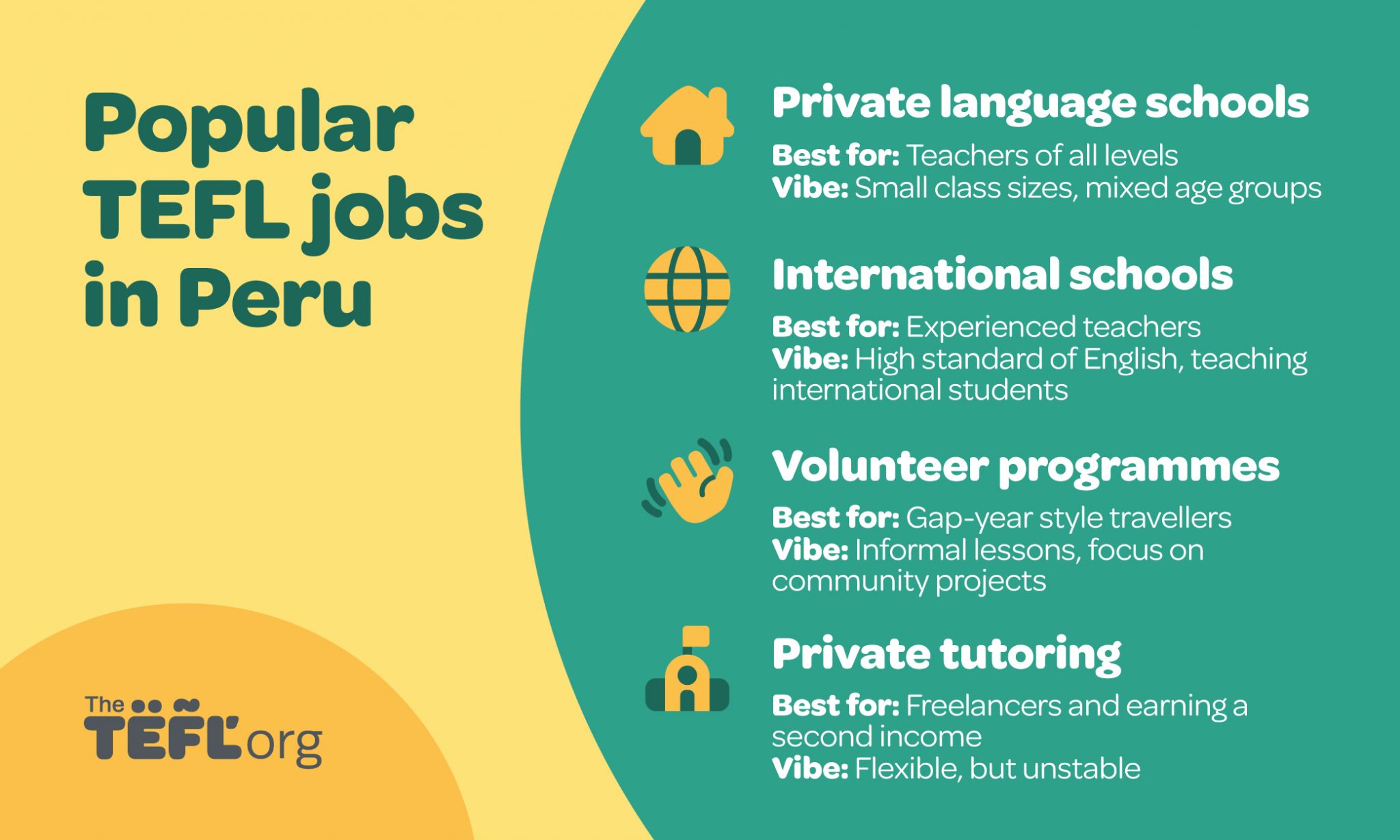
Private language schools make the bulk of Peru’s TEFL market, with students coming in the form of young learners, university students and business professionals. Plenty of students head these centres to improve their English skills, and many of them have a specific goal in mind like exam preparation or Business English.
If you have these skills, you can find schools that cater specifically to this audience at schools like Berlitz, International House, Británico, and more.
What to expect at private language schools in Peru:
- Evening and weekend classes
- Teaching a range of students, from young learners, teenagers, to adults
- Focus on ESP (English for Specific Purposes) subjects like Business English and exam preparation
Tip: Peru’s tourism industry is growing rapidly, and learning to teach Business English is a great way to boost your resume and cater to a specific demand.
International schools
Peru is home to many international schools that follow an American or British curriculum, and these jobs are among the best paid for teachers. These privately funded schools typically cater to local students from wealthier families or international students from expat families. Here, students learn English as a primary language (by itself or alongside Spanish if it’s a bilingual school).
What to expect at international schools in Peru:
- Monday to Friday schedule
- Teaching local and international students following a US, UK, or IB curriculum
- Excellent classroom facilities and small class sizes
- High salary and excellent benefits, but very high requirements and responsibilities
Volunteer programmes
If you're looking to gain experience while giving something back, volunteering in Peru is a great option. NGOs like Sayari Peru and Vive Perú place TEFL teachers in communities where access to English education is limited, often providing accommodation and meals in return. You'll build valuable classroom experience and experience everyday life with local communities while making a lasting impact on your students.
What to expect volunteering in Peru:
- Short-term projects with NGOs like Sayari Perú and Vive Perú
- Receive a small stipend or accommodation
- Teaching English to underprivileged communities
Private tutoring
Many teachers supplement their income through private tutoring. In Peru’s cities, particularly Lima, there are plenty of opportunities to teach English to eager students, whether they want to study English for fun, improve their business English, or prepare to study or work abroad.
Most English tutors in Lima charge between S/.40–90 ($12–$26 / £9–£20) per hour. Demand is higher in cities, where English is more important in tourism and business.
Tip: While people often describe Peruvian culture as “laid-back”, the Peruvian government launched a national campaign to drop the habit of keeping to hora peruana (Peruvian time), which often meant being late to meetings.
Teaching English in Major Cities
Peru is a big country, so there’s plenty of choice when choosing where to teach English. Whether you’re looking for the highest salary, the best lifestyle, or sweeping landscapes, here are the top cities for teaching English in Peru.
Teach English in Lima

If you're looking for the widest choice of teaching jobs in Peru, head to the capital, Lima. As the largest city, it's home to private language schools, universities, international schools and a growing market for private tutoring.
Outside the classroom, Lima is much more than a stopover on the way to Cusco. Tucked along the coast, you can spend your weekends discovering the city’s famous food scene, surfing in Miraflores, and visiting pre-Incan pyramids like Huaca Pucllana. When you’re done teaching but want to stay local, you can visit the museum of art or watch the sun set over the Pacific Ocean from the malecón.
Teach English in Arequipa

Known as Peru's “White City”, Arequipa offers a slower pace of life than Lima without sacrificing career prospects. Private language schools and universities regularly hire English teachers, and the city's lower cost of living means your salary can stretch further.
Arequipa is a great home base for adventurers, with Colca Canyon and El Misti, an active volcano that overlooks the whole city – right on your doorstep. If you want to appreciate El Misti from afar, you can stare at it while checking out the idyllic Basilica Cathedral – or anything else in the city.Teach English in Cusco

Known as the “Belly Button of the World” for its proximity to the equator, Cuscois Peru’s cultural heart. Like Lima, Cusco offers TEFL teachers plenty of options for entry-level and experienced teachers, from language schools and plenty of volunteer teaching opportunities around the city.
One of the biggest benefits of living in Cusco is that one of the world's greatest archaeological sites is right on your doorstep. Visit Machu Picchu during the quieter months, then spend the rest of your weekends exploring the Plaza de Armas, wandering through San Pedro Market or discovering the impressive Inca ruins of Saqsayhuamán.

Ready to Teach English Abroad? Don’t Forget Your TEFL Certificate
Before you start looking for flights to teach English abroad, you'll need to be TEFL certified. A TEFL certificate isn't just a badge on your resume to automatically qualify for a job teaching English, you'll become a skilled and confident teacher because of your studies. With a TEFL course, you'll learn to identify common errors in the classroom, plan and deliver engaging lessons, navigate complex questions, and so much more.
Get started today with our 120-hour TEFL course.
Frequently Asked Questions
Q. Do I need a degree to teach English in Peru?
You can teach English in Peru without a degree, but employers prefer teachers who have a university degree, especially at higher-level positions like universities, international schools, and specific language schools.
Q. What is the average salary for English teachers in Peru?
TEFL teachers in Peru can earn around S/.1,500–3,500 ($440–$1,030 / £330–£775) per month at language centres, but international school teachers can earn up to S/.5,000–9000 ($1,470–$2,650 / £1,105–£1,990).
Q. Can I teach in Peru as a non-native English speaker?
Yes, you can teach English as a non-native speaker in Peru, especially if you have Spanish language skills. But it might affect your salary potential, because many employers want teachers who have specific accents like British or American.
Q. What are the visa options for TEFL teachers in Peru?
Teachers need to get the resident work visa to teach English in Peru legally. You can also enter Peru on a visa-exemption or a tourist visa and search for work in-person, but this also means that you’ll need to leave and re-enter once your work visa has been processed.
Q. Is Peru safe and affordable for first-time teachers?
Yes, Peru is safe and affordable for first-time teachers. But inexperienced teachers will need to work their way up starting from lower salaries, so be sure to bring some savings with you as a safety net.