



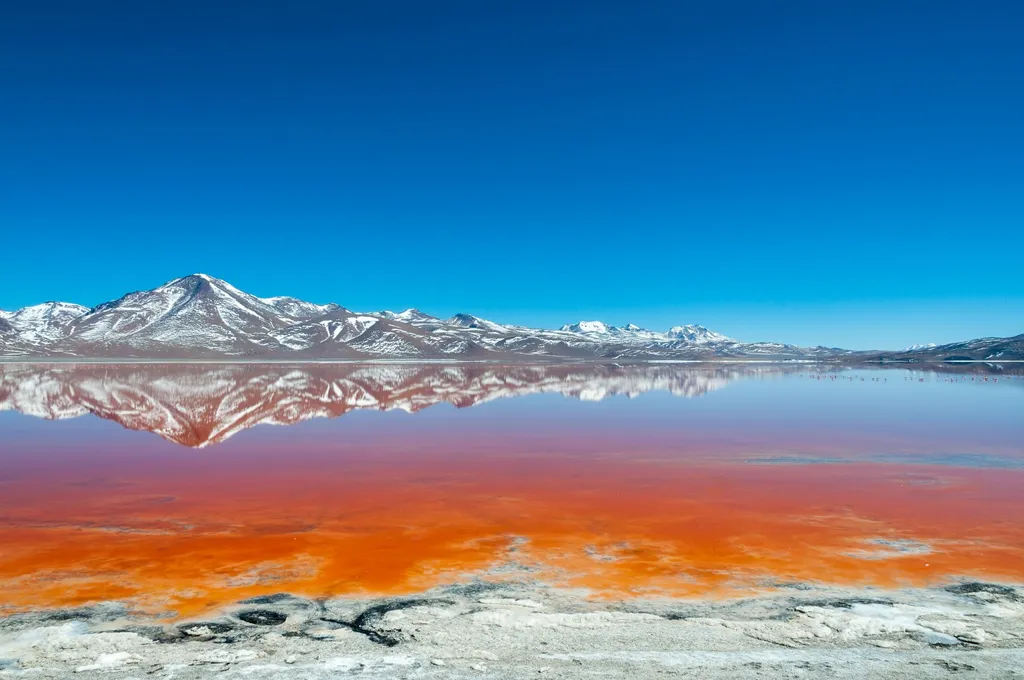
Landlocked between South American giants like Brazil, Argentina, and Peru, Bolivia has plenty of competition when it comes to the travel scene. But while this more secluded country welcomes fewer visitors each year, this is down to a lack of visibility rather than a lack of quality.
But Bolivia’s appeal isn’t limited to attractions like the marvellous Salar de Uyuni, Andean mountain landscapes or its vast canyons, it’s also got a high demand for English teachers. Read on for The TEFL Org’s guide to teaching English in Bolivia, from the best jobs, salaries, visa requirements, and more.
Key Takeaways
- Spanish is the most spoken language in Bolivia, and English proficiency levels are low.
- Foreign teachers need a TEFL certificate, while a bachelor’s degree and prior teaching experience are preferred but not essential.
- Most teaching jobs come in the form of private language institutes like language schools or international schools.
- Most English teachers earn around Bs 4,650–9,300 ($400–$800 / £295–£590) per month. International school teachers can potentially earn up to Bs 14,500–17,440 ($1,240–$1,500 / £915–£1,105) at specific schools.
- English teachers need the Specific Purpose Work Visa.
- Top TEFL locations include La Paz and Santa Cruz.
Requirements for Teaching English in Bolivia
Bolivia has 37 recognised official languages (the most of any country in the world), and English isn’t one of them.
Spanish is the most spoken language in Bolivia, and fluent English speakers are rare. Not much time is spent on learning English in public education either, so the teaching requirements aren’t exactly strict compared to other South American countries.
But for those who want to learn English to improve academic and career prospects, they’ll still look for teachers with the right qualifications.
Do I need a TEFL certificate to teach English in Bolivia?
It’s not a legal requirement, but looking for TEFL jobs without a certificate won’t get you very far in Bolivia. While it might land you a volunteer position, most employers require a minimum of 120 hours of TEFL training for paid jobs.
From classroom management skills to differentiating confusing grammar rules, a TEFL course covers the essentials when it comes to teaching English as a foreign language.
Can I teach English without a degree in Bolivia?
Not having a degree won’t hold you back from teaching in Bolivia, just as long as you’ve got a TEFL certificate. But while you can teach English without a degree in Bolivia, it’ll limit your job search and salary potential. Most employers at higher paying private language schools and international schools require teachers with university degrees.
Do I need teaching experience to teach in Bolivia?
Yes, you can teach English without experience in Bolivia. Many employers welcome inexperienced teachers as long as they’re fluent in English or have a TEFL certificate. But not having experience will limit how much you can earn until you’ve got a few years of experience under your belt.
Can I teach in Bolivia as a non-native speaker?
Yes, you can teach English as a non-native speaker in Bolivia. While some employers might prefer native English speakers, it’s not always an essential requirement. You’ll just need to prove that your English is of a high standard through a language certificate like IELTS, TOEFL, or CEFR.
Tip: If you can speak Spanish, employers will note that you can communicate with co-workers and that culture shock might be less of a factor.
Visa requirements for teaching English in Bolivia
To teach English in Bolivia legally, you’ll need the right work visa. But you’ll need to find a job first, and then your employer can sponsor your application for the Specific Purpose Work Visa, and then you’ll need to apply for a residence permit once you arrive.
You’ll apply for the Specific Purpose Work Visa through the online portal (if your country has one), and then head to the nearest Bolivian consulate/embassy for an interview. This visa is valid for 1–3 years.
You’ll need to show proof of the following documents:
- Valid passport with minimum 6 months validity
- Invitation letter from Bolivian employer
- Academic and professional qualifications (TEFL, degree, etc.)
- Clear criminal background check
- Flight details
- Cover letter
- Medical certificate and vaccinations certificate
Important: Some employers might want teachers to work on tourist visas / visa exemptions and complete visa runs. This is illegal and can lead to fines or deportation.
Download our guide to teaching English in Latin America
Everything you need to know about teaching English in Latin America
Salary and Cost of Living
A secluded and landlocked country in South America, you might assume that Bolivia is an affordable country. And it is — but how do living costs compare to the teacher salary?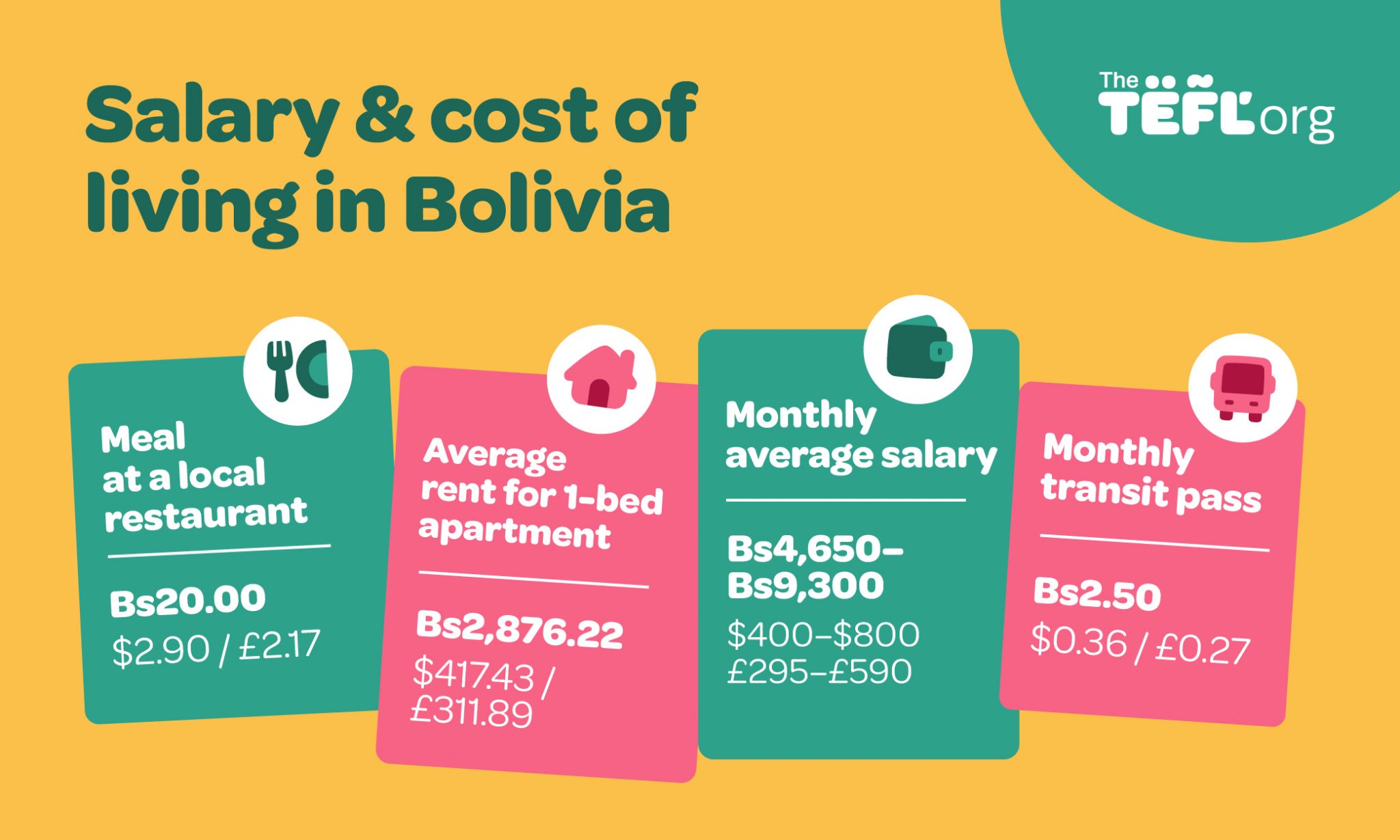
How much can you earn teaching English in Bolivia?
Teaching in Bolivia isn’t a lucrative opportunity, and English teachers can expect to earn around Bs 4,650–9,300 ($400–$800 / £295–£590) per month. But while this seems low, you’ll still have a very comfortable lifestyle on this salary. You’ll find most paid opportunities at private language centres and international schools.
If you have a bachelor’s or master’s degree and a few years of classroom experience, you might be able to land an international teaching job. These jobs pay up to Bs 14,500–17,440 ($1,240–$1,500 / £915–£1,105) per month — which will take you very far in Bolivia.
Alongside salaries, some employers list job perks like free Spanish lessons, visa assistance, training workshops, and more.How much does it cost to live in Bolivia?
As of 2026, Bolivia is around 76% cheaper than the UK or the US. A single person spends around Bs 7,900–10,230 ($680–$880 / £500–£650) per month in Bolivia. But it depends on your lifestyle expectations and also where you live in Bolivia.So while the cost of living is very low in Bolivia, it can exceed the lower end of entry-level teaching salaries in some cases, so you’ll need to be mindful about your budget.
Get more bang for your boliviano with these tips:
- Live outside the city centre: If you live in cities like La Paz or Santa Cruz, you’ll save around Bs 1,000 ($86 / £65) by living outside the city centre. It doesn’t sound like much, but this extra money can cover your monthly transport pass, gym membership, mobile phone plan, and plenty more.
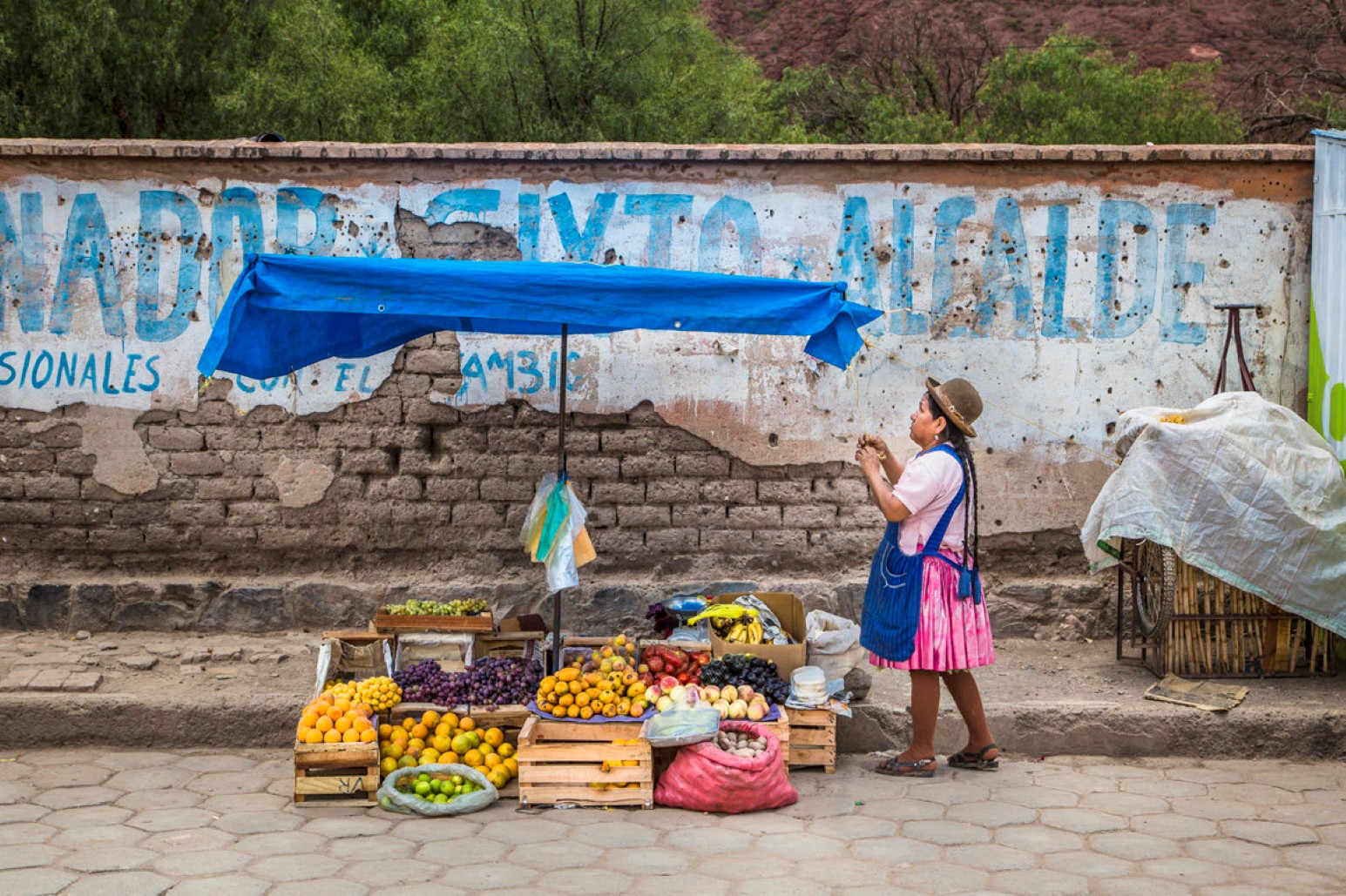
- Eat like a local: Choosing local markets and eateries over western restaurants and supermarkets is kind to your wallet. Favourites among expats include papas rellenas, salteñas, tucumanas, buñuelos, quinoa dishes, Bolivian chocolate, and much more.
- Take the bus: If you’re travelling, consider taking a bus instead of flying. Overnight buses aren’t only cheaper but they can also save you from spending money on an extra night of accommodation.
- Avoid peak season: Bolivia doesn’t receive as many tourists as Brazil or Argentina, but you’ll still save money by travelling outside the peak season. Travelling from November–March will save you plenty of money because there are noticeably fewer tourists.
| Restaurants | BOB | USD | GBP |
|---|---|---|---|
| Inexpensive restaurant meal | |||
| Domestic beer (0.5 litre) | |||
| Regular cappuccino | |||
| Water (0.33 litre) | |||
| Markets | BOB | USD | GBP |
| Regular milk (1 litre) | |||
| Loaf of white bread | |||
| Regular eggs (1 dozen) | |||
| Apples (1 kg) | |||
| Transportation | BOB | USD | GBP |
| One-way ticket (local transport) | |||
| Monthly pass (regular price) | |||
| Taxi start (normal tariff) | |||
| Gasoline (1 litre) | |||
| Utilities | BOB | USD | GBP |
| Electricity, heating, cooling, water, and garbage (for a regular apartment) | |||
| Regular prepaid monthly mobile tariff with 10GB+ data | |||
| Internet (60 Mbps, unlimited data, cable/ADSL) | |||
| Clothing and shoes | BOB | USD | GBP |
| Pair of jeans (Levis 501 or something similar) | |||
| Summer dress in a chain store | |||
| Nike running shoes (mid-range) | |||
| Men's leather business shoes |
English Teaching Jobs in Bolivia
With little emphasis on English education in public schools, the bulk of English teaching jobs in Bolivia come through private schools.
Private language schools have a constant demand and hire all year round, but you’ll need to time your application if you’re applying to an international school. The school year runs through February–November, so consider applying near the end of the previous year.
Many locals can’t afford to pay for classes, which creates plenty of volunteering opportunities for teachers. This is great for teachers who can’t commit to a year of teaching, or for teachers looking to gain informal classroom experience before jumping into a paid job.
While you can find jobs on boards like The TEFL Org Jobs Centre, many teachers take the direct approach of flying into Bolivia and applying for jobs directly.
Private language schools
Private language schools cater to students who want to learn English for academic or career purposes. Usually, these students are learning academic English or exam preparation to study abroad, or Business English to work at international companies. As a teacher at a language school, you’ll likely teach in smaller classrooms in the evening and on weekends to work around busy schedules.
What to expect at language schools in Bolivia:
- Small classrooms
- Focus on ESP (English for Specific Purposes) subjects like academic English or Business English
- Wide age range, from young students and teenagers to adults
International schools
International schools offer some of the best standards of education, and most are concentrated in large cities like Santa Cruz or La Paz. Here, students from wealthy families (often from abroad) pay high tuition fees to learn English as a main language from an international curriculum. Teachers receive excellent salaries and benefits, but the workload and responsibilities are high.
What to expect at an international school in Bolivia:
- Teaching international students English as a main language
- Following an international curriculum (IB, US, or UK)
- Excellent salary and benefits
- High expectations and workload
Volunteer programmes
Many teaching positions come in the form of volunteer roles, and these programmes usually involve informal teaching environments in more rural areas. These roles are much more flexible and allow teachers with minimal experience or qualifications to gain experience as long as they’re fluent in English, but it’s often unpaid and sometimes requires a fee.
What to expect as a volunteer teacher:
- Informal learning environments
- Short-term roles (2+ weeks commitment)
- Unpaid, but teachers sometimes receive accommodation and meals
- May require a programme fee
Teaching English in Major Cities
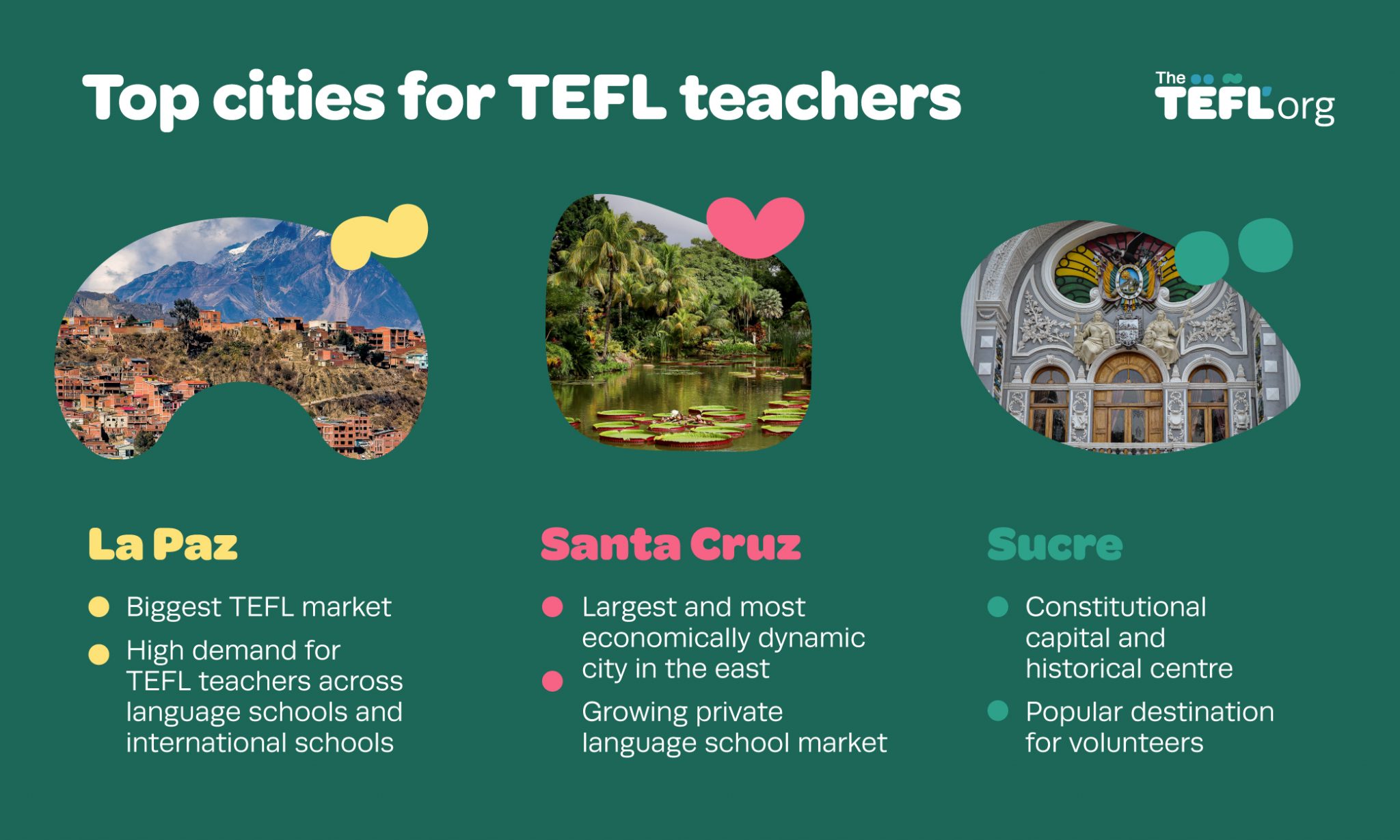
Here are some of the top TEFL locations for English teachers to consider in Bolivia.
Teach English in La Paz
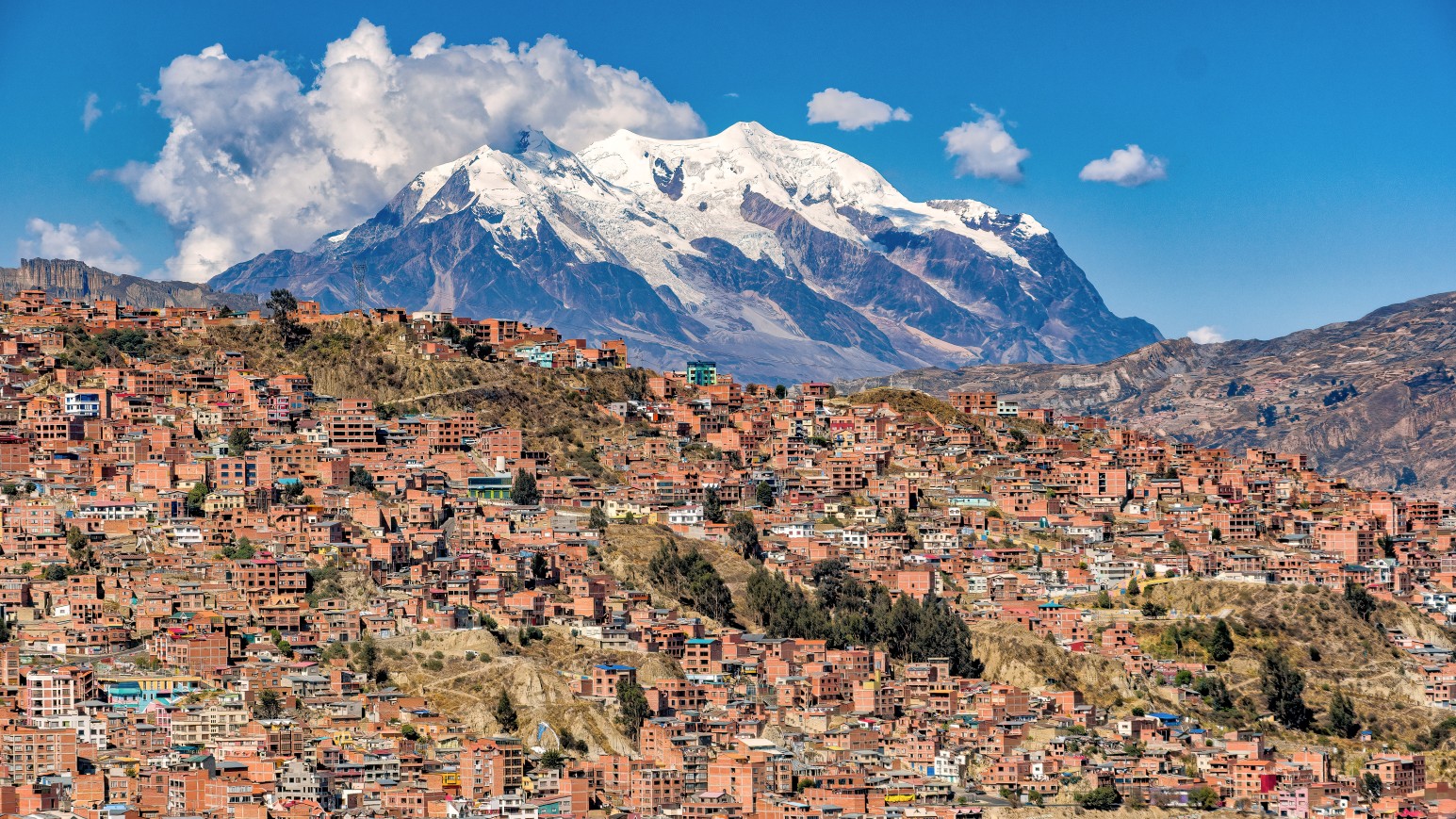
La Paz, or the city that touches the clouds, lies 10,600+ feet above sea level — so don’t be confused if you feel unusually tired in your first few days. From the Andean mountains to colonial architecture, the city fuses charming buildings with rugged terrain to form a cool environment.
As the capital city, it’s one of the obvious choices if you’re looking for teaching opportunities, with language centres, international schools, and a few universities that offer English-taught programmes.When you’re not teaching, you’re spoiled for choice. Once you’ve acclimatised, hike up to Mirador Killi Killi (but pace yourself) for a panoramic view of the city, or take the smooth cable car instead (it’s the longest in the world!). If you prefer something more low-key, visit any of its art museums and cafes, or get a taste of heritage by gorging on indigenous Bolivian food.
Teach English in Santa Cruz
Although La Paz is the capital, Santa Cruz is Bolivia’s economic and business hub, and this brings not just hustle and energy but also plenty of teaching opportunities, especially if you specialise in Business English.Compared to La Paz, Santa Cruz feels more modern and boasts a warmer climate, which creates a more glamorous and tropical vibe than the cooler capital.
When you’re not teaching English, head to any of its busy clubs, bars, malls or Biocentro Güembé if you’re after luxury. If you’re after culture, head to UNESCO-listed Samaipata Fort or the Plaza 24 de Septiembre, the city’s heart which honours the local uprising for independence against Spanish colonial rule.
Ready to Teach English Abroad? Don’t Forget Your TEFL Certificate
Think you’re ready to teach English abroad? Don’t forget your TEFL course! Trying to teach English abroad without TEFL training is like trying to run before you can walk. Teaching English as a foreign language isn’t easy, no matter how articulate you are, and a TEFL certification doesn’t just help you find English teaching jobs but you’ll feel much more confident in the classroom.
Whether you want to teach English in Bolivia, other Latin American countries, or beyond, you’re certified for life. Get started today with our 120-hour TEFL course.
Frequently Asked Questions
Q. Can you speak English in Bolivia?
Yes, you can speak English in Bolivia in larger cities, but it might be difficult outside big cities like La Paz or Santa Cruz. Most of the population speaks Spanish, and English speakers aren’t that common compared to other South American countries.
Q. What are the available jobs for foreigners in Bolivia?
English teachers can work in private language schools or international schools, or as private tutors or volunteers in Bolivia. Private language schools and international school jobs pay the most.
Q. What is education like in Bolivia?
Education in Bolivia is free and compulsory, but there isn’t an emphasis on English in public education. This means that students who want to learn English study private language courses or hire a private tutor if they can afford to.